Thursday, 17 September 2026
The role of the office is continuing to change in Prague, with employees placing greater emphasis on transport, food, green areas and services surrounding their workplace, according to new research conducted among people working at Brumlovka in Prague 4. The survey was carried out by STEM/MARK for Passerinvest Group between 20 May and 26 June 2026. It collected 2,822 completed questionnaires from 12,350 employees approached, equivalent to a response rate of 23%. The research forms part of a series that has tracked employee attitudes at Brumlovka since 2001.
Some 96% of respondents said they were satisfied with Brumlovka as a workplace location, including 47% who selected the highest satisfaction category. The latter proportion has risen considerably over the longer term, from 23% in 2016 and 38% in 2022. In the latest survey, 77% also considered the district to have improved over time, compared with 2% who believed it had deteriorated.
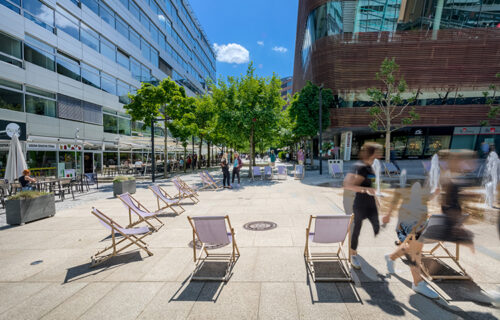
The findings suggest that employees increasingly assess an office location in terms of the wider environment available during the working day. Among respondents for whom environmental considerations are important, 62% prioritised factors including greenery, outdoor areas, opportunities for relaxation and biodiversity. Parks, landscaped public areas and roof terraces consequently form an important part of Brumlovka’s workplace environment. The district has approximately 11,000 sqm of rooftop terraces.
Food provision is another area where behaviour has changed. Satisfaction with catering options increased from 79% in 2022 to 87% in 2026. Almost 70% of employees now use local canteens at least once a week, compared with 63% four years earlier, although around 40% also bring their own food to work. Use of restaurants and bistros at least once a week has declined from 53% in 2022 to 39% this year. At the same time, the proportion of employees travelling outside Brumlovka for food has fallen from 21% to 13%, indicating that more everyday requirements are being accommodated within the district.
Transport remains central to how employees experience the location. Approximately half of respondents reach Brumlovka within 30 minutes, with public transport remaining the most frequently used form of commuting. Cars are used by 38% of respondents. The district’s BB1 and BB2 shuttle services have increased their role since the previous survey, with almost one-third of respondents now identifying the buses among their main transport options compared with approximately one-fifth in 2022. Around 70% use the service at least occasionally, while 96% of users reported being satisfied with it.
Hybrid working nevertheless remains an established part of working patterns. Some 61% of respondents work from home at least once a week and 15% do so at least three days per week. Looking ahead, 66% expect to continue working remotely at least once a week.
The results are consistent with a wider shift in European occupier requirements. CBRE’s 2026 European Office Occupier Sentiment Survey found that 88% of companies surveyed would reject an office building if it lacked an amenity they regarded as essential, compared with 82% a year earlier. This provides broader evidence that building quality is increasingly being considered alongside accessibility, services and the overall workplace environment when companies make property decisions.
The issue is particularly relevant in Prague, where modern office vacancy remained at 5.8% at the end of Q2 2026. The city had approximately 3.95 million sqm of modern office stock and 309,300 sqm under construction, with almost 58% of that pipeline already committed to future occupiers. Prague 4 accounted for 35% of gross quarterly leasing activity.
Renewals are also dominating the current market. Renegotiations represented 69% of Prague’s gross office take-up during Q2, while new leases and expansions accounted for 29%. The high proportion of renewals increases the importance of retaining existing tenants and places greater emphasis on the quality of both individual properties and their surrounding districts.
Brumlovka is also gradually becoming more mixed-use. Around one-fifth of employees surveyed expressed interest in renting a home in the district, rising to 44% among respondents under 30. Passerinvest is adding residential accommodation through projects including Hila and Orion, bringing housing alongside the established concentration of offices, retail, services and leisure facilities.
The Brumlovka research covers employees at one Prague business district and was commissioned by its developer, meaning the findings should not be treated as representative of the entire Prague or Czech workforce. Its long-running format and relatively large number of respondents nevertheless provide useful evidence of how expectations within one major employment location have developed.
Combined with broader occupier research and Prague leasing data, the results point towards a market in which the competitive position of an office increasingly depends on more than the workspace itself. As hybrid working becomes established, accessibility, food, services, public space and greenery are becoming more significant elements in how companies and employees assess office locations.