Wednesday, 4 November 2026
Artificial intelligence has yet to become a regular part of working life for most employees in Germany, despite increasing corporate interest in the technology. Research published by the German Institute for Economic Research (DIW Berlin) indicates that the use of AI varies considerably between occupations, age groups and educational backgrounds, raising questions about how quickly businesses can translate technological investment into productivity improvements.
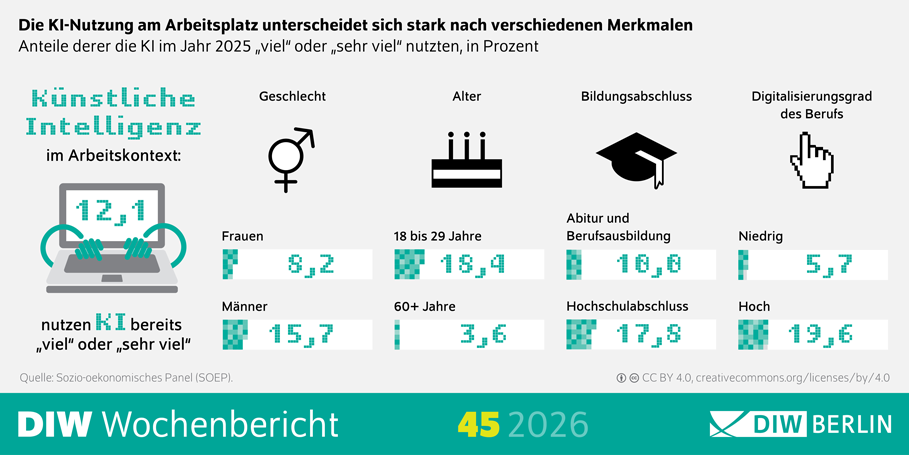
The study, based on information collected through Germany’s Socio-Economic Panel (SOEP) in 2025, found that almost half of employees had not encountered AI applications in their professional activities. Approximately one fifth reported only limited experience, while just 12% said they had used AI extensively. The findings suggest that regular workplace adoption remained concentrated among a relatively small proportion of employees at the time of the survey.
Younger workers, employees with higher educational qualifications and those in occupations involving substantial digital activity were more likely to be familiar with AI applications. Male respondents also reported greater exposure and use than female respondents. The researchers identified differences in employees’ intentions to adopt AI in the future, with women and people holding lower educational qualifications generally expressing less interest in using the technology.
The findings also revealed differences between types of AI. Applications capable of producing written material, images and other content were the most familiar and widely used among respondents. Industrial and service robots received relatively favourable assessments but were less frequently used by the employees surveyed. Predictive systems, including applications designed to support recruitment decisions, were among the least familiar technologies.
Looking ahead, approximately half of the employees surveyed expected to make little or no use of AI in their future work. DIW researchers warned that unequal access to technological knowledge and training could reinforce existing differences in employment opportunities. They highlighted the importance of providing practical education and ensuring that workers understand both the capabilities and limitations of AI systems.
For commercial property owners and office occupiers, the findings provide a useful perspective on the pace of workplace transformation. Businesses are increasingly evaluating AI-supported processes, digital infrastructure and new ways of organising work, but technological availability does not necessarily mean that employees are using these systems extensively. Decisions about office layouts, workplace services and investment in building technology therefore need to reflect actual organisational requirements rather than assumptions about rapid AI adoption.
The research also has implications for companies operating industrial, logistics and technology facilities. AI applications can support manufacturing processes, equipment monitoring, inventory management and administrative functions, but their implementation depends on employee skills, operational requirements and the willingness of businesses to invest in training. The DIW study does not establish adoption rates specifically within Germany’s property, construction or logistics industries, so its findings should not be interpreted as direct evidence of technological progress in those sectors.
The results underline the difference between the expanding availability of AI technology and its practical integration into everyday employment. For employers, property investors and developers, the longer-term effects on workplace productivity and space requirements will depend on how companies implement the technology and prepare their employees to use it. As the study reflects workplace experiences in 2025, further research will be necessary to determine whether adoption has accelerated during 2026.