Thursday, 17 September 2026
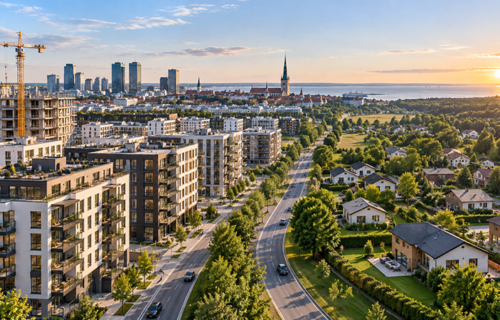
Tallinn’s residential market is developing an increasingly important divide. The capital has thousands of newly built and planned apartments available to buyers, yet purchasing activity remains relatively restrained. Immediately beyond the city boundary, meanwhile, sales of apartments and terraced houses increased during the second quarter of 2026. Around 3,000 new apartments were being marketed in Tallinn during Q2, representing more supply than a year earlier. Average asking prices across new developments remained approximately €5,200 to €5,300 per sqm, maintaining a substantial financial hurdle for households considering newly constructed homes.
Sales figures vary depending on how the market is measured. One dataset recorded 379 new-home contracts during the quarter, while another assessment based on developer information put Tallinn apartment sales at approximately 325 units. The methodologies are different, so the figures should not be treated as directly comparable. Both nevertheless indicate that purchasing activity remains modest relative to the amount of new housing currently available.
The picture outside Tallinn provides an interesting contrast. Sales of apartments and terraced houses in the surrounding municipalities reached 239 units during Q2, according to market data cited by residential developer Liven. That was 12.7% higher than during the corresponding period of 2025. One quarter does not establish that Tallinn residents are moving to the suburbs because they can no longer afford the capital. But the combination of relatively high new-build prices inside Tallinn and increasing residential transactions outside it provides a strong reason to examine whether household demand is becoming more geographically flexible.
Price is only part of that calculation. Using Tallinn’s market-wide new-development asking-price average purely as an illustration, an 80 sqm property at €5,250 per sqm would equate to approximately €420,000 before parking, storage and other potential costs. Actual apartment prices vary substantially according to district, project, specification and stage of construction, but the calculation demonstrates the scale of the budgets increasingly involved in purchasing larger new homes in the capital. Once household budgets reach these levels, buyers can consider a much wider range of alternatives. A family looking for three bedrooms, parking and additional living space may compare a Tallinn apartment not only with another apartment across the city, but with a terraced house or lower-density development beyond the municipal boundary.
This makes Rae, Viimsi, Harku and Saue increasingly relevant to the competitive landscape. Rae benefits from its proximity to Tallinn and major employment and industrial areas east and southeast of the capital. Continued residential development has created alternatives for households prepared to exchange an urban location for additional space and suburban surroundings. Viimsi offers a different proposition, combining established residential communities with coastal locations and access to Tallinn. Harku and Saue provide further alternatives west and southwest of the capital, expanding the range of housing choices available within commuting distance.
These municipalities should not simply be considered cheaper versions of Tallinn. The housing product itself can be different. Terraced houses, semi-detached properties, gardens and lower-density developments provide alternatives that are much harder to deliver at comparable prices in established parts of the capital. The financial comparison therefore extends beyond price per square metre. Households must consider mortgage payments, commuting expenses, car ownership, energy costs and the value they place on additional living and outdoor space.
Infrastructure can be equally decisive. Families considering moving beyond Tallinn need access to schools, kindergartens, shops, healthcare and reliable transport. A comparatively affordable house can become less attractive if daily journeys require substantial additional time and expense. Municipalities experiencing rapid residential construction therefore have to ensure that public infrastructure develops alongside private housing. This creates an important property-development question. The strongest suburban locations may increasingly be those capable of combining more attainable housing with infrastructure good enough to prevent households from feeling disconnected from Tallinn.
For residential developers, that means competition is becoming less dependent on municipal boundaries. A Tallinn apartment project might previously have regarded neighbouring city developments as its most obvious competitors. Increasingly, the same buyer could also consider a terraced house in Rae, an apartment in Viimsi or a family property in Harku or Saue. Tallinn’s substantial new-build supply available to buyers makes this competition particularly important. With around 3,000 apartments being marketed, purchasers have considerable choice and developers have to compete not only on location and design but also on total acquisition cost.
The capital nevertheless retains powerful advantages. Tallinn concentrates employment, universities, cultural facilities, entertainment and much of Estonia’s public transport infrastructure. For households prioritising shorter journeys and urban amenities, those benefits can outweigh the additional space potentially available elsewhere. Different types of buyers could consequently begin making increasingly different choices. One possibility is that smaller households and people prioritising central locations remain concentrated within Tallinn, while families requiring larger homes become more willing to examine surrounding municipalities. The available Q2 figures are not sufficient to demonstrate that this demographic division is already occurring, but it is an important trend to monitor.
The 12.7% annual increase in sales of apartments and terraced houses outside Tallinn provides an early indication that surrounding locations are attracting meaningful demand. Several more quarters will be necessary before it becomes clear whether this represents a lasting change rather than a short-term increase in transactions. For developers and investors, the distinction matters. If Tallinn sales strengthen substantially while suburban activity also grows, the entire metropolitan housing market could be expanding. If activity increasingly shifts towards surrounding municipalities while the capital continues carrying large amounts of available new supply, affordability and housing type may be changing where development demand is strongest.
Either way, Tallinn’s residential market can increasingly be difficult to understand by looking only within the city boundary. The next competition for homebuyers may not be between one Tallinn district and another. It may increasingly be between Tallinn itself and the communities growing around it.
Source: CIJ.World Research & Analysis Team