Sunday, 25 October 2026
Slovakia’s shopping centres are succeeding in bringing more people through their doors, but the latest figures suggest that increasing visitor numbers alone is no longer enough to guarantee stronger retail performance.
During the second quarter of 2026, footfall across a monitored group of Slovak shopping centres increased by approximately 3% compared with the same period a year earlier. Sales generated by tenants across the same sample, however, remained broadly unchanged. That creates an interesting challenge for shopping-centre owners. For years, growing footfall has been treated as an important measure of a property’s health. More visitors create more opportunities for retailers to sell, restaurants to fill tables and landlords to demonstrate the strength of their locations.
The Q2 results show that the relationship between traffic and revenue is becoming less straightforward. The figures do not establish that individual consumers are spending less. More frequent visits by the same customers could increase footfall without changing their total monthly expenditure. The mix of visitors could also be changing, while spending patterns may be moving between different types of tenants. What the data does establish is that a 3% increase in visits did not produce an equivalent increase in overall tenant sales.
That makes understanding what consumers actually do inside a shopping centre increasingly important. A customer visiting for lunch behaves differently from someone purchasing clothing. A cinema customer may spend several hours in a centre but make few additional purchases. Someone using a gym or beauty service could visit regularly without spending money in conventional stores on every trip. The value of a visitor therefore cannot be measured simply by counting entries through the doors.
For landlords, the next stage is understanding which activities generate the strongest revenues, which encourage customers to return and which help other tenants perform better. This helps explain why established shopping centres, particularly in Bratislava, continue investing in their buildings and broadening their offer beyond conventional shops.
Restaurants, leisure, fitness, entertainment and personal services can give customers reasons to visit even when they have no immediate intention of buying clothing, electronics or other discretionary goods. They also provide experiences that are considerably more difficult to replace through online shopping. The result is gradually changing the role of the shopping centre.
Rather than functioning principally as a collection of shops, stronger properties are becoming places where retail is combined with food, entertainment and services. Success increasingly depends on creating several reasons to visit the same building. The commercial challenge is converting that activity into sustainable income.
More visitors are useful only if their presence eventually supports tenant businesses and rental values. A shopping centre can be busy while individual retailers remain under pressure, particularly if consumer expenditure shifts towards restaurants, leisure or services rather than traditional retail categories. This makes the composition of the tenant base increasingly important.
Fashion, health and beauty, electronics, grocery, restaurants and entertainment can experience very different trading conditions even within the same property. Looking only at total shopping-centre turnover can therefore hide significant differences between individual categories.
Inflation adds another dimension. If nominal sales remain broadly unchanged while consumer prices continue increasing, there is a possibility that the actual volume of goods purchased is under greater pressure than the headline turnover figure suggests. More detailed category-level information would be required to determine whether that is happening.
While enclosed shopping centres adapt by becoming broader destinations, another retail format is expanding according to a very different strategy. Retail parks continue to grow across Slovakia because they offer something increasingly attractive to both consumers and retailers: simplicity.
Customers can generally reach them easily by car, park close to the stores they want and complete purchases without navigating a large enclosed complex. Their relatively straightforward physical format can also help keep property operating costs below those associated with more complicated shopping-centre buildings.
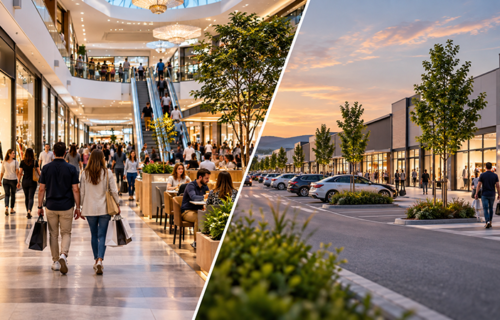
This creates two increasingly distinct approaches to retail property. The modern shopping centre is moving towards a combination of retail, restaurants, entertainment and services designed to encourage repeat visits and longer stays. The retail park is primarily built around accessibility, convenience and efficient shopping.
Both formats can succeed, but their investment cases are different. A dominant shopping centre in Bratislava can draw from a large urban catchment and support international brands alongside restaurants, entertainment and services. Such properties can justify continued capital expenditure because maintaining their destination status protects their competitive position.
Older or weaker centres face a more difficult calculation. Adding restaurants, improving public areas or introducing entertainment requires investment, and there is no guarantee that every location has sufficient spending power to generate an adequate return.
Retail parks generally involve simpler properties, but expansion brings its own risks. New developments still need sufficient local purchasing power and a strong enough tenant base to remain successful as additional projects enter the market.
Around 12,000 sqm of new retail accommodation was completed across three Slovak projects during Q2 2026. While this is not a dramatic amount nationally, it shows that developers are continuing to add space even as consumer behaviour evolves. That makes the quality and positioning of individual assets more important than overall market growth.
For investors, the central question is increasingly not whether Slovak retail property is recovering, but which properties are best positioned to capture consumer expenditure over the next several years.
Some shopping centres may become stronger by expanding their role as urban destinations. Others could find that the investment required to remain competitive becomes increasingly difficult to justify. Retail parks may continue benefiting from demand for accessible and relatively cost-efficient shopping, although their performance will ultimately depend on location, tenant demand and the amount of competing space developed around them.
The second-quarter numbers provide an early indication of why these distinctions matter. Slovakia’s shopping centres attracted approximately 3% more visitors than a year earlier, yet tenant sales across the monitored sample did not grow.
That is not evidence that consumers have stopped spending, nor does it establish that every visitor is spending less. It does show that attracting more people and generating more revenue are no longer necessarily the same achievement.
For Slovakia’s retail landlords, the next competitive advantage may therefore come not from increasing the number of people entering their properties, but from understanding what those visitors are there to do and finding better ways to turn their time into sustainable economic value.
Source: CIJ.World Research & Analysis Team