Friday, 23 October 2026
Croatia’s hotel market is approaching a different kind of growth challenge. After years in which expanding visitor numbers helped underpin the country’s tourism economy, the next investment cycle may depend increasingly on generating more income from existing demand rather than relying on another record season. The first signs of that challenge appeared clearly in June 2026, when Croatia recorded approximately three million arrivals in commercial accommodation and 13.5 million overnight stays. Arrivals decreased 6.6 percent from a year earlier and nights fell 6.1 percent, while overnight stays by international visitors declined 7.5 percent.
Those figures do not indicate that Croatian tourism has entered a broad downturn. Across the first six months of 2026, total arrivals and overnight stays were still approximately 0.5 percent higher than during the same period of 2025. June should therefore be regarded as a weak month within an otherwise relatively stable first half rather than evidence of a sustained decline. What happened inside the hotel sector is more significant for property investors. Hotel overnight stays fell by only 1.7 percent during June, considerably less than the contraction across commercial accommodation as a whole, while hotel room occupancy remained virtually unchanged at 72.1 percent compared with 72.0 percent a year earlier.
That resilience raises a different question about the future of Croatian hospitality. If hotels can maintain utilisation even when overall visitor numbers weaken, future investment performance may depend less on increasing the number of guests and more on increasing the economic contribution of each stay. Room pricing is one part of the equation, but restaurants, bars, wellness facilities, conferences, events, excursions and other services can all influence how much income a property generates from each visitor. A hotel that persuades guests to spend more within the property can potentially increase revenue without requiring significantly more occupied rooms.
Lengthening the operating season could be equally important. Croatia remains highly dependent on summer tourism, and hotels that generate most of their income during a relatively short peak period carry considerable seasonal exposure. Properties capable of attracting guests during spring and autumn can spread operating costs across more months while reducing their dependence on exceptional July and August performance.
This could influence how investors approach the country’s existing hotel stock. In established Adriatic destinations, the most attractive opportunity may sometimes be an existing property in an exceptional location rather than a new development. Prime waterfront sites, historic urban locations and established resort grounds are inherently limited. Acquiring and improving an existing hotel can therefore provide an alternative route to growth. Investment can modernise rooms, restaurants, wellness areas, pools, conference facilities and outdoor spaces while improving energy efficiency and operational performance. The objective would not necessarily be to create additional beds, but to make every existing room more productive.
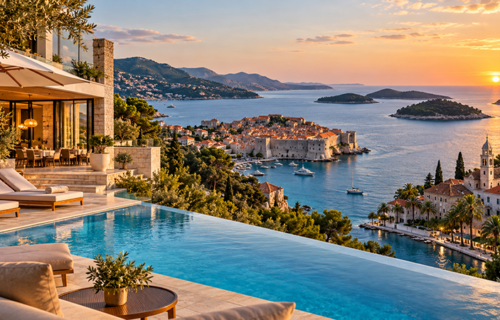
Dubrovnik provides perhaps the clearest example of this approach. The city’s international profile allows well-positioned hotels to compete for affluent visitors, while its historic environment and physical constraints limit how far tourism volumes can expand without creating additional pressure on the destination. For investors in Dubrovnik, increasing the value generated by each visitor may therefore make more sense than pursuing continuous increases in guest numbers. Higher-quality accommodation, stronger food and beverage concepts, wellness and demand outside the peak season could all form part of that strategy.
Split faces a different set of conditions. It combines conventional city demand with leisure tourism and its role as an important gateway to the Croatian islands. Hotels also compete with a substantial private accommodation sector. That competition can encourage professional hotel operators to differentiate themselves through facilities and service rather than price alone. Business events, organised groups, restaurants and wellness facilities can also help hotels develop sources of demand that are less dependent on the peak summer holiday period.
Istria already demonstrates how a destination can broaden its tourism proposition beyond beaches. Food, wine, cycling, wellness and proximity to Central European markets provide reasons for visitors to travel outside the hottest months of the year. For property owners, that creates opportunities to reposition hotels around experiences that support longer operating seasons. A resort capable of attracting guests in April, May, September and October has fundamentally different economics from one heavily dependent on a few summer weeks.
Kvarner offers another potential repositioning market. Its established resort towns, accessibility from Central Europe and history of health and wellness tourism provide a foundation for investment in existing accommodation. Some older properties may therefore become more interesting as redevelopment opportunities than as hotels operating in their current form. Modernisation could potentially move assets into higher-value segments without materially increasing accommodation capacity in the destination.
The islands present a different investment equation. Limited supply, distinctive landscapes and waterfront locations can support premium hospitality. Resorts capable of combining accommodation with restaurants, wellness, private experiences and other services may be able to generate substantially more spending per visitor. But islands also introduce additional costs. Labour can be harder to secure, supplies may be more expensive to transport and infrastructure can be more constrained. Seasonal operations can further increase the complexity of running large properties. For this reason, higher room prices should not automatically be interpreted as higher profitability.
That distinction applies throughout Croatia. A hotel can increase revenue while simultaneously facing higher wages, energy bills, food costs, maintenance expenses and financing charges. Investors therefore need to understand how much additional income translates into operating profit rather than concentrating exclusively on occupancy or advertised room rates. Management quality consequently becomes increasingly important. Two hotels in similar locations can produce very different results depending on pricing strategy, staffing, distribution costs, restaurant performance and the ability to encourage additional guest spending.
International operators and brands could play a greater role in some parts of this market. Their reservation systems, loyalty programmes and global distribution can help properties reach higher-spending international customers. But branding is not automatically the correct strategy for every hotel. Strong independent properties can also succeed by offering a distinctive local experience. The investment decision ultimately depends on which operating model creates the greatest sustainable value for the individual asset.
New hotels will still be required in locations where suitable modern accommodation is insufficient or where exceptional development sites become available. But Croatia does not necessarily need another hospitality cycle defined primarily by adding rooms. A substantial part of future investment could instead be directed towards transforming what already exists.
That would have implications beyond individual properties. Improving the quality and productivity of existing hotels could increase tourism income without requiring equivalent growth in visitor numbers, particularly in destinations already experiencing pressure during the summer peak. It could also encourage greater attention to year-round tourism. Wellness, gastronomy, cultural travel, sporting events, conferences and other activities can help destinations attract guests outside traditional holiday periods.
The June figures make this discussion particularly timely. Croatia experienced a noticeable decline in overall tourism activity compared with June 2025, yet hotel occupancy remained almost unchanged and hotel overnight stays declined considerably less than the broader market. Meanwhile, the first half of 2026 remained slightly ahead of the previous year overall. That combination does not prove that Croatia has successfully shifted towards higher-value tourism, nor does it establish that hotel profitability is increasing. What it does show is that expanding visitor numbers cannot be the only measure used to judge the health of the country’s hospitality property market.
For investors considering Dubrovnik, Split, Istria, Kvarner or the islands, future performance will increasingly depend on the quality of the asset, its operating season, its ability to command appropriate pricing and how much additional spending it can capture from guests. Croatia has already built one of Europe’s most successful tourism destinations around the strength of its coastline, cities and islands. Its next hotel investment opportunity may come from extracting greater economic value from those advantages rather than continually increasing the number of people using them.
The next phase of Croatian hospitality could therefore be defined not by how many additional beds are built, but by how much more effectively the country’s existing hotel rooms are used.
Source: CIJ.World Research & Analysis Team