Monday, 14 September 2026
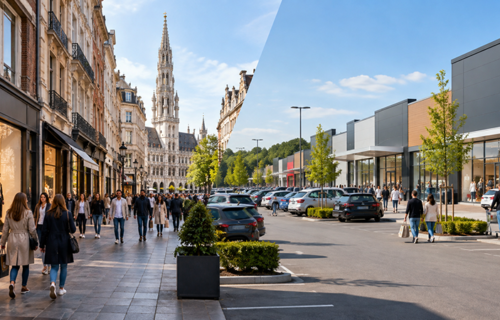
Belgium’s retail property recovery is beginning to reveal an important change in where retailers are expanding and where investors are putting their money. The country’s most famous shopping streets remain valuable, but activity during the first half of 2026 shows that other formats are capturing an increasingly significant share of attention.
Around 197,000 sqm of Belgian retail space was taken up through approximately 430 transactions during the first six months of the year. Behind that national total, however, performance differed substantially by location. Shopping-centre activity increased by approximately 26% compared with the corresponding period a year earlier, while activity in urban shopping locations declined by around 15%.
The investment market produced an even more striking contrast. Estimates differ slightly depending on which transactions are included, with major property advisers placing first-half retail investment at between approximately €368 million and €392 million. Within that activity, retail warehouses represented around 68% of investment according to JLL.
That proportion raises an important question. Why is so much investment moving towards properties where rents are generally far below those achievable on Belgium’s most prestigious shopping streets? Part of the answer may lie in the difference between expensive property and dependable property income.
For investors, the rent written into a lease is only one part of an acquisition decision. Purchase price, vacancy, operating expenditure, future investment requirements and the financial strength of tenants can be equally important. A property generating a lower rent can still produce an attractive investment if it is acquired at the right price and remains consistently occupied.
Retail parks can offer several characteristics relevant to that calculation. They typically provide direct road access, parking and relatively large stores. These features suit retailers whose customers want to make planned purchases, visit several shops during the same journey or transport larger products home.
Occupancy economics can also differ considerably from those of prime city centres. Retailers operating from prestigious streets in Brussels or Antwerp gain visibility and access to substantial pedestrian traffic, but they can also face much higher property costs. An out-of-town store can provide access to a broad customer catchment without requiring the same level of rent.
That distinction has become more relevant as retailers scrutinise the profitability of individual stores. Physical shops remain important, but companies increasingly have to determine what purpose each location serves within a network that also includes online sales. A flagship store can justify expensive central premises because it contributes to brand recognition as well as direct sales. A regional store has a different task. It may need to generate high sales volumes while keeping occupancy and operating costs under tight control. Retail parks fit particularly well into the second model.
Their appeal does not mean that Brussels and Antwerp are losing their positions at the top of Belgian retail. The best urban locations retain characteristics that cannot easily be reproduced outside city centres. Tourism, offices, restaurants, public transport, cultural attractions and dense residential populations generate customer flows throughout the day. For international brands, occupying a prominent central location can also have value extending beyond the revenue generated by the individual store.
The greater pressure may therefore fall on urban locations below the very top tier. These streets do not necessarily provide the international profile of the strongest addresses, while also lacking the easy access and parking associated with out-of-town retail. If retailers concentrate their networks into fewer but stronger stores, this middle section of the market could become increasingly exposed.
Shopping centres present a different picture. Leasing activity strengthened during the first half of 2026, indicating that retailers continue to see opportunities in established centres. Their ability to bring numerous brands, restaurants, services and leisure activities together in one location gives them advantages that neither individual high-street stores nor conventional retail parks completely replicate.
Performance nevertheless varies considerably between centres. A dominant regional destination with substantial visitor numbers has a different investment profile from an ageing secondary scheme requiring extensive modernisation. Investors therefore need to assess individual properties rather than treat shopping centres as a single category.
Retail warehouses have their own variations. Location, tenant mix, access and planning restrictions can make substantial differences to value. Some parks serve wealthy and densely populated catchments, while others depend on customers travelling much greater distances.
The amount of land associated with many retail parks can also be important. Depending on planning conditions, larger sites may provide opportunities to reorganise units, introduce additional uses or redevelop parts of a property over the longer term. This potential can give investors another way of creating value beyond collecting existing rent.
Supermarkets add another component to Belgium’s retail investment landscape. Grocery stores benefit from frequent purchasing patterns and can attract customers repeatedly throughout the week. When combined with other shops and services, they can also support neighbourhood retail clusters.
Smaller local retail depends even more closely on surrounding communities. Pharmacies, bakeries, restaurants, convenience stores and personal services can succeed without drawing customers from an entire region because their business is based primarily on people living and working nearby.
Mixed-use developments extend this principle further. Shops positioned beneath apartments or offices can serve populations already present on the site. Their success depends less on becoming standalone shopping destinations and more on becoming useful parts of everyday urban life.
Belgian retail is consequently becoming a collection of different property strategies rather than a straightforward ranking based on rent. Prime high streets provide visibility, shopping centres offer concentration and destination value, retail parks emphasise convenience and accessibility, supermarkets and neighbourhood stores benefit from recurring local demand, while mixed-use developments connect retail directly with residential and workplace populations.
The investment activity recorded during early 2026 suggests that capital currently sees considerable value in the retail-park model. That conclusion needs perspective, however. Belgium’s investment market is not large enough for six months of transactions to establish a permanent change in ownership preferences. A small number of major acquisitions can significantly influence sector statistics, and the properties available for sale are just as important as investors’ theoretical preferences.
If a large shopping centre or portfolio of prime urban properties changes hands, the investment split could look very different. Nevertheless, retail investment cannot be understood simply by comparing rents. The fact that Belgium’s most prestigious shopping streets can command substantially higher rents does not automatically make them the preferred destination for every investor.
Capital is ultimately buying future income, not prestige alone. That makes tenant affordability, accessibility, occupancy, property costs and the ability of a site to adapt increasingly important considerations. Retail parks can perform strongly against several of these measures even though their rents are considerably below those found in central Brussels or Antwerp.
The first half of 2026 therefore points towards a more complicated Belgian retail hierarchy. High streets remain important, shopping centres are showing renewed leasing momentum, and out-of-town properties have captured an exceptionally large share of investment.
Whether that balance persists will depend on future transactions and retailer behaviour. But the direction of early-2026 activity suggests that the definition of a desirable Belgian retail property is becoming broader. The country’s retail investment market is no longer determined simply by which address charges the highest rent. Increasingly, the stronger asset may be the one where customers can reach the stores easily, retailers can trade profitably and owners can depend on the income for longer.
Source: CIJ.World Research & Analysis Team