Monday, 14 September 2026
The Dutch industrial and logistics market is sending two apparently conflicting signals in 2026. Companies are taking more space, but the amount of property available to occupiers is also increasing. The combination suggests that the market’s next challenge may be less about the overall quantity of warehouse space and more about whether the available buildings match what businesses actually need. Around 1.8 million square metres of industrial and logistics property was taken up during the second quarter of 2026, approximately 12% more than during the same period a year earlier. At the same time, available supply increased from roughly 6.8 million square metres to around 7.7 million square metres.
The 7.7 million square metres should not be interpreted simply as empty warehouses. Available supply can include completed space as well as property being marketed before completion. Nevertheless, the increase is significant because it is occurring while occupier activity remains relatively strong. This raises an important question for investors. If demand is recovering, why is more property becoming available? Part of the answer may lie in the widening differences between individual buildings and locations. A logistics company does not choose a distribution centre simply because the required number of square metres exists. The building must work within a much larger operational network.
Location remains fundamental. The Netherlands occupies a strategic position within European distribution because of its ports, motorway infrastructure, connections with Germany and Belgium and proximity to large consumer markets. Within the country, however, occupier demand continues to concentrate in established logistics corridors. Tilburg and Venlo illustrate the point. Both markets have developed into major distribution locations because they provide access to international transport routes and European supply chains. Rotterdam and the Schiphol region have different advantages but similarly benefit from infrastructure and connectivity that cannot easily be reproduced elsewhere. An available warehouse in one part of the Netherlands therefore cannot necessarily satisfy demand in another.
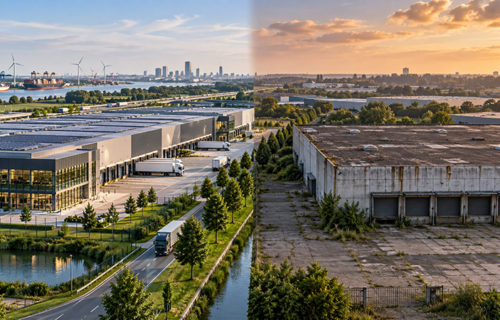
The difference becomes even greater when building specifications are considered. Modern distribution operations increasingly depend on the efficient use of cubic rather than simply floor space. Greater internal height can accommodate sophisticated storage systems and allow companies to handle more goods from the same building footprint. Floor quality, structural layout and column spacing can also influence whether automated equipment can be installed efficiently. A large warehouse constructed for an earlier generation of logistics may consequently provide less operational capacity than a smaller but more sophisticated modern building. Loading infrastructure creates another dividing line. High-volume distribution requires sufficient loading doors, appropriate yards and enough manoeuvring space to handle intensive vehicle movements. Buildings that cannot accommodate these operations may remain perfectly usable for smaller businesses while becoming increasingly unsuitable for major logistics occupiers.
Automation is accelerating the difference. Distribution centres are becoming increasingly technological, with automated storage, robotics, conveyor systems, sorting equipment and digital inventory management changing both the operation and physical design of warehouses. As a result, companies moving between properties may increasingly be seeking better buildings rather than simply more space. This distinction is important for investors because strong logistics demand does not necessarily support every warehouse equally. Occupiers can reduce their use of older properties while simultaneously taking modern space elsewhere, leaving national take-up relatively healthy while weaker buildings accumulate in available supply.
Electricity capacity is adding another layer to this process. The Dutch electricity network faces significant congestion in several regions, while logistics operations are becoming more dependent on power. Automation, refrigeration, building systems and other equipment can require substantial electricity supplies. Commercial transport could increase those requirements further. As delivery vans and eventually larger vehicles become increasingly electrified, some distribution centres will require significant charging infrastructure. A warehouse designed twenty years ago may therefore face a problem that has little to do with the physical condition of its walls or roof. It may simply lack the infrastructure required by the next generation of occupiers.
For power-intensive operations, this could become an important measure of competitiveness. Two warehouses can have similar floor areas, motorway access and loading facilities but offer completely different possibilities if one can accommodate substantial additional electricity demand while the other cannot. Environmental performance is creating a similar distinction. Major occupiers increasingly examine building efficiency as part of their property decisions. Energy consumption influences operating costs, while corporate environmental commitments can affect which buildings companies are prepared to occupy. Older warehouses may therefore require substantial investment not because they have reached the end of their physical lives but because they no longer meet the operational and environmental requirements of their target tenants.
This is where the Dutch logistics market begins to separate into different investment categories. At the strongest end are modern buildings in established logistics locations with specifications and infrastructure capable of supporting sophisticated occupiers. These assets can continue attracting tenants and institutional investors even if national available supply increases. A second group consists of older buildings that can remain competitive after refurbishment. Improvements to energy systems, roofs, offices, loading facilities or technical infrastructure may extend their economic life considerably.
Whether that investment makes sense depends heavily on location. An ageing warehouse in a major distribution corridor may justify significant expenditure because the underlying occupier demand remains strong. The same building in a weaker market may not generate enough additional rent or value to support an equivalent refurbishment programme. This creates another category of properties where redevelopment may eventually become more attractive than renovation. Some older warehouses occupy strategically valuable sites. If planning, infrastructure and development economics permit, replacing the existing building with a modern facility may produce a better long-term return than repeatedly upgrading an ageing structure. For investors with development expertise, such sites could become an important source of opportunity.
The most difficult properties are those where none of these strategies works particularly well. They may be too outdated to attract major occupiers without substantial investment, while the location may not support the rents required to justify refurbishment. At the same time, the land value may be insufficient to make complete redevelopment attractive. These warehouses are not necessarily empty. They can continue attracting smaller businesses or companies with relatively straightforward operational requirements, but their future occupier base may gradually narrow as larger logistics businesses demand more sophisticated buildings.
This creates the risk of economic obsolescence long before physical obsolescence. A warehouse can remain operational while becoming progressively less competitive. Rents may fall relative to modern buildings, incentives may increase and owners may need to commit more capital simply to maintain occupancy. For investors, that changes the meaning of supply statistics. The important question is not simply how many square metres are available across the Netherlands. It is how much of that space satisfies the requirements of the businesses generating the strongest demand.
A company looking for a large distribution centre in a particular corridor may begin with apparently abundant national supply. Once location, internal height, loading infrastructure, automation capability, electricity capacity and environmental performance are considered, the number of realistic alternatives can become much smaller. This explains how increasing availability and shortages can exist simultaneously. The Netherlands can have more logistics property on the market while modern facilities in selected locations remain relatively difficult to secure.
That distinction also matters to developers. Adding another warehouse to national supply does not necessarily address occupier demand if the property is built in the wrong location or without the infrastructure required for future operations. Development therefore needs to be increasingly selective. The strongest projects are likely to be those designed around how logistics companies will operate over the next decade rather than simply around today’s minimum building specification. Electricity, automation, transport electrification and energy efficiency could become as important to long-term competitiveness as conventional considerations such as loading doors and motorway access.
Lenders face the same challenge. The Netherlands can remain one of Europe’s strongest logistics markets while individual properties become increasingly difficult to finance if their future competitiveness is uncertain. Assessing a warehouse therefore requires looking beyond national take-up and supply. Banks and investors need to understand whether the building will remain suitable for the occupiers expected to use it throughout the investment period. The result could be an increasingly pronounced pricing difference between prime and secondary logistics property, with capital continuing to concentrate on modern buildings in established corridors while investors demand larger discounts for properties requiring significant expenditure or carrying greater leasing risk.
This does not mean the Netherlands already has a quantified surplus of obsolete warehouses. Nor does increasing available supply demonstrate that the country’s logistics market has entered a conventional downturn. Instead, the figures point towards a more complicated adjustment. Some of the additional supply will find occupiers. Some buildings will be successfully modernised. Others will be replaced. But a portion of the existing stock could face increasing difficulty competing as logistics operations become more technologically and infrastructure intensive.
The Netherlands may therefore be moving towards a market where measuring warehouses purely by square metres becomes progressively less useful. The more important distinction will be between buildings capable of supporting the next generation of logistics operations and those designed around the requirements of the previous one. If that divide continues widening, Dutch logistics could experience strong demand and excess supply at the same time. The shortage would be in the buildings companies want. The surplus would increasingly be found among the buildings they are leaving behind.
Source: CIJ.World Research & Analysis Team