Thursday, 17 September 2026
Qatar’s real estate market is entering a stage in which broad measures of supply, vacancy and average pricing are becoming less useful for understanding investment performance. The country already has substantial quantities of offices and housing, yet demand is not being distributed evenly across that stock. Businesses, residents and investors are increasingly making choices according to the characteristics of individual buildings and locations. The pattern was visible during the second quarter of 2026. Better-quality office accommodation continued to achieve rents of around QAR 115 per square metre per month, while weaker commercial properties experienced greater pricing pressure. Residential activity strengthened, with approximately 755 transactions completed during the quarter, 23.6% more than in the first three months of the year, while overall residential values changed relatively little.
That combination points towards a market becoming more selective rather than simply stronger or weaker. Increasing transaction activity does not necessarily mean that every residential district is appreciating, just as substantial office availability does not mean that every landlord faces the same leasing conditions. For investors, this creates a different way of looking at Qatar. The most important distinction may increasingly be between properties capable of satisfying contemporary occupier requirements and those requiring substantial investment to remain competitive.
The office sector illustrates the change particularly clearly. Doha accumulated a large commercial property inventory during successive periods of economic expansion. These buildings vary considerably in age, specification, location and management quality, creating very different propositions for businesses searching for premises. Corporate occupiers increasingly evaluate the complete working environment. Rental cost remains important, but companies also consider floor efficiency, building systems, parking, transport connections, digital infrastructure, amenities and the quality of common areas. For employers competing for skilled workers, the location and condition of the workplace can also influence recruitment and employee experience.
Consequently, an empty office is not automatically competitive office supply. A company seeking modern premises may reject an older building even if substantial space is available and the landlord offers a lower rent. Inefficient layouts, dated systems or inadequate parking can create operating disadvantages that cannot always be compensated for through cheaper occupancy costs. This helps explain how the upper part of Qatar’s office market can remain comparatively resilient while weaker buildings experience greater pressure. Businesses prepared to pay for higher standards concentrate demand within a smaller portion of the total stock.
For landlords, that creates two very different investment situations. Owners of competitive buildings can concentrate on retaining tenants and maintaining their properties. Owners of ageing assets must decide whether lower rents are sufficient to attract occupiers or whether significant refurbishment is required. Some older buildings could present an investment opportunity. A property in a strong location with an outdated interior or building systems may be capable of repositioning through improvements to entrances, common areas, mechanical equipment, energy performance and workplace amenities. If the acquisition price is sufficiently attractive, refurbishment could create a route back into the stronger part of the leasing market.
Other assets will be much more difficult to rescue. Structural limitations, inefficient floor plates, inadequate parking or poor accessibility can make upgrading expensive without guaranteeing higher rents. These properties risk remaining occupied primarily by tenants whose main consideration is price. Over time, that could create a much clearer hierarchy within Qatar’s office market.
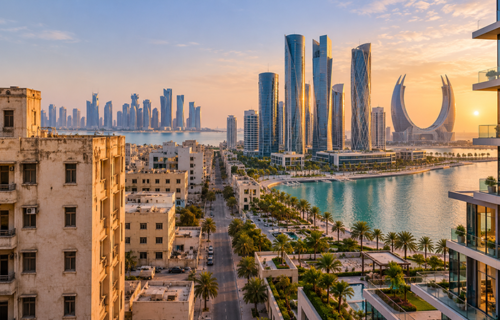
Lusail will be one of the most important places to observe this process. The city contains a large concentration of comparatively recent offices, housing, hotels and mixed-use development supported by substantial transport and public infrastructure. Its investment story is therefore changing. The question is no longer simply whether Lusail can deliver large amounts of real estate. Much of that construction has already taken place. The more important test is whether the city can generate the permanent businesses, residents and everyday economic activity required to support its buildings over the long term.
For office occupiers, Lusail provides an alternative to established Doha business locations. Modern buildings and newer infrastructure can appeal to companies that do not require a traditional central address. As more businesses establish themselves there, the district can gradually develop its own commercial ecosystem. But Lusail itself should not be treated as a guarantee of quality. Buildings within the same master-planned city can perform very differently. Accessibility, management standards, operating costs, views, amenities and proximity to transport can create substantial differences in occupier demand. As Lusail matures, investors are likely to become increasingly selective about individual assets rather than simply buying exposure to the location.
The residential market presents a similar picture. The increase in transaction numbers during Q2 demonstrates that buyers remain active, but broadly stable overall values suggest that purchasing activity has not translated into uniform price inflation. That potentially gives buyers greater influence over the market. When purchasers have numerous alternatives, developers must compete on more than price. Apartment design, construction quality, management, maintenance costs, community facilities and location can become increasingly important in determining which projects attract demand.
This environment could favour established communities and well-executed newer developments simultaneously. An older property in a highly desirable location can remain competitive because the surrounding neighbourhood is difficult to reproduce. Conversely, a newly completed apartment can struggle if the wider environment lacks services, transport or a permanent community. Lusail’s residential development will therefore depend increasingly on its success as a city rather than simply as a construction programme. Housing becomes more resilient when residents have practical reasons to remain. Employment, schools, shops, restaurants, recreation, transport and everyday services gradually create those reasons. The more complete the urban environment becomes, the less individual residential projects need to compete solely through their own amenities.
Established Doha districts retain advantages of their own. Mature neighbourhoods benefit from recognised locations, existing services and established patterns of demand. Qatar’s emerging divide should therefore not be interpreted as a straightforward competition between new and old property. The more important distinction is between relevant and increasingly obsolete real estate. A well-managed older building in a strong location may remain attractive for decades. A newer property can lose competitiveness relatively quickly if management is poor or its location fails to develop as expected. Investors therefore need to look beyond construction dates when assessing future performance.
This is particularly important for institutional capital. Larger investors generally seek properties capable of producing predictable income, maintaining occupancy and attracting future buyers. Building quality, tenant profile, management, operating efficiency and location therefore matter considerably when deciding whether an asset can support a long holding period. Qatar could consequently develop a clearer distinction between institutional-quality property and the wider stock available in the market. The best assets may continue attracting investment even during periods when overall transaction volumes or prices appear subdued.
At the opposite end, weaker buildings could require increasingly large discounts to attract buyers. Investors acquiring these properties must consider not only current rental income but the amount of capital that may be required to keep them competitive. That could eventually produce a refurbishment and repositioning market. Investors willing to acquire older buildings with strong underlying locations could modernise them and target occupiers seeking better accommodation without the highest prime rents. The opportunity will depend heavily on pricing. A building requiring substantial investment is only attractive if its acquisition cost leaves enough room to finance improvements and still generate an acceptable return.
Qatar’s continued economic diversification could reinforce these differences. Expansion in finance, technology, tourism, professional services and international business could increase the number of occupiers accustomed to modern commercial environments. As the country competes for businesses and skilled professionals, the standard of offices, housing and surrounding urban districts could become an increasingly important part of its overall proposition.
This makes Qatar’s next property phase very different from the development cycle surrounding the 2022 FIFA World Cup. That period was dominated by construction, infrastructure and the delivery of enormous quantities of physical capacity. The challenge now is what happens to that capacity. Some buildings will establish themselves as desirable long-term assets. Others will need significant investment to remain relevant. A further group may eventually face more fundamental questions about redevelopment or alternative use.
For investors, this means market averages should be treated carefully. Overall vacancy can conceal competition for particular offices. Stable residential prices can hide substantial differences between communities. Citywide rental figures can say relatively little about an individual building’s ability to retain occupiers. The analysis therefore needs to move closer to the asset itself. Investors should ask whether a building provides something occupiers genuinely value, how much competing space offers the same proposition, what capital expenditure will be required over the next decade and whether the surrounding district is becoming more or less desirable.
Those questions will be particularly important in Lusail, where the transition from large-scale development to a functioning urban economy is still unfolding. They will also matter across established Doha districts as older buildings compete with newer alternatives. Qatar does not necessarily need significantly more property to create the next investment opportunity. In many parts of the market, the opportunity may instead come from identifying which existing buildings will continue attracting demand and which can be repositioned successfully.
That is why the next phase of Qatar’s real estate market may ultimately be decided building by building. The country has already demonstrated its ability to construct at scale. The investment challenge now is determining which of those assets will remain valuable as businesses, residents and capital become increasingly selective.
Source: CIJ.World Research & Analysis Team