Sunday, 25 October 2026
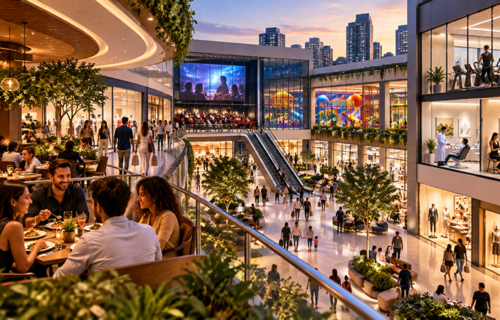
Brazil’s shopping-centre industry is undergoing a transformation that reaches well beyond the changing mix of stores inside its malls. The country’s strongest centres are increasingly being managed as complex consumer businesses where restaurants, entertainment, healthcare, services and events work alongside traditional retail to generate visits and spending throughout the week. This evolution has significant implications for property investors. Shopping centres have always required more active management than many other forms of commercial real estate, but the difference between simply owning a mall and successfully operating one is becoming more pronounced.
Brazil provides fertile ground for that strategy. The country has hundreds of established shopping centres serving enormous metropolitan and regional consumer markets. Many malls function as important social destinations as well as retail locations, combining shopping with dining, cinemas and other activities. As consumers gain more ways to purchase products without visiting physical stores, successful centres increasingly need to provide reasons to visit that cannot be delivered through a smartphone.
Traditional retailers remain central to the model. Fashion, footwear, electronics, cosmetics and other categories continue attracting customers and generating substantial rental income. But successful operators are increasingly considering how different uses work together rather than evaluating each unit solely according to the merchandise sold inside it. Restaurants demonstrate the shift particularly clearly. Food and beverage can extend the hours during which a shopping centre remains active and give consumers a reason to visit without intending to purchase conventional retail products. A customer arriving for dinner may also visit stores, while shoppers who stay for a meal spend considerably longer at the property.
Entertainment can have a similar effect. Cinemas have long formed part of Brazilian shopping centres, but leisure is becoming much broader. Children’s attractions, gaming, fitness, events and other experiences can increase both the frequency and duration of visits. These uses can also attract families and younger consumers whose relationship with traditional retail is increasingly influenced by online shopping. Healthcare and personal services add another layer. Medical clinics, diagnostic facilities, dental practices, beauty services and wellness businesses generate visits based on appointments rather than discretionary shopping. That can bring customers into a mall during weekday periods when conventional retail traffic might otherwise be weaker.
For landlords, these uses can be valuable even when their direct rental economics differ from those of traditional stores. A tenant that generates regular visits can strengthen the wider property by increasing footfall for surrounding businesses. The performance of an individual unit therefore needs to be considered partly according to what it contributes to the entire centre. This changes how successful malls are managed. Owners increasingly need to understand customer behaviour, determine which combinations of tenants encourage longer visits and continually adjust the property as consumer preferences evolve. Leasing becomes less about filling vacant units and more about constructing an ecosystem of complementary uses.
The distinction has important implications for occupancy. A shopping centre can report high occupancy while still containing a weak combination of tenants. Keeping an underperforming retailer simply to avoid vacancy may preserve the headline occupancy rate while doing little to improve the attractiveness of the property. More active owners may instead accept temporary vacancies while replacing tenants, restructuring units or introducing new concepts. The short-term loss of rent can potentially produce stronger traffic and income once the repositioning is completed.
This helps explain why operational capability is becoming increasingly important to shopping-centre valuations. Location remains fundamental, but it cannot guarantee performance. Two centres serving similar populations can produce very different results depending on their tenant mix, management, physical condition and ability to respond to changing consumer demand.
Dominant malls have significant advantages in this environment. Strong visitor numbers make them attractive to leading domestic and international brands. Those brands generate additional traffic, which encourages restaurants and entertainment operators to enter the property, reinforcing the centre’s position. This can create a powerful cycle. Strong performance allows an owner to invest in refurbishment and new concepts. Improvements attract additional customers and tenants, supporting higher sales and potentially stronger rents. Those returns provide further capital for investment.
Secondary centres can face the opposite dynamic. Weak traffic makes it harder to attract desirable tenants. A poorer tenant mix then gives consumers fewer reasons to visit, making the property even less attractive to new operators. Breaking that cycle can require substantial capital. Brazil’s financing environment makes this challenge particularly important. Repositioning a shopping centre can involve major expenditure on common areas, food and beverage zones, leisure facilities, entrances, circulation and individual units. When the cost of capital is high, investors need greater confidence that those improvements will generate sufficient additional income.
Owners of dominant centres have an advantage because existing cash flows can help support investment. Investors considering weaker assets must decide whether the purchase price is low enough to compensate for both the cost and uncertainty of repositioning. This could result in an increasingly pronounced valuation divide. The strongest malls may command investor demand because their income is supported by established consumer behaviour, successful tenants and barriers to new competition. Secondary properties requiring large amounts of capital may need to trade at substantially different return levels before buyers are willing to accept the operational risk.
New development adds another competitive pressure. Recently constructed shopping centres can incorporate contemporary consumer expectations from the beginning, including larger restaurant areas, leisure uses, public spaces and more flexible layouts. Older centres may need extensive redevelopment to offer comparable environments. The implications extend beyond individual buildings. Brazil’s leading shopping-centre owners increasingly require capabilities that resemble those of consumer businesses. They need data on customer behaviour, sophisticated leasing teams, marketing expertise, relationships with national retailers and the ability to identify concepts that can strengthen a centre before competitors secure them.
Events and programming are becoming part of that process. Seasonal attractions, cultural activities and temporary installations can create reasons for customers to return even when they do not have a specific purchase in mind. Common areas that once served primarily as circulation space can increasingly become part of the customer experience.
Digital technology also changes the relationship between the mall and its visitors. Online shopping does not necessarily have to compete directly with physical centres. Loyalty programmes, apps, digital promotions and customer data can help operators understand who visits their properties and communicate with them beyond the physical shopping trip. The most sophisticated operators can therefore use the shopping centre as both a physical destination and a platform connecting retailers, restaurants, services and customers.
For institutional investors, this makes shopping centres fundamentally different from relatively passive commercial assets. Buying a successful mall involves acquiring not only land, buildings and lease contracts but also exposure to the quality of the operating platform responsible for managing them. That creates both opportunity and risk. Experienced operators may be able to improve income through tenant changes, redevelopment and better use of underperforming areas. Investors without strong operational capabilities can struggle to reproduce those results even when they acquire properties in apparently attractive locations.
The investment case for secondary malls consequently becomes more complicated. Some may offer compelling repositioning opportunities, particularly where the surrounding consumer market remains strong but the property has been poorly managed or underinvested. Others may suffer from structural disadvantages that additional capital cannot easily solve. Understanding the difference requires investors to look beyond conventional property metrics. Occupancy, rents and yield remain important, but so do customer traffic, tenant sales, visit frequency, dwell time, competitive position and the amount of capital required to keep the centre relevant.
Brazil’s shopping-centre market is therefore unlikely to divide simply between successful and unsuccessful retail locations. The more important separation may be between centres capable of continually reinventing themselves and those that remain dependent on the traditional model of collecting rent from a relatively static collection of stores.
For the strongest assets, restaurants, entertainment, healthcare and services are not replacements for retail. They are tools for making the entire property more valuable by giving consumers more reasons to visit. That distinction could become increasingly important as institutional capital evaluates Brazilian retail property. Dominant centres with strong management platforms may begin to look less like conventional buildings and more like operating businesses with valuable real-estate foundations.
The weaker end of the market faces a different future. Without sufficient traffic, investment and management capability, secondary centres risk becoming increasingly difficult to reposition as stronger competitors continue improving their offer. Brazil’s next shopping-centre investment cycle may therefore be determined less by how much retail space a property contains than by how effectively that space is operated. The malls capable of continually creating reasons for people to return are likely to become increasingly difficult for ordinary retail properties to compete with.
Source: CIJ.World Research & Analysis Team