Saturday, 24 October 2026
Logistics companies have spent years collecting increasingly large quantities of information from vehicles, warehouses, customers, financial systems and supply chains. The next challenge is considerably more difficult: turning that information into decisions quickly enough to change what happens in the physical world.
Speaking at Ai4 2026 in Las Vegas, Grupo Traxión CIO Joshua Bernal described this as the industry’s “last mile” of data. The problem is no longer simply whether companies possess information. It is whether the right information can reach the person — or increasingly the automated system — capable of acting on it. The distinction has significant implications for logistics operations and the industrial real-estate sector supporting them.
Modern fleets continuously generate information about location, fuel consumption, vehicle condition, driver behaviour and mechanical performance. Warehouses generate another stream of information from inventory systems, orders, scanners, sensors and automated equipment. Financial platforms, customer systems and transportation-management software add further layers. Yet having more information does not automatically create a more efficient business.
One of the biggest problems is fragmentation. Finance may work from one set of systems, operations from another and sales from something else entirely. Individual business units can consequently reach different conclusions because they are looking at different parts of the same organisation. This becomes particularly problematic in large logistics groups built through acquisitions, where different businesses may retain their own systems, terminology, databases and reporting processes.
Employees can therefore spend substantial amounts of time reconciling information before they can even begin making a decision. Bernal described an example in which an operations team spent several days reconciling a figure that theoretically should have taken minutes to establish. The information existed, but it was distributed across several systems and formats.
This is increasingly where enterprise AI is being positioned. Rather than simply producing another dashboard, companies are attempting to create an intelligence layer capable of interrogating several data sources simultaneously, understanding their relationships and presenting an answer in ordinary language.
The difference appears subtle but could fundamentally change how companies use business intelligence. Traditional dashboards require someone to know which report to open, understand the underlying metrics, interpret what has changed and frequently compare the result with information held somewhere else. The dashboard supplies information, but the employee still has to determine what it means.
AI potentially moves that process further. A manager could ask why fleet availability has deteriorated in a particular region. The system could examine maintenance information, vehicle telemetry, schedules and operating history before identifying likely causes and suggesting what should happen next. Eventually, the system could carry out some of those actions itself.
This creates a progression from data to information, from information to analysis, from analysis to recommendation and ultimately from recommendation to action. The final stages are potentially the most economically important. Many companies have already invested heavily in collecting and visualising information. The larger productivity opportunity may now lie in reducing the time between recognising a problem and doing something about it.
Fleet maintenance provides a useful example. A conventional system might identify that a vehicle has developed a mechanical problem after a warning appears or the vehicle stops operating. More sophisticated predictive systems can analyse historical maintenance information and real-time telemetry to identify patterns associated with future failure. That allows maintenance to become increasingly proactive.
Instead of waiting for a breakdown, the system can flag a vehicle as deteriorating and recommend that it is removed from service at a convenient point. Agentic AI potentially takes the process another step. Bernal demonstrated a concept in which a vehicle’s operating data contributes to a continuously updated health assessment. Once the vehicle crosses a predetermined risk threshold, the system can schedule maintenance and prevent the transportation-management platform from assigning the vehicle another journey.
The important development is not simply that AI predicted the problem. It is that the prediction became an operational action. Grupo Traxión believes this approach could materially reduce unplanned downtime across its operations, although the financial savings and performance improvements presented at Ai4 remain company estimates rather than independently verified results.
The underlying principle nevertheless illustrates why logistics is emerging as an important testing ground for agentic AI. The sector contains thousands of repetitive operational decisions that have measurable financial consequences. Which vehicle should perform a journey? When should it undergo maintenance? Which warehouse should process an order? Which route should a shipment follow? Should additional capacity be secured? Does an unusual operating pattern require intervention?
Historically, many of these questions have been answered through combinations of software, spreadsheets, dashboards and human judgement. AI could increasingly coordinate those systems.
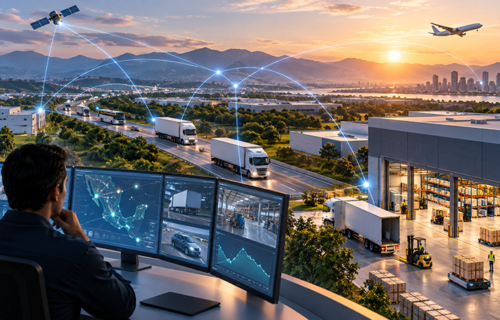
For logistics property, this represents another stage in the technological evolution of warehouses and distribution centres. Buildings are already becoming more automated through conveyors, robotics, automated storage, computer vision and sophisticated warehouse-management systems. The next layer is intelligence capable of connecting what is happening inside the building with the wider transportation network.
A distribution centre could eventually understand not only what inventory it contains but which vehicles are available, which equipment requires maintenance, which orders are becoming urgent and where disruption is developing elsewhere in the supply chain. That information could influence how labour, loading bays, vehicles and automated equipment are allocated throughout the day.
The warehouse consequently begins to function less like an isolated building and more like a node inside a continuously managed logistics network. Grupo Traxión provides a useful illustration of the scale involved. The Mexican mobility and logistics group operates across cargo transportation, personnel mobility and logistics and technology services, with a substantial vehicle fleet and more than one million square metres of logistics warehouse space. At that scale, relatively small improvements in vehicle availability, maintenance scheduling or operational decision-making can potentially produce meaningful financial benefits.
The presentation also highlighted one of the biggest obstacles confronting enterprise AI: trust. An AI system recommending a marketing headline creates relatively limited operational risk. A system removing a vehicle from service, changing a transport schedule or triggering maintenance has direct financial and physical consequences. Employees therefore need to understand why the system reached its conclusion.
This makes data lineage increasingly important. Companies need to know where information originated, how it was transformed, who was authorised to access it and what actions were subsequently taken. In this environment, enterprise AI cannot operate as an unexplained black box.
Bernal argued that confidence comes from being able to trace the answer back through the underlying information. That means permissions, audit trails and governance become part of the AI infrastructure rather than additional compliance features added later. The requirement becomes even more important as AI moves from recommendation towards autonomous action.
A manager can ignore a questionable dashboard. An automated system capable of changing vehicle assignments, scheduling maintenance or modifying a logistics workflow requires substantially stronger controls. This creates an important distinction between consumer AI and industrial AI. The objective in enterprise logistics is not simply to produce an answer that sounds convincing. The answer has to be based on authorised corporate information and be sufficiently reliable for someone to act upon it.
That also explains why natural-language interfaces could become significant. For decades, business-intelligence systems have required employees to adapt themselves to the structure of the software. Users need to understand dashboards, filters, reports and sometimes database terminology. Generative AI reverses part of that relationship.
Instead of learning where information is stored, employees can increasingly ask questions in the same way they would ask a colleague. The system determines which underlying sources are required and constructs the response. If this develops successfully, it could reduce dependence on large collections of static dashboards.
That does not necessarily mean conventional business-intelligence platforms disappear. They remain useful for standardised reporting, regulatory requirements and recurring management information. But the interface to corporate information could increasingly become conversational.
A warehouse manager might ask which equipment is most likely to fail during the next week. A transport executive could ask which vehicles are producing unusually high maintenance costs. A finance director could ask which customers or routes are generating deteriorating margins. The same intelligence layer could answer each question using different combinations of underlying information.
Traxión’s Northstar project is intended to demonstrate this approach. Bernal described a system trained on the company’s own information that can interrogate underlying data and provide contextual responses without requiring a new dashboard to be built for every question. He also presented performance improvements and potential cost reductions associated with the system. Those figures should be regarded as Traxión’s internal estimates and development results, but they illustrate what the company is attempting to achieve: reducing the distance between an operational signal and a business response.
This could ultimately prove more important than the ability to generate reports faster. The real economic value of enterprise AI may emerge when systems can identify an event, understand its consequences and initiate the appropriate workflow.
For logistics companies, that could mean a maintenance warning automatically becoming a workshop appointment. A predicted delivery failure could trigger an alternative route. A deteriorating customer relationship could prompt intervention. A sudden capacity shortage could initiate a search for alternative transportation.
The transition also changes how companies should approach AI investment. Bernal argued that businesses should begin with important decisions rather than simply selecting large datasets and searching for applications. The first question becomes what operational decision needs to improve.
Companies can then identify who owns that decision, how long it currently takes, which information is required and where the process encounters friction. Only after understanding that process does the technology become relevant.
This is particularly important for logistics because the physical consequences of decisions are easy to observe. A truck either arrives or it does not. A warehouse either processes an order on time or it does not. A vehicle either remains available or suffers an unexpected breakdown.
That makes logistics potentially well suited to measuring the financial return from AI. It also means AI could influence the requirements occupiers place on industrial property. Warehouses capable of supporting real-time operational intelligence require reliable connectivity, sensors, modern building systems and increasingly integrated technology infrastructure.
As automation grows, electricity requirements can also increase through robotics, charging infrastructure, computing equipment and automated handling systems. Industrial buildings therefore risk developing a technology divide similar to the quality divide already emerging in office markets.
Modern logistics facilities designed around automation and data could become increasingly attractive to sophisticated occupiers, while older buildings may require investment to support the same operating model. Location will remain fundamental, but digital capability is becoming another component of logistics-property quality.
The wider transformation is ultimately about connecting information with physical action. For years, companies concentrated on collecting more data and building better dashboards. AI is beginning to challenge the assumption that humans should always be responsible for interpreting every piece of that information before something happens.
The next generation of logistics systems could continuously observe fleets, warehouses and supply chains, identify emerging problems and initiate responses within predetermined limits. Humans would remain responsible for the most important decisions and for defining the rules under which automation operates, but much of the routine movement between information, recommendation and execution could increasingly be handled by machines.
That is the real last mile of enterprise data. The competitive advantage may no longer come from possessing the largest amount of information. Most large logistics companies already generate more data than their employees can realistically analyse.
The advantage will come from shortening the distance between detecting something important and taking the correct action. For logistics operators — and increasingly for the warehouses and infrastructure supporting them — that could become one of the most valuable applications of enterprise AI.
Source: CIJ.World Research & Analysis Team