Wednesday, 21 October 2026
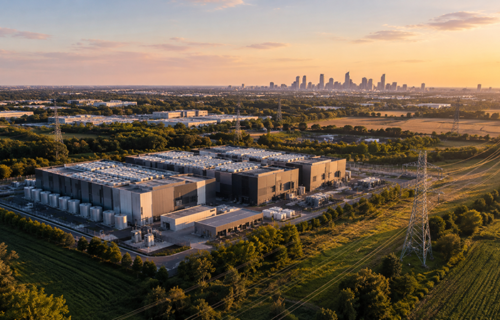
France’s accelerating data-centre development is beginning to introduce a new factor into the country’s industrial property market. Location, motorway access, fibre connectivity and planning remain essential, but another consideration is becoming increasingly influential: whether a development site can secure enough electricity to support the enormous computing facilities now being proposed.
The challenge is not that France lacks electricity at national level. The country benefits from substantial generating capacity and a predominantly low-carbon electricity system. The more immediate difficulty is delivering very large amounts of power to individual locations through the transmission and distribution networks. For the largest data-centre projects, that can mean securing hundreds of megawatts at a single site. The availability and timing of a grid connection can therefore determine whether otherwise suitable industrial land can actually accommodate the development being considered.
The scale of demand has increased rapidly. France had around 300 data centres in 2026, while by May the national transmission operator RTE had reserved close to 18 GW of potential connection capacity for approximately 80 proposed data-centre projects. At the end of 2024, the comparable pipeline had been around 5 GW across approximately 40 projects.
Those figures demonstrate the extraordinary increase in electricity being requested by the sector, but they should not be interpreted as a forecast that all 18 GW will be constructed. Some proposed developments will be delayed, changed or abandoned. Others may use considerably less electricity than the maximum capacity requested, particularly during their initial years of operation. Data centres also tend to increase their electricity consumption progressively as servers and computing equipment are installed.
The pipeline nevertheless shows why electricity infrastructure is becoming increasingly important to property development. Île-de-France remains the country’s largest data-centre market and accounted for approximately 7 GW of reserved connection capacity by May 2026. Hauts-de-France followed with around 6 GW, indicating that the next development cycle could become considerably more geographically dispersed.
Paris continues to dominate existing capacity. New facilities were delivered during the first half of 2026 and available capacity remained relatively tight. Demand from cloud computing, artificial intelligence and digital services continues to support expansion. But building the next generation of facilities close to established Paris clusters is becoming increasingly complicated.
Suitable large sites are limited, planning can be difficult and the electricity required for major campuses cannot necessarily be delivered everywhere. This is encouraging developers to examine a broader range of industrial and brownfield locations around the metropolitan region.
The scale of individual projects makes this particularly important. Many large facilities now seek electricity connections of between 100 MW and 200 MW, while some exceptional proposals require more than 400 MW. At these levels, electrical infrastructure becomes a major part of the development process. New substations, high-voltage equipment and substantial transmission connections may be necessary before construction can result in an operational data centre.
This creates the potential for a new distinction within the industrial land market. Two development sites may have similar road access, planning conditions and plot sizes, yet have very different prospects for data-centre use if one can obtain a large grid connection within a commercially acceptable period and the other cannot.
Electricity availability does not automatically make land valuable. Developers still require fibre connections, suitable planning, adequate physical space and a location capable of accommodating the environmental and operational requirements of a major computing facility. But access to high-capacity power is increasingly becoming part of the assessment of whether a site has additional development potential.
Southern Île-de-France provides an example of how infrastructure investment could influence this market. RTE is preparing approximately 1.2 GW of additional connection capacity in the area, using infrastructure capable of supporting several large electricity consumers. For nearby landowners and developers, the significance extends beyond the data-centre industry. Additional grid infrastructure can change the range and scale of projects that are technically possible in an area.
The French government and RTE have also identified five priority locations intended to accommodate particularly large computing projects. Two are in Île-de-France and three in Hauts-de-France. Their advantages include large development sites and proximity to France’s high-voltage transmission infrastructure.
The initiative illustrates an important change in site selection. Traditionally, a property developer might identify land first and then arrange the utility connections required for the project. For a very large data centre, developers increasingly need to understand where sufficient electricity can realistically be supplied before committing to the land. In effect, infrastructure can help determine the geography of future development.
Hauts-de-France could become one of the principal beneficiaries. The region’s approximately 6 GW of reserved data-centre connection capacity places it surprisingly close to Île-de-France despite the much greater concentration of existing facilities around Paris.
Large industrial sites, established energy infrastructure and access to northern European markets strengthen the region’s proposition. Major technology and infrastructure investors have already announced substantial projects, although the eventual scale of operational development will depend on how many of these schemes progress from proposed connections to completed facilities.
Marseille represents another important market, but for different reasons. The city has become a significant international digital gateway because of the submarine telecommunications cables connecting Europe with Africa, the Middle East and Asia. This communications infrastructure has encouraged data-centre investment and gives Marseille an advantage that cannot simply be replicated by providing electricity elsewhere.
Further growth will nevertheless require additional power. Around Plan-de-Campagne, between Aix-en-Provence and Marseille, approximately 500 MW of additional grid connection capacity is being prepared. Combined with the region’s telecommunications infrastructure, that could support further digital development.
The emergence of large electricity users also creates a wider industrial question. France is simultaneously attempting to electrify manufacturing and reduce emissions from heavy industry. Battery factories, steel production, hydrogen projects and other industrial developments increasingly require very large electricity connections.
Industrial areas including Dunkerque, Fos-sur-Mer and Le Havre are therefore attracting infrastructure investment for reasons extending far beyond data centres. This means digital infrastructure will not be the only sector seeking access to new grid capacity.
For property investors, the resulting competition could become significant. Industrial sites capable of accommodating energy-intensive uses may attract interest from several types of occupier, each with different requirements and development economics.
The overlap with logistics is particularly worth watching. Data centres and large distribution facilities can both require substantial plots, infrastructure access and planning environments capable of accommodating major commercial buildings. Former industrial sites can potentially appeal to both sectors.
Their electricity requirements are very different, but logistics is becoming more power-intensive as well. Automated warehouses, electric vehicle charging and increasingly sophisticated building systems are increasing the amount of electricity required by modern distribution facilities. This creates the potential for competition over certain well-located industrial sites, particularly where land also benefits from unusually strong electrical infrastructure.
It would be premature to conclude that data centres are already displacing logistics development across France on a significant scale. Warehousing remains a much larger user of industrial land, and the site requirements of the two sectors are not identical. However, where a plot is genuinely capable of supporting a large computing campus, the economics of the alternative uses can change.
A data centre represents an extremely capital-intensive investment, meaning the land cost forms only one part of a much larger development budget. This can potentially allow digital infrastructure developers to compete strongly for scarce sites offering the right combination of electricity, fibre and planning.
Brownfield industrial property could become particularly interesting as a result. Former manufacturing sites can sometimes provide large plots, existing utility infrastructure and locations where intensive commercial uses are already established. They may also sit further from dense residential neighbourhoods, reducing some of the planning conflicts associated with major data-centre developments.
But investors need to distinguish carefully between land located near electrical infrastructure and land that genuinely has access to usable capacity. A transmission line passing close to a site does not guarantee that hundreds of megawatts can be supplied. Network capacity may already be committed, reinforcement may be required or connection works may take years.
This creates an increasingly important due-diligence issue. The value of a potential data-centre site depends not simply on theoretical electricity availability but on how much power can actually be delivered, when it can be supplied and what infrastructure investment is necessary to achieve the connection.
The same caution applies to the national development pipeline. The almost 18 GW of reserved capacity demonstrates extraordinary developer interest, but it represents potential rather than completed demand. The eventual operational market will be smaller if projects fail to secure financing, planning or customers. This makes the distinction between announced projects and deliverable projects increasingly important for investors assessing industrial land.
Planning could also become more significant as the sector grows. Very large data centres consume substantial electricity while employing fewer people than some alternative industrial uses. Local authorities may therefore examine their economic contribution, environmental impact, noise, visual footprint and infrastructure requirements more closely as development expands.
France nevertheless has significant advantages in the European competition for digital infrastructure. Its electricity system provides access to large quantities of relatively low-carbon power, Paris remains a major European business and technology centre, and Marseille provides exceptional international telecommunications connectivity.
The constraint is increasingly about getting those advantages to the right physical location. As artificial intelligence increases the scale of computing infrastructure, developers may have less freedom to choose sites according to traditional property criteria alone. The electricity network will increasingly influence where projects can realistically be built.
That could gradually change how some French industrial land is valued. Roads, labour, planning, population and proximity to customers will remain central to industrial property. But for the most electricity-intensive developments, another layer is being added to the location equation.
The emerging premium will not simply belong to land near electricity infrastructure. It will belong to sites where substantial electrical capacity can genuinely be secured within the timeframe required by investors. As France’s data-centre pipeline expands, the difference between land that is merely available and land that can actually be powered could become one of the defining property questions of the next development cycle.
Source: CIJ.World UK Research & Analysis Team