Wednesday, 21 October 2026
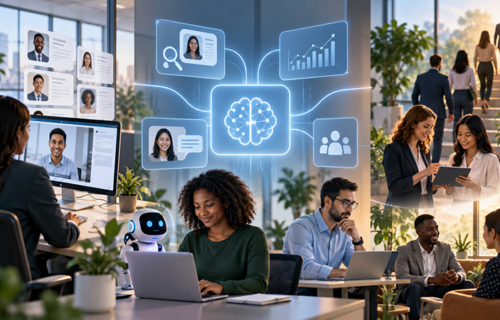
AI is starting to rebuild HR from hiring to retention by connecting recruitment, employee support, workforce analysis and retention through systems that can interpret large volumes of workforce information while still leaving critical employment decisions in human hands. The shift is becoming more significant than simple automation. Traditional HR software was largely designed around standardised processes serving the majority of customers. AI is making it possible to create more adaptable systems that can respond to the structure, policies and needs of individual organisations rather than forcing every company into the same workflow.
That transition was central to a discussion at AI4 2026 involving representatives of HireVue, BambooHR and satellite manufacturer Astranis. Despite approaching AI from different positions, the participants broadly agreed that its greatest value in HR lies not in replacing professionals but in improving access to information, removing repetitive administrative work and allowing human judgement to concentrate on decisions where context matters most. Recruitment is already one of the clearest examples. Generative AI has made it far easier for candidates to produce polished résumés, application responses and cover letters, which has reduced the effort required to apply for jobs and contributed to employers receiving large volumes of increasingly professional-looking applications.
The unintended consequence is that the résumé itself is becoming a weaker indicator of genuine ability. When candidates can use AI to improve how their experience is presented, recruiters need better ways of determining who can actually perform the job. This is pushing recruitment technology away from simply screening applications and towards validating skills. HireVue has been developing AI-supported interviewing around this problem, using technology to expand the number of candidates who can be assessed while maintaining human oversight over final hiring decisions.
The company launched a voice-based AI Interviewer in 2026 that can conduct structured conversations with candidates without requiring a recruiter to personally perform every initial interview. For organisations involved in large-scale recruitment, this can change the economics of the process. Employers may need to handle tens of thousands of applicants within short hiring periods, and conventional recruiter capacity inevitably forces them to reduce those numbers before meaningful conversations can take place.
AI can potentially loosen that constraint. Instead of deciding which applicants deserve an interview primarily from résumés and application forms, employers can conduct structured initial assessments across much broader candidate groups. That could give more people an opportunity to demonstrate their capabilities before a recruiter decides where to invest limited human time. It does not mean everyone reaches a final interview, but it can increase the amount of information available before candidates are eliminated from the process.
The opportunity is accompanied by another problem: candidates now have access to increasingly sophisticated AI themselves. Applicants can use AI to prepare résumés, anticipate interview questions and generate suggested responses. Tools capable of assisting people during interviews are also becoming more accessible. Recruitment is therefore entering an unusual arms race in which employers use AI to evaluate candidates while candidates use AI to improve how they appear to employers.
The result is likely to increase the importance of skills validation. Employers increasingly need evidence that candidates can do what they claim rather than relying primarily on how effectively they describe their experience. AI could also improve matching between applicants and vacancies. Someone might apply for one role while possessing skills better suited to another position within the same organisation. Historically, identifying that opportunity depended heavily on a recruiter recognising it. Systems capable of analysing capabilities across a company’s entire vacancy portfolio can potentially surface alternative matches automatically.
This shifts recruitment from processing applications towards understanding capabilities. The same principle extends beyond the hiring stage. One of the larger opportunities discussed at AI4 involved connecting recruitment information with what happens after someone joins the company. Businesses collect substantial amounts of workforce information throughout the employment lifecycle, including interview feedback, assessment results, performance reviews, engagement surveys, management evaluations and exit interviews. Much of this information has historically remained fragmented across different systems or stored as unstructured text that is difficult to analyse systematically.
Generative AI changes the economics of working with that information. Organisations can potentially examine patterns across thousands of written comments without requiring someone to manually read every document. That makes it possible to ask more complicated questions about employee performance, management quality, retention and organisational behaviour.
Management performance provides one example. Companies have traditionally evaluated managers through financial results, formal appraisals and perhaps employee surveys. AI-supported analysis can potentially combine those measures with turnover patterns, peer comments, direct-report feedback and exit interviews over time. If unusually large numbers of employees repeatedly leave the same team, management can investigate whether the explanation lies with recruitment, workload, leadership or another organisational issue.
The technology does not automatically provide the correct answer. Its value lies in making previously difficult qualitative information easier to examine. HR has never lacked information. The problem has been getting the right information to the right person at the moment it becomes useful. AI can increasingly act as an intelligence layer between workforce databases and managers.
BambooHR is moving in this direction with a connected AI architecture designed around organisational context rather than individual AI features. Its approach combines workforce information with AI systems capable of analysing data, answering employee questions and completing selected actions while operating within existing permissions and governance controls. That reflects a broader transformation occurring throughout enterprise software.
Traditional software-as-a-service platforms were generally built around the requirements shared by the largest possible number of customers. Developers identified what most users needed and constructed relatively standardised products around those workflows. Customers could configure them, but usually only within boundaries established by the software provider. AI makes it possible for the underlying platform to remain standardised while the user experience becomes more individualised.
Different organisations can potentially interact with the same HR platform in different ways according to their structures, policies and workforce characteristics. Individual employees may also receive different information depending on their role, permissions and circumstances. From the customer’s perspective, the number of AI agents operating behind the software matters far less than whether the system improves the experience and produces useful results.
An HR director is unlikely to care whether a provider operates ten agents or several hundred. The important questions concern whether employee requests are answered correctly, managers receive useful information, repetitive administration is reduced and important decisions become better informed. This creates pressure on technology companies to move beyond simply attaching AI features to established software in order to market the product as AI-enabled.
The underlying architecture is becoming more important. HR systems contain some of the most sensitive information in an organisation, including compensation, performance data, employment records, benefits and recruitment information. AI systems operating across these datasets require strict controls governing which information can be accessed and what actions can be taken.
Data architecture is also becoming a competitive issue. Many established enterprise platforms were designed long before generative AI existed. Their databases expanded gradually as companies added customers, integrations and new functions. Information can therefore be fragmented across numerous systems and tables that were never designed to support AI-driven analysis. Placing an intelligent interface above poorly organised information does not solve the underlying problem.
This could trigger a significant investment cycle across enterprise software. Existing platforms may need to redesign data structures, improve interoperability and create more consistent information models if they want AI systems to operate effectively across their products. At the same time, new HR technology companies have an opportunity to design systems around AI from the beginning.
Legacy software providers retain major advantages in customer relationships, historical information and established workflows. New entrants, however, can build platforms specifically around connected data, adaptable workflows and AI without needing to accommodate decades of older architecture. This may create a new divide within HR technology between companies that place AI above existing systems and those that redesign the underlying infrastructure around it.
Corporate customers are simultaneously gaining another option: building applications themselves. This could become one of the more disruptive consequences of generative AI for enterprise software. Historically, an HR department wanting specialised technology generally had two choices. It could purchase a commercial product or ask an internal engineering team to create something. Custom development was normally realistic only for larger organisations with substantial technical resources. That barrier is falling.
At Astranis, members of the people organisation have been building internal AI tools to support recruitment and administrative workflows. According to the AI4 discussion, one system can help recruiters prepare job descriptions, create educational material, map talent pools, develop sourcing strategies, produce outreach campaigns and organise interview plans through a common interface. Tasks that once required substantial manual research can therefore be compressed significantly.
More importantly, the people creating these tools understand the processes themselves. This creates a new form of enterprise development in which domain specialists become builders. HR professionals, recruiters, finance teams and operational managers no longer necessarily need to translate every requirement into a specification for an engineering department. AI-assisted development can allow them to prototype or create applications directly.
The person who understands the problem and the person capable of constructing the solution are therefore moving closer together. That could reshape enterprise software procurement. Companies will still buy sophisticated platforms where reliability, security, compliance and scale justify specialist providers, but they may increasingly create smaller applications around those platforms themselves rather than purchasing another standalone software product for every process.
The future may therefore be neither entirely build nor buy. Businesses could continue purchasing core systems of record while developing customised intelligence and automation layers around them. This places pressure on software providers to make their platforms more open and extensible. Systems that allow customers to connect data, create agents and integrate external AI environments may become more valuable than closed products offering only predetermined workflows.
The implications extend beyond HR technology. Over the past two decades, companies have bought specialised applications for increasingly narrow business requirements. AI could consolidate some of those functions because adaptable agents can potentially perform workflows that previously required separate products. That does not mean established software disappears. Systems responsible for payroll, compliance, financial transactions and authoritative workforce records remain difficult to replace. But the number of additional applications surrounding those core systems could eventually decline.
Value may instead migrate towards the quality of the underlying data and the intelligence capable of using it. HR provides a particularly clear example because context is essential. A general AI model can recognise patterns, generate text and answer broad questions, but it does not automatically understand an organisation’s compensation rules, management structure, recruitment policies, employee history or internal procedures. Connecting AI with that context dramatically increases its usefulness.
An employee asking about leave, for example, does not simply need a generic explanation of company policy. The relevant answer may depend on location, employment status, available allowance, previous leave and the permissions of the person making the request. An HR system capable of understanding those relationships can move from answering generic questions towards performing useful work.
This is also why companies need to improve their data before expecting major returns from AI. Automating a badly designed process does not make it good. Poor information hygiene, inconsistent records and unclear workflows can simply produce faster mistakes. The panel repeatedly returned to this point. Organisations should resist the temptation to automate everything at once and instead identify specific problems where AI can produce measurable value.
High-volume, repetitive processes with relatively limited downside are obvious starting points. Tasks involving irreversible consequences, complex judgement or substantial regulatory exposure require greater caution. Companies can begin with employee questions, reporting, recruitment research, meeting summaries and administrative preparation before progressing towards systems that influence employment decisions or take actions autonomously.
Hiring is particularly sensitive because the consequences directly affect people’s livelihoods and expose employers to regulatory and reputational risk. Human oversight therefore remains important. AI can organise information, conduct preliminary assessments and identify patterns that people might otherwise miss, but final decisions involving hiring, promotion, discipline or dismissal are much more difficult to automate responsibly.
The challenge is finding the appropriate boundary between machine assistance and human authority. There is also an important distinction between productivity claims and actual productivity. AI adoption alone does not guarantee efficiency. Organisations need to determine whether systems genuinely reduce work rather than simply moving it elsewhere. An automated process that requires extensive checking may deliver far less value than the initial time-saving estimate suggests.
This is especially relevant as companies begin deploying increasing numbers of agents. Counting agents is not a useful measure of transformation. Business outcomes are. A company with several carefully designed AI workflows solving important problems may achieve more value than an organisation deploying hundreds of agents without clear objectives.
HR departments therefore need to approach AI as an operational redesign rather than simply a technology purchase. The starting point should be the business problem. Companies can identify a high-friction process, determine why it performs poorly, clean the relevant information and then decide whether AI is an appropriate solution.
Retention could become one of the most important areas. Companies invest substantial resources in recruitment but often possess limited ability to identify early signs that valuable employees are disengaging or likely to leave. Workforce systems can increasingly analyse patterns associated with absence, declining engagement, turnover or other retention risks. Used carefully, these signals could allow managers to intervene earlier.
The danger is allowing probabilistic analysis to become an unquestioned judgement about an individual employee. A model identifying a possible retention risk is very different from knowing why someone may leave. This reinforces the broader principle emerging across HR technology: AI is most useful when it expands human understanding rather than pretending to replace it.
The same applies to recruitment. AI can allow more applicants to be evaluated, but scale creates value only if the assessment remains meaningful. It can analyse years of workforce information, but patterns still require interpretation. It can automate employee support, but sensitive situations continue to require empathy and judgement.
The future of HR may therefore become both more automated and more human. Routine administration can increasingly move into the background while HR professionals concentrate on decisions, relationships and organisational problems requiring context. The skills needed inside HR departments will change as a result.
Process knowledge alone will no longer be enough. Professionals will increasingly need to understand data, automation and the capabilities and limitations of AI systems. Some will effectively become technology builders within their own functions. That transition is already visible in emerging roles combining domain expertise with technical implementation.
Instead of engineers attempting to understand every detail of HR operations, organisations can develop specialists capable of translating directly between workforce problems and AI systems. The broader economic implication is that generative AI may weaken the traditional division between business departments and technology departments.
Marketing professionals can increasingly build marketing applications. Finance professionals can construct analytical workflows. HR teams can create recruitment tools. Engineering does not disappear, but its role shifts towards architecture, security, reliability and helping business specialists move prototypes into production.
That final step remains critical. Building a demonstration has become dramatically easier. Maintaining reliable enterprise software has not. Applications still fail. Models change. Data requires protection. Access permissions need management. Systems require monitoring and support, while regulatory obligations remain.
The democratisation of software development therefore does not eliminate engineering discipline. It makes that discipline relevant to many more people. For HR technology companies, the strategic contest will increasingly concern who can combine flexibility with trust. Customers want systems capable of adapting to their organisations, but they also need confidence that sensitive workforce information remains protected and employment decisions can be explained.
That combination will be difficult to achieve, but it could determine which platforms become the foundations of the next generation of HR technology. AI is already making recruitment faster and administrative work easier, yet the larger transformation is only beginning. Workforce systems are moving from databases that record what happened towards intelligence layers that attempt to understand what is happening and recommend what should happen next.
If that transition continues, the most important HR technology may no longer be the application employees open. It may instead be the intelligence connecting recruitment, performance, workforce data and employee experience behind the scenes. The companies that succeed will not necessarily be those deploying the most AI. They will be those that combine reliable data, organisational context and human judgement to solve specific workforce problems.
That makes the next phase of HR technology less about replacing people than redesigning the systems around them.
Source: CIJ.World Research & Analysis Team