Wednesday, 21 October 2026
Consumer brands have spent decades learning how to influence people at the moment they decide what to buy. Artificial intelligence is beginning to change that relationship because the next important shopper may not always be a person navigating a supermarket aisle, website or mobile application. Increasingly, an AI assistant could help decide which products consumers see, compare and eventually purchase. That emerging shift was at the centre of a presentation by Lizbeth James of Mars at Ai4 2026 in Las Vegas, examining how artificial intelligence could transform shopper intelligence within the consumer packaged goods industry.
The change is taking place on two sides simultaneously. Retailers are giving manufacturers access to increasingly detailed first-party commerce information, while AI assistants are becoming capable of helping consumers discover, evaluate and purchase products. Together, those developments could fundamentally alter how brands understand demand and compete for sales. Consumer-goods companies have traditionally depended on market research, household panels, retailer reports and periodic sales information, but large retailers can now provide much more detailed data about customer behaviour across physical stores, websites, advertising and digital transactions.
The scale and speed of this information creates a new problem. Brands may receive hundreds of measurements covering sales, inventory, search visibility, advertising performance, product-page engagement, customer switching and other indicators across thousands of products. Giving managers more dashboards does not necessarily solve the problem because humans still need to identify which signals matter, understand how they are connected and decide what action should follow. James argued that the next stage is therefore a move from business intelligence that explains what happened towards systems capable of continuously detecting changes, investigating possible causes and proposing commercial responses.
A decline in one coffee product, for example, might initially appear to be a straightforward sales problem. But the underlying explanation could involve several factors occurring simultaneously, including customers switching brands, changes in price, reduced online visibility, lower availability, stronger competitor advertising, differences between online and in-store purchasing or changes within particular customer groups. Traditionally, different teams might investigate each part separately. An AI system could potentially examine those signals together and identify relationships that are difficult to see through individual reports.
The commercial opportunity lies in connecting that diagnosis directly with action. If a product is losing visibility online, the system might recommend changes to product information or advertising. If consumers are moving towards a competitor because of price, it might model different promotional responses. If certain products are frequently substituted during online fulfilment, the manufacturer and retailer could investigate assortment or inventory. The objective is to shorten the distance between detecting a problem and doing something about it.
This does not mean conventional analytics are disappearing. Traditional statistical methods and machine-learning models remain important alongside generative AI. Forecasting, segmentation, clustering and other established techniques can provide the quantitative foundation, while generative and agentic systems make it easier for employees to interrogate the information, connect different sources and translate results into potential actions. A reliable data foundation therefore becomes more important rather than less important as AI adoption increases, because retailer information, advertising results, inventory data, digital-shelf performance and pricing all need to be harmonised before autonomous systems can make useful decisions.
Privacy creates another important boundary. Consumer-goods companies generally do not need to know the identity of every individual shopper to identify useful patterns. Retailer environments can use privacy-protected identifiers and aggregated groups to understand behaviour without simply handing manufacturers personally identifiable customer information. The resulting intelligence can show how groups of customers purchase, switch brands or respond to promotions while operating within retailer-controlled data environments and applicable privacy rules.
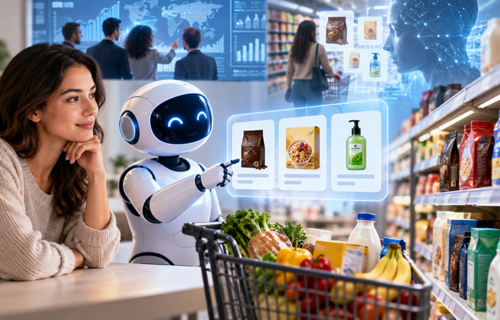
The more disruptive change, however, is occurring on the consumer side. Shopping assistants are moving beyond answering questions towards performing parts of the purchasing process. Consumers can increasingly use AI to research products, compare alternatives, examine prices, assemble shopping carts and automate some routine purchases. As these systems become more capable, people may increasingly delegate parts of product discovery and selection to software.
That development changes the traditional idea of the digital shelf. Until recently, a brand mainly needed to perform well in retailer search results, category pages, advertising placements and conventional search engines. In an agent-mediated environment, the consumer may instead ask for a week’s groceries within a particular budget, a coffee matching certain preferences or a replacement household product offering the best combination of price and quality. The AI assistant then decides which products deserve consideration.
Brands would consequently be competing for algorithmic recommendation as well as human attention. Packaging, imagery and advertising will remain important when consumers make visual choices, but product information will also need to be sufficiently structured, accurate and credible for AI systems to understand. Availability, price, reviews, product attributes, retailer information and external sources could all influence what an assistant chooses to recommend.
This creates an emerging commercial challenge around making products understandable and discoverable by answer engines and shopping agents. The concept remains immature, and brands should be cautious about claims that AI recommendations can simply be manipulated in the same way companies once optimised webpages for search engines. Nevertheless, the direction is significant. If an AI assistant becomes the interface between a consumer and millions of products, being accurately represented by that system becomes commercially important.
Retail media could change alongside it. Advertising has traditionally influenced people while they browse, search or consume media. Agentic commerce raises the question of what advertising means when software is helping make the decision. Retailers and technology platforms will have to determine how sponsored recommendations, organic recommendations, consumer preferences and commercial incentives coexist without undermining trust in the assistant.
For manufacturers, this creates a new competitive dimension. Large consumer-goods groups possess enormous amounts of historical information, established retailer relationships and substantial marketing resources, but they can also carry complicated organisational structures. James argued that this can slow implementation because insights frequently have to travel through multiple departments before action is approved. Smaller brands may have fewer resources but can sometimes respond more quickly, meaning AI does not automatically strengthen the largest companies and could instead reward businesses capable of converting information into action faster.
This helps explain why the organisational side of autonomous intelligence may prove harder than the technology. James described internal experiments in which AI systems improved their ability to answer business questions after receiving repeated feedback from employees. But even an apparently high level of accuracy leaves important questions about the remaining errors, particularly if a system is eventually allowed to take commercial actions without human approval.
Human oversight is therefore likely to remain essential for many decisions. Automatically identifying a sales anomaly is relatively low risk. Changing a product description may carry somewhat more risk. Altering pricing, reallocating substantial advertising budgets, changing assortment or making decisions affecting customers and supply chains can have much larger consequences. The degree of autonomy should therefore depend on the potential impact of the decision rather than on whether the technology is technically capable of executing it.
The transformation may initially be less dramatic than the idea of an autonomous commercial organisation suggests. Instead of removing employees entirely, AI is more likely to compress the time required for analysis. Work that previously required several analysts to collect reports, reconcile data and prepare presentations could increasingly be produced through a conversational interface that alerts different executives to the issues relevant to their responsibilities.
This could eventually reduce corporate dependence on conventional dashboards. A sales executive may not need to open a series of reports every Monday morning if an AI system can identify the most significant changes from the previous week, explain likely causes and suggest which issues deserve investigation. Brand managers, sales teams and senior executives could interact with the same underlying information through different interfaces tailored to their responsibilities.
The economic value comes from speed. Consumer demand can change quickly, competitors can adjust prices or advertising almost immediately and digital availability can fluctuate throughout the day. A company that requires several weeks to understand what happened may be reacting to conditions that have already changed again. Systems capable of reducing that cycle to hours or minutes could provide a meaningful competitive advantage.
But the most consequential development may ultimately take place outside the consumer-goods company itself. If consumers increasingly ask AI assistants to replenish household products, compare alternatives and choose between brands, manufacturers will have less control over the point at which purchasing decisions are made. The traditional battle for shelf space will increasingly be accompanied by a battle for inclusion in the recommendations generated by machines.
That does not mean consumers disappear from the decision. People will continue to have favourite brands, budgets, tastes and values, and they can override recommendations. But AI could increasingly filter the enormous number of choices before a person sees them. In categories involving routine purchases, consumers may eventually delegate much of that filtering altogether.
The implication for Mars, Nestlé, Coca-Cola and thousands of other consumer brands is significant. The next generation of shopper intelligence will not simply be about understanding what people bought yesterday. It will involve understanding how retailer algorithms, advertising systems, consumer preferences and AI shopping assistants interact to determine what gets purchased tomorrow.
Consumer companies have spent generations learning how to win the physical shelf and the past two decades learning how to win the digital shelf. They may now have to master a third environment: the algorithmic shelf. In that market, the brands with the largest advertising budgets will not necessarily have an automatic advantage. Success may increasingly depend on which companies can organise their data, detect changes quickly, make their products understandable to AI systems and respond before competitors recognise that shopper behaviour has changed.
The transition is still at an early stage, and fully autonomous commercial decision-making remains considerably more ambitious than today’s deployments. But agent-assisted shopping is no longer theoretical. As retailers and technology companies give AI systems greater roles in product discovery and purchasing, consumer brands face a strategic question that barely existed a few years ago: when the shopper’s AI starts deciding what deserves to be bought, how does a brand make sure it remains part of the choice?
Source: CIJ.World Research & Analysis Team