Saturday, 24 October 2026
The transformation of Greater Paris is entering a new stage as one of Europe’s largest transport projects moves progressively from construction into operation. After years in which investors could only anticipate the impact of the Grand Paris Express, the expanding network is beginning to provide a clearer indication of which suburban districts could develop into stronger property markets.
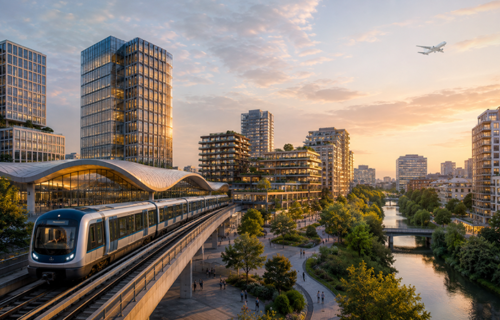
The scale of the programme is substantial. Around 200 kilometres of automated metro infrastructure and dozens of stations are being developed across the metropolitan region, alongside the extension of Line 14. Rather than simply improving journeys into central Paris, much of the new system is designed to connect suburban employment centres, residential districts, airports, universities, hospitals and research clusters directly with one another.
For real estate, that distinction is fundamental. The traditional Greater Paris investment map has been heavily influenced by distance and travel time to the centre. The new network has the potential to make accessibility between suburban economic centres increasingly important, allowing some districts to compete for residents, businesses and investment capital on different terms.
The effect will not occur everywhere at the same time. Grand Paris Express lines are being delivered progressively, with individual sections reaching operation at different points through the remainder of the decade and into the early 2030s. Timetables have also changed during construction, making the actual stage of each station and line more important to investors than earlier projected completion dates.
Saint-Denis Pleyel is already demonstrating what happens when anticipated infrastructure becomes operational. The district has been served by the extended Line 14 since 2024 and is intended ultimately to become one of the largest interchange points on the new network, connecting several metro lines.
Transport investment has arrived alongside extensive redevelopment in and around Saint-Denis, including projects associated with the transformation of former industrial land and the legacy of the 2024 Olympic and Paralympic Games. Housing, offices, public facilities, hotels and mixed-use developments are gradually changing the character of an area that historically sat outside the core institutional property markets of Paris.
For investors, however, the important question is no longer whether Saint-Denis Pleyel will become better connected. That process has already begun. The question is whether improved transport can generate sufficient long-term occupier demand and investment liquidity to support the volume of development taking place around it.
That distinction applies throughout Greater Paris. A metro station can reduce journey times dramatically, but it cannot by itself create a successful property market.
Villejuif provides a good illustration of where transport investment is being combined with an existing economic specialisation. Villejuif–Gustave Roussy is already connected to Line 14 and is intended to become an interchange with Line 15 South. The surrounding district benefits from the presence of the Gustave Roussy cancer treatment and research centre, giving it a substantial healthcare and scientific employment base.
Better accessibility could strengthen demand for more than conventional offices. Laboratories, healthcare-related facilities, residential accommodation, hotels and other property serving employees, patients, researchers and visitors could all benefit as connections across Greater Paris improve.
This makes Villejuif different from locations where developers are relying primarily on infrastructure to create demand. Transport is strengthening access to an economic cluster that already exists.
The Paris-Saclay corridor presents an even larger version of that opportunity. Universities, engineering schools, laboratories, research organisations and technology businesses have been concentrated across the area, creating one of France’s most important centres for science and innovation. Accessibility has nevertheless remained one of its weaknesses.
Line 18 is designed to change that by connecting the Saclay area with Massy and subsequently Orly Airport, with later development extending the route further west. During 2026, the first section has been moving through the testing and commissioning process ahead of passenger services.
The real estate consequences could extend across several sectors. Research facilities and specialist offices may benefit from easier access to the scientific cluster, while student accommodation and residential development could respond to better connections for the large academic population. Hotels and supporting commercial services could also gain from increased movement through the area.
Yet Saclay demonstrates why investors need to separate infrastructure potential from guaranteed property performance. Considerable development has already taken place, and future demand remains dependent on continued expansion of the area’s education, technology and research economy.
A new metro line makes Saclay easier to reach. Whether every development around it becomes more valuable will depend on the quality, location and use of the individual property.
Orly represents another type of transport-led opportunity. The airport has been connected directly with Paris by Line 14 since 2024, substantially changing public transport access to one of the metropolitan area’s largest employment centres. Line 18 will eventually create an additional connection between Orly, Massy and the Saclay corridor.
The implications extend beyond airport passengers. Hotels are an obvious component of the market, but the wider Orly and Rungis area also contains substantial logistics, industrial and commercial activity. For these sectors, metro access is unlikely to replace the importance of motorway connections or proximity to consumers. It can, however, improve access to labour, which has become an increasingly important consideration for logistics and industrial occupiers.
East of Paris, Noisy–Champs represents a different stage of the investment cycle. It is intended to become an interchange between Line 15 South and Line 16, strengthening connections with other parts of the metropolitan region.
The surrounding market contains residential neighbourhoods, university activity and substantial development potential. Its future property proposition may therefore depend more on housing, education and mixed-use regeneration than on becoming another large conventional office district.
Improved suburb-to-suburb connectivity could be particularly significant for residential markets such as this. Workers who previously needed to travel through central Paris to reach employment elsewhere in the metropolitan region could eventually gain much faster direct connections. That could expand the number of residential locations considered practical for people employed in suburban business, healthcare, education and technology centres.
This does not mean housing values near every station will automatically rise. Construction costs, mortgage conditions, planning policy, affordability and the amount of new supply will continue to influence individual markets. Transport is one component of the investment case rather than a substitute for these fundamentals.
Line 15 South could nevertheless become one of the most important changes to the southern and eastern property geography of Greater Paris. The route is intended to connect Pont de Sèvres with Noisy–Champs through a series of established municipalities without requiring passengers to travel through central Paris.
The current programme places its opening in 2027, although Grand Paris Express schedules have changed during the project’s development. Investors assessing sites around future stations therefore need to work from the latest official commissioning programme rather than older development documents.
The eventual effect could be the emergence of a stronger investment corridor running around Paris rather than towards its centre.
There is, however, an important reason to remain cautious about offices. Île-de-France entered the second half of 2026 with approximately 6.5 million square metres of immediately available office space. Leasing activity during the first half remained subdued, while investment capital continued to show a strong preference for the most established Parisian locations and highest-quality buildings.
Against that background, accessibility alone is unlikely to rescue every secondary office market. An older building with significant vacancy, weak environmental performance or expensive refurbishment requirements does not automatically become attractive because a new station opens nearby. Investors still need evidence that occupiers want to locate there and that rents can justify the capital required.
This could make the Grand Paris Express more important for some alternative property sectors than for traditional offices. Healthcare and research property around Villejuif, technology and education-related development around Saclay, hotels and commercial assets around Orly, residential and mixed-use projects around Noisy–Champs and regeneration around Saint-Denis each represent different ways in which transport investment can influence real estate.
Student accommodation may also become increasingly relevant as university campuses become easier to reach. Residential developers could benefit where journey times to major employment clusters are materially reduced, while hotels may gain around airports and large interchanges.
The immediate areas around stations deserve particular attention. Urban planning analysis of Grand Paris Express neighbourhoods frequently considers roughly an 800-metre radius around each station, broadly corresponding to a 10-to-15-minute walk.
For property investors, this provides a useful framework for evaluating where transport accessibility can interact most directly with land use and development. But even within that radius, opportunities can vary considerably. A redevelopment site beside a major interchange has different economics from an ageing office building. Residential land close to a university has a different demand profile from a hotel near an airport. Research space next to an established scientific institution may have considerably stronger fundamentals than speculative offices in a location without a substantial business base.
The Grand Paris Express therefore should not be viewed as a single property investment story. It is creating dozens of individual markets at different stages of development, with different economic drivers and different levels of transport benefit already reflected in property prices.
Some districts have spent years anticipating their new connections. Others are only now reaching the point where trains begin operating and theoretical accessibility improvements become part of everyday commuting. Locations attached to later phases of the network still carry greater delivery and timing risk.
That uneven development may create the most interesting opportunities. Investors who entered the best-known locations years ago were effectively buying the expectation of infrastructure. The next phase will be different. Increasingly, investors will be able to examine actual passenger movements, occupational demand, development activity and transaction evidence to determine whether individual station districts are genuinely becoming stronger property markets.
The eventual winners are unlikely to be determined simply by proximity to a metro entrance. They will be places where transport connects with employment, housing demand, universities, healthcare, development capacity and attractive urban environments.
For decades, central Paris has dominated the investment geography of the metropolitan region. The Grand Paris Express is unlikely to overturn that position. What it can do is make a larger number of suburban districts viable as independent investment markets.
As more of the network opens, the central question for property investors is therefore changing. It is no longer simply where the next station will be built, but which of the places surrounding those stations can turn improved accessibility into lasting real estate demand.
Source: © CIJ.World UK Research & Analysis Team