Tuesday, 20 October 2026
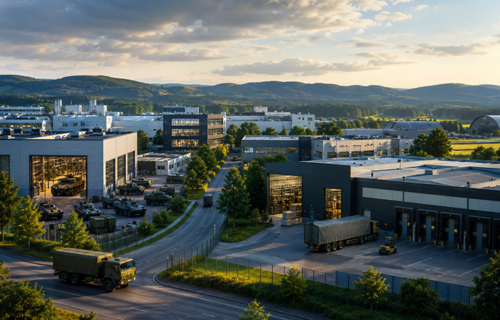
Germany’s rapid expansion of defence spending is beginning to create consequences far beyond military procurement. As manufacturers increase production of vehicles, ammunition, electronics, aerospace systems and other equipment, a parallel requirement is emerging for factories, engineering facilities, secure warehouses, testing locations and supplier capacity. For Germany’s commercial property market, defence could become an increasingly important new source of industrial demand.
The scale of government spending provides the foundation for that shift. Germany has substantially increased its defence budget for 2026 and plans further increases over the coming years as it rebuilds military capabilities and expands domestic and European production capacity. The programme represents a structural change rather than a short-term procurement cycle, potentially giving manufacturers sufficient visibility to invest in additional factories and equipment. That matters for property because military production cannot be expanded indefinitely within existing facilities. Companies can initially increase shifts, reorganise production lines and install additional machinery, but larger and longer-term order books eventually require additional physical capacity.
The German industrial market is beginning to see evidence of this process. During the first half of 2026, industrial and logistics take-up reached around 3 million sq m, approximately 11% higher than a year earlier. Investment in the sector also increased, reaching roughly €3.3 billion. Within that market, defence companies are emerging as an additional source of competition for suitable industrial land.
This demand differs substantially from conventional logistics. A distribution warehouse primarily requires road access, loading capacity and an efficient building. Defence manufacturing can involve far more specialised requirements, including substantial electricity supply, controlled access, perimeter security, reinforced structures, engineering facilities and secure digital infrastructure. Certain production activities require even more specialised locations. Ammunition manufacturing, explosives storage and weapons testing can require extensive safety zones, environmental approvals and separation from residential areas. These requirements significantly reduce the number of sites capable of accommodating some forms of defence production.
Germany’s existing manufacturing geography therefore provides an important advantage. The country already contains major concentrations of aerospace, automotive, mechanical engineering, electronics and precision manufacturing. These regions offer not only industrial buildings but also something considerably harder to create from scratch: skilled workers, engineering expertise, established suppliers and transport infrastructure.
Bavaria is particularly well positioned because of its combination of aerospace, electronics, automotive and defence industries. Baden-Württemberg provides another deep engineering and supplier base. Northern Germany combines aerospace, shipbuilding and military manufacturing, while Lower Saxony contains important industrial and defence production locations. North Rhine-Westphalia also has a large industrial workforce and established defence businesses, while the Kassel area has long been associated with military vehicle manufacturing. As major contractors increase production, these established clusters could attract further suppliers, logistics companies and engineering businesses.
The relationship between Germany’s automotive restructuring and defence expansion may become particularly important. Parts of the German automotive industry are reducing capacity and reconsidering manufacturing footprints at the same time that defence companies need additional production space. This creates the possibility that factories originally built for cars and automotive components could find new uses within the defence supply chain.
The Volkswagen plant in Osnabrück became one of the clearest examples during the second quarter of 2026. Discussions involving Israeli defence company Rafael demonstrated that an established automotive manufacturing site could be considered for defence-related production. Regardless of the final outcome at that particular facility, the case illustrates a much broader property opportunity.
Automotive factories already possess characteristics that would take years and substantial capital to reproduce on greenfield sites. They typically have significant power connections, large production halls, loading infrastructure, road and rail connections, extensive land and access to skilled industrial labour. For defence manufacturers facing pressure to increase production rapidly, acquiring or adapting an existing manufacturing facility can therefore offer advantages over developing an entirely new factory. This could give some ageing or surplus German industrial properties an unexpected second life.
The opportunity is particularly interesting because defence manufacturers do not necessarily follow the same location priorities as logistics operators. A distribution company generally values motorway access and proximity to large consumer markets. A defence manufacturer may place considerably greater importance on engineering labour, existing suppliers, secure land and proximity to testing or military infrastructure.
As a result, locations considered secondary by conventional logistics investors could become strategically valuable to defence companies. This could change industrial property values in selected regional markets. A former manufacturing site outside Germany’s largest logistics corridors might have limited appeal as a conventional warehouse development but become highly attractive if it sits within an established engineering cluster and can accommodate secure production.
Large defence investments can also create secondary property demand. When a major manufacturer expands a factory, suppliers frequently have an incentive to locate nearby. Precision engineering businesses, electronics companies, component manufacturers, software specialists, maintenance providers and logistics operators can all require additional premises around an anchor facility. The resulting clusters could create demand for smaller factories, industrial parks, research buildings and warehouses extending well beyond the property occupied by the main defence contractor.
This multiplier effect could prove more accessible to commercial real estate investors than the largest weapons-production facilities themselves. Many strategically important defence factories are likely to remain owner-occupied. Manufacturers may prefer direct control over properties containing sensitive production processes, specialist machinery and security infrastructure. The wider supply chain presents a different opportunity.
Secure warehouses, engineering buildings, component factories, maintenance facilities and conventional logistics properties supporting defence manufacturers may be capable of institutional ownership. If the underlying buildings retain alternative industrial uses, they could potentially offer investors long leases without assuming the full redevelopment risk associated with highly specialised military facilities.
Sale-and-leaseback transactions could also emerge as manufacturers expand. Companies receiving substantial new orders may prefer to direct capital toward machinery, technology and production capacity rather than owning all of their property. Selling a facility to a property investor and leasing it back could release capital while allowing the manufacturer to continue operating from the same location. For investors, long leases to financially strong industrial occupiers could create an attractive income profile, provided the building remains suitable for alternative uses.
Germany’s defence expansion is also arriving at a time when competition for industrial land is already intense. Logistics companies, data centre developers and advanced manufacturers are competing for sites with sufficient electricity, transport connections and planning certainty. Defence businesses now add another source of demand to that equation.
This competition could become particularly visible around major metropolitan and industrial regions where suitable development land is already scarce. Industrial land with strong power capacity and appropriate planning status may consequently become increasingly valuable. However, the emerging defence-property opportunity should not be treated as a conventional logistics growth story.
Defence procurement remains dependent on government budgets, political decisions and individual programmes. Contracts can be delayed or redesigned, while planning requirements for certain facilities can be lengthy and complex. Highly specialised buildings also carry greater residual-value risk. A conventional warehouse can normally be occupied by numerous logistics businesses. A factory specifically designed for ammunition or military systems may have a much smaller group of potential future users.
This means investors will need to distinguish carefully between property benefiting from defence-sector growth and property that becomes permanently dependent on a single defence programme. The strongest opportunities may therefore lie in buildings that combine defence demand with broader industrial flexibility.
An engineering facility capable of supporting aerospace, automotive or defence businesses offers considerably more alternative-use potential than a highly specialised weapons plant. The same applies to warehouses, component factories and research facilities that can serve multiple advanced-manufacturing industries.
There is another reason why the property impact could become significant. Germany is attempting to increase defence production while much of its traditional manufacturing economy remains under pressure. Defence investment could therefore absorb some industrial capacity, labour and property released by sectors undergoing restructuring.
Rather than constructing every new facility from the ground up, manufacturers may increasingly look at existing industrial estates, former automotive plants and underused production locations. This could create a new redevelopment strategy for industrial investors. Properties previously considered obsolete because they were too manufacturing-specific for modern logistics could regain relevance if they provide the heavy infrastructure required by defence and advanced manufacturing.
The geographic impact is unlikely to be evenly distributed across Germany. Regions already containing major defence contractors, aerospace companies, automotive engineering, military installations or specialist suppliers should have an advantage. Once expansion begins in those locations, clustering effects can reinforce their position. Suppliers follow customers, engineering talent concentrates around employers and local authorities gain experience dealing with specialised industrial requirements.
Over time, this could produce identifiable defence-oriented manufacturing corridors and industrial clusters. For the property industry, the most important development is that defence is beginning to move from being primarily a government spending story to becoming a physical-capacity story.
Germany can approve larger military budgets relatively quickly. Creating the factories, testing facilities, warehouses and supplier networks required to turn those budgets into equipment takes considerably longer. That gap creates opportunities for developers, landowners, municipalities and investors capable of providing suitable industrial capacity.
The eventual property market may not develop into a clearly defined defence real estate sector. Much of the demand will overlap with existing industrial, logistics, research and advanced-manufacturing property. Nevertheless, the underlying occupier base is changing.
Germany’s industrial property market has traditionally been shaped by automotive manufacturing, engineering, logistics and increasingly data centres and technology. Defence companies are now joining the competition for land, infrastructure and skilled manufacturing locations. The most valuable opportunities may consequently appear where these industries intersect.
Former automotive factories could become defence production sites. Aerospace clusters could attract military technology companies. Existing industrial parks could accommodate suppliers. Secure warehouses could serve expanding manufacturers, while engineering campuses could support research into drones, electronics, communications and other defence technologies.
For investors, the key question is therefore not simply how much Germany intends to spend on defence. The more important property question is where the physical infrastructure required to deliver that expansion will be located.
Germany’s military investment programme will ultimately require considerably more than equipment orders. It will require buildings, land, electricity, transport connections, skilled workers and secure industrial environments. As those requirements become clearer, defence could emerge as one of the most important new sources of specialised industrial property demand in Germany, and potentially provide a new purpose for manufacturing locations that only a few years ago appeared to be facing structural decline.
Source: CIJ.World Research & Analysis Team