Wednesday, 21 October 2026
Africa’s expanding ports are beginning to reshape the continent’s industrial real estate market, but the most important property opportunities are not necessarily appearing directly beside the water. As new terminals increase capacity and transport connections improve, investment is spreading outward into industrial zones, warehouses, manufacturing facilities, logistics parks and inland freight hubs positioned along the routes connecting ports with major cities and regional markets. This is changing how investors should assess port-led development. A larger terminal does not automatically translate into higher surrounding property values. The more important question is what happens to cargo after it leaves the port. Where efficient roads, railways, serviced industrial land and reliable utilities are available, freight volumes can support substantial clusters of logistics and manufacturing property. Where those connections remain weak, even major port investment may have a limited impact on the wider real estate market.
Tanger Med provides perhaps the strongest African example of how far the relationship between maritime infrastructure and industrial property can develop. The port has become the anchor for a much larger economic system around Tangier, with an industrial platform extending across approximately 3,000 hectares and accommodating around 1,500 companies supporting more than 145,000 jobs. The significance for real estate lies in the depth of activity surrounding the port. Automotive manufacturing, components, electronics, logistics and other industries have created demand for factories, warehouses, distribution facilities and industrial land. Rather than functioning as an isolated cargo terminal, Tanger Med has helped establish a manufacturing ecosystem connected directly with international shipping routes and European markets. The greatest value has therefore come not simply from moving more containers through the port but from attracting businesses that manufacture, assemble, store and distribute goods within the surrounding region. Each additional occupier strengthens the case for suppliers, logistics companies and further industrial development.
Nigeria is attempting to create a comparable port-industrial relationship around Lekki. Lekki Deep Sea Port has changed the long-term logistics geography of Lagos by establishing major new maritime capacity east of the traditional port districts. Its importance to property investment is amplified by its relationship with Lagos Free Zone and the wider industrial development taking place along the Lekki axis. Lagos Free Zone covers roughly 860 hectares and already contains manufacturers from consumer goods, food, chemicals and other industries. The development provides serviced industrial land alongside completed warehouses and factory accommodation, while its proximity to the deep-sea port allows occupiers to position production and distribution facilities close to maritime infrastructure.
International institutional capital is also participating in the development. IFC committed up to US$50 million to support further expansion of Lagos Free Zone, including industrial infrastructure and serviced development land. This is particularly significant for the property market because investment is being directed not simply towards individual manufacturing businesses but towards the physical platform on which those occupiers operate. The next stage will determine whether Lekki develops into a deeper institutional industrial market. Owner-occupied factories and individual logistics facilities can establish the initial cluster, but a mature property market requires a larger supply of leasable warehouses, build-to-suit facilities and investment assets capable of being traded between institutional owners. Land immediately surrounding the port may not capture all of that growth. As the Lekki corridor becomes more developed and congested, logistics operators may increasingly look for larger and less expensive sites farther inland while maintaining efficient connections to the terminal. The property opportunity could therefore spread across a considerably wider geography than the port itself.
South Africa presents a different model because it already has the continent’s most developed institutional logistics-property market. Durban is one of Africa’s most important container gateways, while Richards Bay plays a major role in bulk commodities and industrial trade. The property implications extend far beyond the waterfront. Durban’s industrial geography is shaped by warehouses, distribution centres, manufacturing properties and logistics facilities positioned around major transport routes connecting the port with KwaZulu-Natal and eventually Gauteng. For institutional investors, the question is therefore less about whether port activity creates industrial property demand and more about which locations benefit most from changing freight patterns.
Port congestion can alter that geography. When access roads become unreliable or land around terminals becomes constrained, logistics companies have an incentive to position facilities farther inland. Modern distribution networks do not always need warehouses beside the docks. They need sites where trucks can move efficiently, large buildings can be developed economically and cargo can connect with national transport networks. This helps explain why road junctions, inland freight terminals and established logistics precincts can become more valuable than land immediately surrounding a port. The relationship between Durban and Gauteng illustrates the point particularly well. Much of the cargo arriving at the coast ultimately serves businesses and consumers hundreds of kilometres inland, meaning the entire freight corridor influences industrial property demand.
Mombasa provides a similar example in East Africa. Its significance extends well beyond Kenya because the port serves the Northern Corridor linking the coast with Nairobi, Uganda, Rwanda, eastern Democratic Republic of Congo and other inland markets. For real estate investors, the opportunity therefore needs to be viewed across the corridor rather than only around Mombasa. Port-related warehouses and container facilities remain important at the coast, but additional logistics demand can emerge around highway intersections, railway connections, inland container facilities and industrial areas closer to Nairobi.
Naivasha and other inland logistics locations could become increasingly relevant as Kenya’s transport infrastructure develops. Moving freight handling away from congested coastal areas can free port capacity while creating new industrial development locations inland. The same pattern could eventually strengthen Nairobi’s position as an East African distribution centre. Companies importing goods through Mombasa do not necessarily need their principal warehouses at the coast if most customers are located in Nairobi or farther inland. Large regional distribution centres may be more efficient when positioned closer to the final market while remaining connected to the port by rail and road.
Tema provides another important West African case study. Ghana’s principal port already sits within one of the country’s most established industrial areas, creating a combination of maritime trade, manufacturing and logistics activity. Port investment has increased Tema’s cargo-handling capability, while the surrounding industrial geography includes warehouses, factories, distribution facilities and established industrial estates. This gives Ghana an important foundation from which to develop a deeper institutional logistics market.
The challenge is the quality and ownership structure of existing stock. Much of Africa’s industrial property remains fragmented or owner occupied. International logistics investors generally require larger, modern warehouses with clear ownership, reliable utilities, professional management and occupiers capable of signing longer leases. Tema’s future property opportunity may therefore come as much from replacing and modernising existing stock as from expanding the amount of industrial land. Developers capable of delivering modern logistics facilities close to the port and Accra consumer market could benefit as occupier requirements become more sophisticated.
Djibouti represents a particularly unusual port-property relationship because its importance is driven heavily by another country’s trade. Landlocked Ethiopia relies extensively on Djibouti for maritime access, making the ports and transport connections between the two countries strategically important. This has supported the development of free zones, logistics facilities, warehouses and transport infrastructure around Djibouti. The railway connection with Ethiopia strengthens the country’s role as a gateway rather than simply a local port market.
For property investors, however, Djibouti demonstrates why cargo volumes alone are not sufficient to create a broad real estate market. Transit trade can support logistics facilities and specialised industrial property, but the relatively small domestic economy limits demand for some other commercial uses. The investment opportunity is therefore concentrated around assets directly connected with trade, including warehousing, storage, industrial processing and logistics infrastructure. This makes Djibouti a specialist property market rather than a conventional large-city industrial market.
Egypt offers perhaps the largest potential port-linked development system on the continent. Rather than relying on one gateway, the Suez Canal corridor connects ports, industrial zones and manufacturing locations along one of the world’s most important shipping routes. Sokhna is particularly important because maritime infrastructure is being combined with industrial development through the wider Suez Canal Economic Zone. Manufacturing projects, logistics facilities, industrial land and increasingly ready-built factories are creating a property market that extends beyond traditional port operations.
Qantara West and other parts of the economic zone are attracting substantial manufacturing commitments, although investment announcements must be distinguished carefully from completed and occupied industrial buildings. Dozens of projects have been contracted, but not all represent operational factories. The move towards ready-built industrial accommodation is especially relevant to commercial real estate investors. Programmes announced during 2026 include substantial amounts of factory and storage space intended for occupiers that prefer leasing completed facilities rather than acquiring land and developing independently. If this model expands, the Suez Canal Economic Zone could gradually create a more recognisable institutional industrial property market. Developers would own income-producing buildings occupied by manufacturers and logistics companies, rather than relying primarily on land allocation.
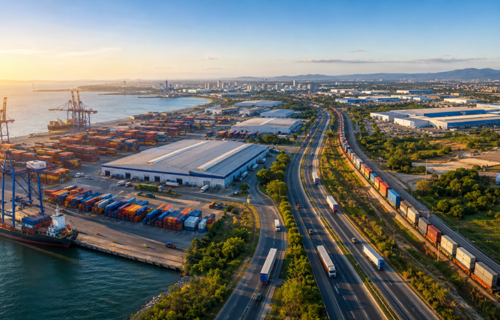
Across these African gateways, a common pattern is beginning to emerge. Ports provide the initial infrastructure, but property value is created through the network that develops around the movement of goods. The first layer consists of facilities that must remain close to the waterfront, including container handling, customs areas, storage yards and specialised maritime logistics. The second develops around nearby industrial and economic zones, where manufacturers benefit from direct access to imported materials and export routes. These locations create demand for factories, warehouses, cold storage and supplier facilities. A third layer can emerge farther inland. Distribution centres, logistics parks, dry ports and manufacturing facilities frequently require larger sites and better motorway access than congested waterfront areas can provide. Their optimal location may therefore be tens or even hundreds of kilometres from the port.
This is where Africa’s improving transport corridors become particularly important. The Northern Corridor from Mombasa, the routes connecting Durban with Gauteng and the logistics systems developing around Lekki and Tangier demonstrate that port-related property should increasingly be analysed as a network rather than a single location. This also changes the investment case for land. It is tempting to assume that property closest to an expanding port will automatically appreciate most rapidly. In practice, heavy truck movements, congestion, environmental restrictions and incompatible land uses can make immediate port surroundings difficult development locations.
The strongest sites may instead be those positioned at the intersection of several forms of infrastructure: a motorway interchange, railway terminal, industrial zone and reliable electricity network. Such locations can provide access to the port while avoiding many of the operational disadvantages of waterfront land. Special economic zones can accelerate this process where they provide functioning infrastructure rather than simply regulatory incentives. Tanger Med’s industrial zones, Lagos Free Zone and the Suez Canal Economic Zone demonstrate different versions of the same strategy: combine trade infrastructure with serviced land and create locations where manufacturers can establish operations more easily.
Institutional property capital is likely to follow only when those locations develop sufficient occupier depth. A logistics park containing several multinational tenants on long leases represents a fundamentally different investment proposition from industrial land waiting for future development. The first can produce measurable income and potentially be sold to another institutional investor. The second remains primarily a development or land-value proposition. This distinction will determine which African port markets attract international logistics-property investors at scale.
Tanger Med is already a mature industrial ecosystem. Durban sits within an established institutional logistics market. Lekki is rapidly developing a port-linked manufacturing platform with international capital participation. Mombasa’s opportunity extends increasingly along the Northern Corridor, while Tema has the potential to modernise an established industrial base. Djibouti remains a specialised gateway serving regional transit trade, and Egypt’s Suez corridor offers enormous development scale but still contains a substantial pipeline that has yet to become completed, income-producing property.
Africa’s ports are therefore becoming increasingly important to commercial real estate, but not simply because more cargo increases demand for buildings beside the docks. The larger opportunity lies in the geography created as goods move away from the waterfront. Ports establish the international gateway, railways and highways determine how efficiently cargo travels inland, special economic zones and industrial parks provide locations where goods can be manufactured and processed, while warehouses and distribution centres connect those products with businesses and consumers.
Africa’s port investment is consequently beginning to redraw the continent’s industrial property map. The most valuable locations may not always have a view of the harbour. They may instead be the logistics parks, manufacturing clusters and inland freight hubs positioned farther along the route, where maritime trade is ultimately converted into occupier demand, rental income and investible real estate.
Source: © CIJ.World Africa Research & Analysis Team