Friday, 23 October 2026
Japan’s waterfronts are entering another stage of transformation as cities reconsider how valuable land surrounding their ports can contribute to future urban growth. Areas once dominated by shipyards, cargo handling and industrial infrastructure are increasingly accommodating offices, hotels, homes, retail, entertainment, cultural facilities and public spaces.
The transition is particularly visible in Yokohama, Tokyo and Kobe, where decades of port restructuring have created opportunities to introduce new uses to strategically located waterfront land. Rather than abandoning their maritime economies, these cities have increasingly separated modern logistics operations from areas capable of supporting higher-value urban development.
This distinction is important for real estate. Container terminals and other large-scale port operations require extensive land, efficient road connections and facilities capable of handling increasingly large vessels. Older inner-harbour sites do not always provide the most efficient environment for these activities, particularly when they sit immediately beside established city centres.
Moving or reorganising some of these functions can release unusually large development sites in locations where comparable land would otherwise be extremely difficult to assemble.
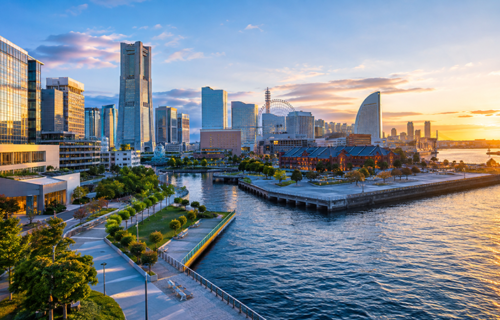
Yokohama’s Minato Mirai 21 provides one of Japan’s most established examples of this process. Development of the approximately 186-hectare waterfront district began in the early 1980s on land previously associated with shipbuilding, freight and other port-related activities.
The objective went considerably further than redeveloping an obsolete industrial site. Yokohama used the project to connect previously separated sections of its central area while creating a new commercial and business district capable of strengthening the city’s economic position within Greater Tokyo.
Over subsequent decades, offices, hotels, residential towers, shopping destinations, cultural venues, convention facilities and public spaces were introduced alongside major transport improvements. Today, Minato Mirai functions as an extension of central Yokohama rather than a peripheral waterfront development.
Almost all of the planned development area has now been completed, is under construction or has been allocated for future use, demonstrating the extraordinary time horizon involved in regeneration at this scale.
For the property industry, Minato Mirai shows how infrastructure and public investment can transform the economics of former industrial land. New railway connections, roads, pedestrian routes and public spaces helped create the conditions for private commercial development, while the waterfront itself became part of the area’s attraction to businesses, residents and visitors.
Tokyo provides a different example because of the enormous scale of land created around its port.
Since the 1960s, approximately 2,766 hectares have been reclaimed within the Port of Tokyo. The land has accommodated a wide variety of uses, ranging from container terminals and essential infrastructure to parks, housing and commercial development.
Within this much larger reclaimed area, Tokyo Waterfront City covers approximately 442 hectares and demonstrates how newly created land can be incorporated into the wider metropolitan economy.
Districts including Odaiba, Ariake and Aomi have developed into locations for exhibitions, hotels, entertainment, offices, retail and residential uses while remaining closely connected with port and infrastructure functions elsewhere along Tokyo Bay.
The result is not a conventional redevelopment model in which industrial activity disappears entirely. Instead, Tokyo demonstrates how a working port and large-scale urban development can coexist by allocating different sections of the waterfront according to their most appropriate economic function.
This ability to create substantial new urban districts is particularly valuable in a city where large central development sites are scarce. As demand for modern commercial and residential property changes, reclaimed waterfront locations provide Tokyo with development capacity that would be extremely difficult to generate within established neighbourhoods.
Kobe is now offering another version of the same wider transformation.
The city’s identity has always been closely connected with its port, but changes in container shipping gradually altered the geography of freight activity. Modern cargo operations increasingly concentrated around Port Island and Rokko Island, allowing parts of the older waterfront closer to central Kobe to take on new roles.
Regeneration has gathered momentum over the past decade, with the city now planning another significant phase of development through its latest waterfront strategy.
The programme looks toward approximately 2040 and places greater emphasis on connecting the harbour with central Kobe, improving pedestrian movement, expanding green and public spaces and encouraging more activity after normal business hours. Private investment is expected to play an important role in introducing new commercial, leisure and tourism uses.
This creates opportunities across several property sectors.
Hotels can benefit from tourism and waterfront locations, while restaurants, entertainment venues and cultural facilities can extend the amount of time visitors spend in the area. Residential development can take advantage of attractive surroundings and proximity to the city centre, while carefully positioned offices can appeal to companies seeking locations outside traditional corporate districts.
The attraction of waterfront regeneration is also closely connected with scarcity. Large development sites close to established city centres are difficult to find in Japan, particularly in metropolitan markets where land ownership is highly fragmented.
Former industrial and port sites can provide something different: sufficient scale to create complete neighbourhoods rather than individual buildings.
That allows planners and developers to coordinate offices, housing, hospitality, leisure and public infrastructure from the beginning. It also creates opportunities to introduce parks, pedestrian routes and waterfront access that can increase the attractiveness of surrounding private development.
However, converting port land into urban property is neither simple nor inexpensive.
Waterfront sites require substantial infrastructure investment and careful management of environmental and natural-hazard risks. Flooding, storm surges, earthquakes and ground conditions can influence construction costs and development design. Former industrial locations may also require remediation before new uses can be introduced.
There can also be tension between property development and the continuing economic role of ports. Japan remains heavily dependent on maritime trade, meaning commercially attractive waterfront redevelopment cannot simply displace strategically important logistics infrastructure.
The strongest projects therefore depend on finding a balance.
Modern freight operations need to remain in locations capable of handling future logistics requirements, while older sites that are no longer essential to those operations can be opened to alternative investment.
This is what makes Japan’s waterfront story particularly relevant to real estate investors. The opportunity is not simply created by proximity to water. Value emerges when changes to infrastructure allow land to move from a relatively restricted industrial function toward a broader range of economically productive uses.
The process can take decades, as Yokohama demonstrates, but successful waterfront regeneration can permanently alter the investment geography of a city.
Tokyo continues to use reclaimed land to accommodate functions that would be difficult to deliver elsewhere. Kobe is entering another phase of harbour regeneration designed to attract private capital and reconnect the city with its waterfront. Yokohama provides evidence of what can ultimately be achieved when infrastructure, planning and commercial development are coordinated over the long term.
Together, the three cities demonstrate how Japan is gradually extracting greater urban value from one of its most important geographical assets.
The country’s ports will remain essential gateways for trade, but the land surrounding them is increasingly capable of serving a much wider purpose. As logistics infrastructure modernises and cities search for new development capacity, Japan’s waterfronts are becoming not only places of movement and commerce, but some of the country’s most significant long-term real estate opportunities.
Source: © CIJ.World Japan Research & Analysis Team