Monday, 19 October 2026
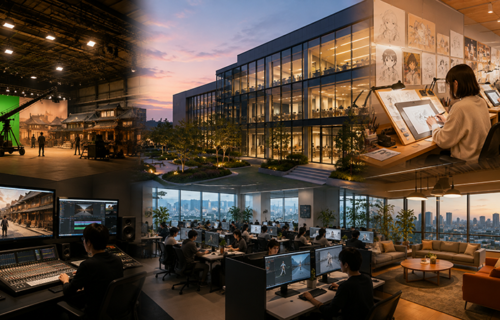
Japan’s global influence in animation, gaming and film is increasingly developing a physical property dimension. As the country seeks to expand its creative industries internationally, companies need more sophisticated places to produce, develop and commercialise content. Studios, digital workplaces, post-production facilities and dedicated creative campuses are consequently becoming a small but increasingly relevant part of Japan’s commercial real estate landscape.
The opportunity is being strengthened by government ambitions to turn Japanese entertainment and intellectual property into a considerably larger export industry. Animation, games, film and other forms of content are increasingly viewed as areas where Japan can use its established creative reputation to generate economic growth overseas. Expanding these industries, however, requires investment not only in people and technology but also in the buildings and technical infrastructure where production takes place.
Film and television demonstrate this relationship particularly clearly. Japan has introduced substantial financial incentives to encourage qualifying international productions to carry out filming and post-production work in the country. Greater production activity can translate directly into demand for sound stages, production offices, editing facilities, equipment storage and other specialist space.
Large film campuses illustrate how different these properties are from conventional offices. TOHO Studios in Tokyo occupies approximately 78,000 sqm and includes ten sound stages alongside production, post-production and supporting facilities. Such campuses require substantial amounts of land, specialist construction and technical infrastructure, making them a distinct form of commercial property.
If Japan succeeds in attracting more domestic and international screen production, utilisation of existing studios should increase while additional investment could become necessary in both production and post-production capacity. This could also benefit supporting businesses located around established production centres, from equipment companies and digital specialists to logistics and technical services.
Gaming creates a different property requirement. Japan remains one of the most influential countries in the global games industry, but contemporary game development increasingly resembles a combination of software engineering, entertainment production and digital design.
Large development teams can bring together programmers, artists, sound specialists, designers and other technical employees. Their requirements are consequently closer to those of technology companies than traditional media businesses, creating demand for well-connected offices with strong digital infrastructure and flexible environments capable of accommodating collaborative production.
Competition for talent makes location particularly important. Tokyo’s high-quality office market has become increasingly tight, meaning gaming and other creative businesses compete with technology companies and conventional corporate occupiers for suitable premises. Convenient rail access and proximity to established employment and entertainment districts can therefore become important elements of a company’s ability to recruit and retain specialist employees.
Animation provides perhaps the clearest indication that Japan’s creative property requirements are beginning to change.
The industry has traditionally operated through a fragmented network of studios and subcontractors, many occupying comparatively modest premises. As Japanese animation generates greater international commercial value, larger media companies have stronger incentives to improve working environments, consolidate production functions and create facilities capable of supporting larger teams.
KADOKAWA’s Studio One Base in Tokyo demonstrates this transition. Scheduled to begin operating in autumn 2026, the approximately 4,628 sqm facility in Ikebukuro is expected to bring several animation businesses and related functions together under one roof, accommodating around 400 employees.
The significance for real estate extends beyond the size of the project. Consolidating production teams within a purpose-designed environment can allow companies to share facilities, improve communication between departments and create better working conditions for employees.
Its location also demonstrates the importance of creative clustering. Ikebukuro already has strong links with anime, manga, entertainment and character-based retail. Bringing production companies into districts where related businesses, consumers and creative talent are already concentrated can reinforce local economic ecosystems.
Similar clustering has long been visible in technology and life sciences, where businesses benefit from proximity to specialist employees, suppliers and research institutions. Creative industries can generate comparable effects, although the buildings they occupy may range from conventional offices to highly specialised production facilities.
This diversity is important for property investors. Creative real estate should not be regarded as one uniform investment sector.
Film studios can require large sites, high ceilings, acoustic treatment and expensive technical infrastructure. Animation businesses may occupy adapted offices or purpose-built creative campuses, while gaming companies are more likely to compete within the wider market for high-quality digital workplaces.
The investment opportunity therefore lies in understanding individual occupier requirements rather than simply attaching a creative-industry label to conventional property.
Tokyo’s rising office costs could also influence where the next generation of creative businesses chooses to locate. Companies requiring substantial floor space may find it increasingly difficult to justify the most expensive central districts, particularly when their employees do not need to be located alongside traditional corporate headquarters.
Well-connected districts outside Tokyo’s conventional business core could consequently benefit. Locations offering strong public transport, comparatively affordable premises and existing cultural or technology clusters may become increasingly attractive to growing creative companies.
Government ambitions add a longer-term dimension to this trend. Japan wants overseas revenues generated by its content industries to increase substantially over the coming decade. Achieving that objective will require greater production capacity alongside improvements in international distribution and commercialisation.
That creates a straightforward property implication. More content production requires places in which that content can be created.
The result is unlikely to be a wave of investment comparable with Japan’s logistics or residential sectors. Creative property is more specialised, individual occupiers have very different requirements and many facilities may continue to be developed or controlled directly by media companies.
Nevertheless, the sector represents an interesting extension of Japan’s commercial property market. Purpose-built studios, creative campuses and specialised offices can become increasingly valuable infrastructure as entertainment companies expand their international businesses.
Japan has spent decades exporting some of the world’s most recognisable games, characters, films and animation. The next stage of that growth will depend partly on something considerably less visible to global audiences: the physical infrastructure behind the content.
As Japan turns its creative industries into a larger component of its economic strategy, the studios, offices and production hubs where those ideas are transformed into commercial products could become an increasingly important niche within the country’s real estate market.
Source: © CIJ.World Japan Research & Analysis Team