Tuesday, 20 October 2026
India’s logistics property market is moving into a new phase in which the environmental performance of a warehouse is becoming increasingly important to occupiers, developers and institutional investors. The rapid expansion of e-commerce, organised retail, manufacturing, third-party logistics and rapid-delivery networks has already transformed warehousing from a largely fragmented property sector into one of India’s important institutional real-estate markets. Sustainability is now becoming part of that transformation.
Modern occupiers increasingly expect warehouses to consume less electricity and water, provide access to renewable energy and operate more efficiently. For developers, this is changing the specifications required to compete for major corporate tenants.
India’s Grade-A warehouse stock across its principal markets increased from approximately 88 million sq. ft. in 2019 to around 238 million sq. ft. by the end of 2024. Institutional-quality property expanded particularly quickly, increasing from approximately 28 million sq. ft. to around 90 million sq. ft. during the same period.
Environmental standards are increasingly concentrated within this higher-quality segment. Approximately 65 million sq. ft. of institutional warehouse stock was already certified or progressing towards certification by 2024, and sustainable logistics space could approach 270 million sq. ft. by 2030 if current development trends continue.
The growth raises an important commercial question for property owners: will tenants actually pay higher rents for greener warehouses? Current evidence suggests that there is no simple national premium. Large occupiers increasingly favour environmentally efficient buildings, but there is insufficient evidence to conclude that a warehouse automatically commands a specific increase in rent simply because it has obtained environmental certification.
The financial argument is instead becoming centred on the overall cost of occupying the property. A more efficient warehouse can consume less electricity and water while potentially generating part of its own energy through rooftop solar. For a major occupier leasing hundreds of thousands of square feet, those savings can become significant over the duration of the lease.
This means a tenant may be prepared to accept a somewhat higher headline rent where the building delivers sufficiently lower operating expenditure, but the decision is based on economics rather than environmental branding alone. Modern green warehouse design can potentially reduce energy consumption by approximately 20–30% and potable water requirements by around 30–40%, although actual savings depend on the building, equipment and nature of its operations.
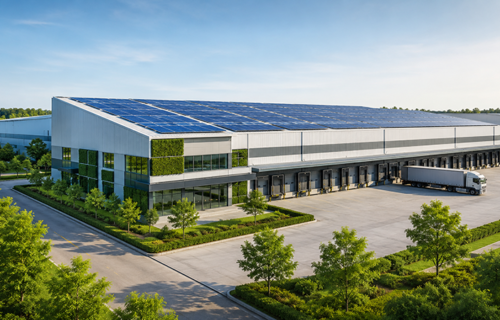
Warehouses are particularly well suited to solar power because their large roofs can accommodate extensive photovoltaic installations without requiring additional land. For energy-intensive logistics and manufacturing occupiers, electricity generated at the property can become a meaningful consideration when selecting between competing facilities.
This is particularly relevant in India, where corporate tenants are becoming more interested in securing renewable electricity for their operations. Recent occupier research indicates that more than half of surveyed logistics companies regard access to renewable energy at the property as an important sustainability consideration.
The shift is being reinforced by corporate environmental commitments. Large international retailers, manufacturers, technology companies and logistics operators increasingly measure emissions throughout their operations and supply chains. Warehouses form part of that footprint.
Companies attempting to reduce their environmental impact cannot concentrate exclusively on offices while overlooking distribution centres and industrial facilities that may consume considerably more electricity. This is gradually changing the relationship between sustainability and building quality.
Several years ago, environmental certification could be promoted as an additional feature differentiating one warehouse from another. For many large occupiers, efficient energy use, renewable power and modern environmental specifications are increasingly becoming expected components of institutional Grade-A property.
That change could eventually make the idea of a separate green premium less relevant. Instead of environmentally efficient warehouses commanding significantly higher rents, older and less efficient properties could increasingly suffer a competitive disadvantage.
The distinction is important for investors. A modern sustainable warehouse may not necessarily generate substantially more rent today, but it could be easier to lease, retain tenants for longer and remain competitive as environmental standards become more demanding. An older building may require substantial capital expenditure to achieve the same performance.
The financial consequences of sustainability therefore extend well beyond the initial rental agreement. Lower operating expenditure, reduced vacancy risk, stronger tenant demand, longer economic life and lower future refurbishment requirements can all contribute to investment returns.
Institutional investors are particularly sensitive to these factors because warehouses are acquired as long-term income-producing assets. A logistics property developed today could remain operational for several decades. During that period, electricity prices, building standards, environmental regulation and corporate procurement requirements are likely to change considerably.
Buildings developed only to minimum present-day specifications could consequently become less attractive before reaching the end of their physical life. This creates the possibility of environmental obsolescence becoming an increasingly important investment risk.
India has not yet developed sufficient transaction evidence to calculate a consistent discount for inefficient logistics property, but the direction of travel is becoming clearer. The country’s institutional logistics developers are increasingly incorporating sustainability into new projects from the design stage.
This approach can be more economical than retrofitting existing warehouses later. Building orientation, insulation, natural lighting, efficient electrical systems, rainwater collection, wastewater treatment and rooftop solar can all be incorporated during development. Green features can therefore improve operating performance without necessarily transforming the property into an expensive specialist building.
The continuing expansion of India’s logistics market provides developers with an opportunity to introduce these standards across a large volume of new supply. Industrial and warehousing leasing remained strong through 2025 and the first half of 2026, supported by demand from third-party logistics companies, manufacturers, automotive businesses, engineering companies, retailers and e-commerce operators.
Modern Grade-A stock across India’s leading markets has reached approximately 300 million sq. ft. under current industry measurements and is expected to continue expanding substantially towards 2030. As this new stock is delivered, competition between developers is increasingly likely to be determined by building quality rather than simply available floor area.
Location will nevertheless remain fundamental. A highly sustainable warehouse situated far from major highways, consumers, manufacturing clusters or labour pools will not necessarily outperform a less environmentally advanced building in a strategically superior location. Logistics occupiers ultimately make property decisions according to the efficiency of their supply chains.
Sustainability therefore needs to complement traditional property fundamentals rather than replace them. The strongest buildings will combine transport connectivity, modern technical specifications, appropriate labour availability and lower operating costs.
Different occupier groups are also likely to place different values on environmental performance. Multinational companies, major Indian corporations, export-oriented manufacturers and institutional logistics operators generally face greater reporting and environmental requirements than smaller local businesses. These companies are therefore likely to drive demand for sustainable warehouses first.
Smaller occupiers may remain more sensitive to headline rent, particularly where utility consumption represents a relatively small proportion of their total costs. India could consequently develop a two-tier market in which environmental performance becomes essential at the institutional end while remaining less influential among basic or locally owned warehouse stock.
This division could become increasingly visible as international investment continues entering the sector. Institutional capital has already helped transform India’s logistics market by creating large portfolios of modern facilities with consistent technical standards. Sustainability is becoming another element of that institutional specification.
Investors want properties capable of meeting international environmental requirements, while multinational tenants increasingly need buildings that support their own corporate targets. The interests of landlords and occupiers are therefore beginning to align.
The development of quick commerce adds another dimension. Rapid-delivery networks require facilities closer to consumers, creating demand for urban distribution and fulfilment space where land and electricity costs can be relatively high. Energy efficiency could become particularly valuable in such locations, although the technical requirements of smaller urban facilities differ considerably from large regional distribution centres.
Manufacturing expansion is also increasing demand for modern logistics property around India’s industrial corridors. Automotive, electronics, engineering, pharmaceutical and other manufacturers frequently have extensive environmental reporting obligations throughout their supply chains. Warehouses serving these industries may consequently face increasingly detailed sustainability requirements.
The result is that environmentally efficient logistics property is becoming relevant across a wider range of Indian occupiers. For landlords, however, the investment case should not be reduced to whether they can charge several percentage points more in rent.
The more important advantage may be protecting the long-term competitiveness of the asset. A warehouse capable of reducing an occupier’s energy costs, supplying renewable electricity and meeting corporate environmental requirements has more reasons to remain attractive as the market develops. A building unable to provide those benefits could gradually find itself competing primarily on price.
India’s green warehousing market is therefore entering a stage where sustainability is moving from differentiation towards expectation. There is not yet sufficient evidence to claim that environmentally certified warehouses consistently achieve a separate nationwide rental premium.
What is becoming clearer is that large occupiers increasingly expect modern logistics properties to deliver environmental as well as operational performance. For India’s institutional warehouse market, the long-term value of sustainability may therefore come less from charging tenants more and more from avoiding the discount that could eventually be attached to buildings that fail to keep up.
Source: © CIJ.World India Research & Analysis Team