Sunday, 11 October 2026
Czech employers are facing a growing workplace challenge in 2026 as companies encourage employees to spend more time in offices while significant numbers of workers report persistent fatigue, stress and difficulty separating their jobs from their private lives.
New research from Edenred Czech Republic indicates that almost one fifth of employees finish virtually every working day mentally or physically exhausted, while a further 28% experience this several times a week. Around one third of respondents also question whether they could maintain their present workload over the longer term. The Healthy Employee Index survey was conducted between 28 July and 4 August among 1,270 respondents.
The findings should not be interpreted as evidence that these employees are suffering from clinically diagnosed burnout. They do, however, point towards widespread pressure on employees’ ability to recover from work, a conclusion supported by other Czech and European workplace research.
A separate STEM survey released in August found that around three quarters of employed Czech respondents experienced work-related exhaustion at least occasionally, while a similar proportion described their work as stressful. About one third experienced stress frequently or continuously, and approximately one fifth said work significantly interfered with their private lives.
European occupational-safety research provides further evidence of the problem. EU-OSHA’s latest Czech employee findings showed that 31% of workers reported severe time pressure or excessive workloads. The research also identified organisational factors such as recognition, cooperation and employees’ willingness to discuss psychological difficulties with management as important elements of workplace wellbeing.
The boundary between employment and private life appears particularly important. More than half of respondents to Edenred’s research said they continued thinking about or dealing with their jobs outside their normal working hours several times a week.
The figures point towards a workplace issue that extends beyond conventional discussions about working from home or returning to the office. Employers increasingly need to consider how workload, management practices, working hours and the physical workplace interact.
Management quality appears particularly significant. Almost 96% of Edenred respondents believe employers should help establish conditions supporting psychological wellbeing, yet 34.3% said their immediate manager did not adequately address workload and employee wellbeing.
The issue is also becoming relevant to recruitment. More than 70% of respondents said an employer’s attitude towards mental wellbeing influenced their assessment of a potential new job.
This is consistent with broader evidence that Czech employees are placing greater importance on the relationship between their jobs and their lives outside work. Randstad’s 2026 Workmonitor found that 43% of Czech employees who had changed employer identified conflict between their working and private lives as a factor, compared with a global average of 39%. The research also indicated comparatively weaker confidence among Czech workers in management and company prospects.
For employers competing for skilled workers, wellbeing is consequently becoming part of the employment proposition alongside salary, career progression and traditional benefits.
What employees say they want provides some indication of where companies could respond. Around 59% of Edenred respondents favoured financial support that could be used for leisure or relaxation, while almost 46% wanted additional sick leave or days specifically available for psychological recovery. Approximately 24% wanted greater flexibility over working hours or opportunities to work from home.
Benefits alone, however, are unlikely to resolve problems created by the organisation of work. Edenred found that 50.6% of respondents identified tiredness after work as an obstacle to taking better care of their mental wellbeing, while 48.6% cited insufficient time.
This distinction is important. Providing counselling, fitness programmes, wellbeing applications or leisure allowances may have limited impact if employees lack sufficient time or energy to use them. Staffing levels, workload allocation, meeting culture, expectations surrounding availability outside normal hours and the behaviour of managers can be equally important.
Gallup’s 2026 Czech data provides another indication of the relationship between employees and their workplaces. Only 16% of Czech employees were classified as engaged at work. Although this was above the European average of 12%, it suggests considerable scope for companies to improve employees’ connection with their work and organisations.
For the commercial property sector, these trends add another dimension to the continuing emphasis on higher-quality offices.
Companies no longer need workplaces designed exclusively around five days of individual desk attendance. As flexible and hybrid arrangements have become established, the office increasingly needs to provide functions that are harder to reproduce elsewhere.
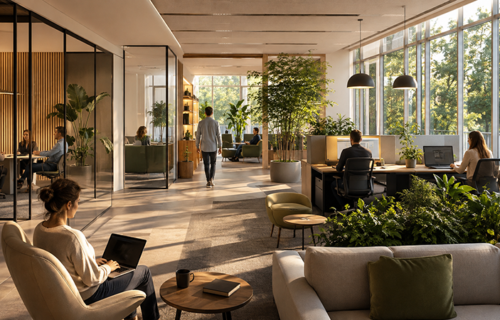
That changes the balance of space required within buildings. Quiet areas for concentrated work, smaller rooms for calls and virtual meetings, collaborative zones, informal meeting areas and spaces where employees can temporarily withdraw from continuous interaction can become more useful than simply maximising workstation density.
The physical environment can also contribute directly to employee wellbeing. Acoustics, air quality, natural light, temperature control and access to outdoor or relaxation areas influence comfort and concentration throughout the working day. These characteristics therefore have practical value beyond their role in environmental certification or corporate sustainability strategies.
European research into hybrid working reinforces the importance of management alongside workplace design. Eurofound has found that flexible working can improve work-life balance and productivity, but poorly organised arrangements can also result in longer hours, fewer breaks and weaker boundaries between work and private time. Employee autonomy, management practices and clear expectations are consequently important to whether flexible working produces benefits.
Office utilisation presents another challenge. Flexible attendance can result in buildings becoming heavily occupied during particular midweek periods while remaining relatively quiet on other days. Simply increasing attendance requirements without adjusting workplace planning can therefore create overcrowding at peak times without materially improving overall utilisation.
For landlords and developers, this broadens the definition of office quality. Energy efficiency, environmental certification, transport connections and location remain important, but occupiers increasingly need buildings capable of supporting different patterns of concentration, collaboration and social interaction.
The implications extend to asset management. Understanding when and how employees use a building can help owners and occupiers adjust meeting facilities, shared areas, services and amenities rather than treating occupancy purely as a measure of how many people enter the office.
The Czech evidence also suggests that workplace wellbeing should not be reduced to an amenities competition. A gym, roof terrace or relaxation room may improve an office, but physical facilities cannot compensate for consistently excessive workloads or management practices that prevent employees from disconnecting.
The emerging workplace question in Czechia during 2026 is therefore less about choosing between the office and home. It is about creating a working model in which physical space, flexibility and management practices support one another.
For employers, that means making office attendance worthwhile while addressing the workload and management issues contributing to employee fatigue. For property owners, it means providing adaptable buildings where occupiers can create environments suitable for concentration, collaboration and recovery.
With around one third of Edenred respondents questioning whether their current workload is sustainable, workplace quality is becoming more than an HR consideration. It increasingly affects recruitment, retention and the way companies select and use their offices.
The strongest workplaces of the next cycle may therefore be judged not simply by their occupancy levels or technical specifications, but by whether they help people work effectively without adding unnecessarily to the pressures they already experience.