Wednesday, 16 September 2026
Japan’s real estate market is no longer moving in a single direction. Instead, it is evolving into a collection of distinct regional markets, where economic strength, population trends and investment activity increasingly determine local performance.
The country’s largest metropolitan areas continue to attract businesses, residents and international capital, while many smaller cities and rural communities are facing declining populations and weakening housing demand. This growing divergence is reshaping investment strategies and influencing where developers, lenders and institutional investors choose to allocate capital.
Metropolitan Areas Continue to Attract Investment
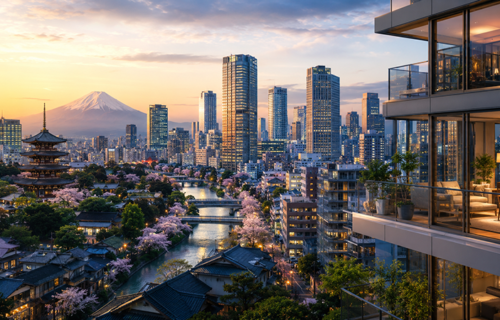
Tokyo remains the dominant force in Japan’s property market. Strong employment, extensive infrastructure investment and a steady flow of domestic migration have helped maintain demand for residential, office and mixed-use developments despite higher construction costs.
Large-scale regeneration projects in districts such as Yaesu, Toranomon, Shibuya and Shinagawa are creating new commercial centres that combine workplaces, housing, hotels, retail and public spaces. These developments continue to strengthen the capital’s appeal for both occupiers and investors.
Other major cities, including Osaka, Fukuoka and Nagoya, are also benefiting from corporate expansion, tourism and infrastructure improvements, although growth remains more moderate than in Tokyo.
Premium Housing Maintains Momentum
Demand for quality residential property has remained resilient in central Tokyo, where limited development land and rising construction costs continue to support pricing.
Luxury apartments have attracted attention from both Japanese buyers and overseas investors seeking stable assets in an established legal and financial environment. The comparatively weak yen has further increased Japan’s appeal to international purchasers looking for long-term investment opportunities.
While overseas buyers remain most active in the premium segment, domestic purchasers continue to account for the majority of housing transactions across the wider market.
Rental Market Regains Strength
Japan’s rental sector has also entered a period of gradual change. In central Tokyo, population growth and limited housing supply have contributed to stronger rental performance than the market experienced during much of the previous decade.
Institutional investors continue to increase allocations to multifamily residential assets, attracted by high occupancy rates and improving rental income. The sector has become one of the country’s most stable real estate investment classes, particularly for long-term income-focused investors.
Outside the largest cities, however, rental markets remain considerably weaker, reflecting slower population growth and lower household formation.
Regional Japan Faces Different Challenges
Away from the country’s major metropolitan areas, demographic trends continue to influence property performance.
Many regional municipalities are experiencing population decline as younger residents relocate in search of employment and educational opportunities. This has reduced housing demand in numerous communities and contributed to a growing inventory of vacant residential properties.
Local governments are responding through redevelopment initiatives, renovation grants and programmes designed to attract new residents, entrepreneurs and remote workers. While these measures have achieved positive results in selected locations, reversing long-term demographic trends remains a significant challenge.
At the same time, some regional cities are benefiting from new economic drivers. Semiconductor investment in Kyushu, tourism growth in Hokkaido and redevelopment projects in several provincial centres demonstrate that regional success increasingly depends on the strength of local industries rather than broader national trends.
Sustainability Shapes Future Development
Environmental performance is becoming a more important consideration throughout Japan’s property sector. Developers are placing greater emphasis on energy-efficient buildings, carbon reduction and resilient design, while investors increasingly evaluate long-term operating costs alongside financial returns.
Modern buildings that combine sustainability with earthquake-resistant construction are attracting stronger investor interest than ageing assets that require extensive upgrades. Consequently, refurbishment projects have become an important part of Japan’s property market, extending the life of existing buildings while improving their environmental performance.
Infrastructure Remains a Competitive Advantage
Japan’s extensive transport network continues to support real estate values in well-connected locations. New railway stations, urban regeneration schemes and improvements to public transport are helping create opportunities for both commercial and residential development.
Areas with strong accessibility continue to outperform locations where transport links and employment opportunities are more limited, reinforcing the importance of connectivity in investment decisions.
Outlook
Japan’s property market is entering a period where success will depend less on nationwide trends and more on local economic fundamentals.
Major metropolitan areas are expected to remain the primary destinations for investment, supported by redevelopment, international capital and resilient occupier demand. Selected regional cities with expanding industries are also likely to generate attractive opportunities.
Meanwhile, communities facing population decline will increasingly focus on regeneration, adaptive reuse and improving the quality of existing housing rather than expanding supply.
For investors, the Japanese market is becoming increasingly selective. The strongest prospects are likely to be found in locations that combine economic growth, modern infrastructure and sustainable development, while areas lacking these advantages may continue to face slower growth and weaker demand. Rather than one national property story, Japan is evolving into a market where local dynamics will determine long-term success.
Source: © CIJ.World Japan Research & Analysis Team