Thursday, 24 September 2026
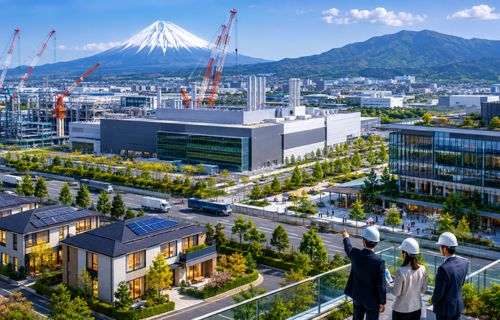
Japan’s efforts to rebuild its semiconductor manufacturing capabilities are generating far-reaching effects well beyond the technology sector. Across Kyushu, particularly in Kumamoto Prefecture, a surge in investment is transforming industrial land markets, accelerating infrastructure projects and creating new demand for housing, logistics facilities and commercial development.
At the centre of this transformation is the rapid expansion of advanced chip manufacturing capacity, supported by a combination of government incentives, foreign direct investment and private-sector capital. What began as an industrial policy initiative aimed at strengthening supply chain resilience has evolved into one of the most significant regional development stories in Japan.
Kumamoto Emerges as a Strategic Manufacturing Hub
Kumamoto has become one of the focal points of Japan’s semiconductor strategy. Major investments in fabrication facilities have attracted a growing network of suppliers, equipment manufacturers, logistics operators and service providers, creating a rapidly expanding industrial ecosystem.
The region’s appeal stems from several factors, including available land, access to water resources, an established manufacturing base and proximity to other technology clusters across Kyushu. As production capacity expands, industrial demand is spreading beyond the manufacturing plants themselves and into supporting sectors that require warehousing, distribution facilities, research centres and specialised infrastructure.
The scale of investment is reshaping perceptions of Kumamoto from a regional city into one of Japan’s most important technology and manufacturing destinations.
Industrial Land and Logistics Demand Accelerate
The expansion of semiconductor manufacturing has triggered strong demand for industrial land across the region. Developers are actively seeking sites suitable for factories, supplier facilities and logistics operations, while municipalities are working to prepare additional industrial zones to accommodate future growth.
Demand for modern logistics facilities has also increased as semiconductor production requires highly sophisticated supply chains involving precision components, specialised materials and time-sensitive deliveries. As more suppliers establish operations near major production facilities, the need for distribution infrastructure continues to expand.
This has created new opportunities for industrial real estate investors, particularly those focused on build-to-suit developments and modern logistics assets capable of serving advanced manufacturing occupiers.
Infrastructure Investment Becomes a Priority
The rapid pace of industrial growth has placed increasing pressure on local infrastructure. Roads, utilities and public transport systems are facing greater demand as construction activity intensifies and employment expands throughout the region.
Traffic congestion has emerged as a growing concern around major industrial sites, prompting local and national authorities to accelerate infrastructure improvements. Investment in transport networks, utility upgrades and site preparation is becoming a critical component of the region’s long-term development strategy.
The experience highlights a broader lesson increasingly relevant across global manufacturing markets: industrial expansion requires supporting infrastructure to develop at a similar pace if growth is to remain sustainable.
Housing Market Feels the Impact
The arrival of new employers and thousands of workers has also begun to reshape local residential markets. Demand for housing has increased significantly as engineers, technicians, construction specialists and service-sector employees relocate to the area.
Developers are responding with new residential projects, but supply has struggled to keep pace with demand in some locations. Rising housing costs and limited availability of modern accommodation have become increasingly visible challenges for local authorities seeking to support economic growth while maintaining affordability.
The situation has created opportunities for residential developers, investors and operators of rental housing, particularly in communities located near major employment centres.
Beyond Manufacturing: The Return of “Silicon Island”
The current wave of investment is reviving Kyushu’s historical reputation as one of Japan’s most important technology production regions. While the area has long maintained a presence in electronics manufacturing, recent investments are attracting a new generation of companies focused on advanced semiconductors, materials science, research and development, and precision engineering.
This broader ecosystem is expected to generate long-term demand across multiple real estate sectors, including industrial, logistics, residential, hospitality and business parks. Universities, research institutions and training facilities are also likely to play an increasingly important role as companies compete for highly skilled talent.
Outlook
Japan’s semiconductor resurgence is becoming one of the strongest drivers of regional economic development and industrial real estate activity in the country. Supported by government policy, international investment and growing demand for advanced technologies, Kumamoto and the wider Kyushu region are emerging as strategic locations within the global semiconductor supply chain.
For the real estate sector, the implications extend well beyond factory construction. Industrial parks, logistics facilities, housing developments and infrastructure projects are all benefiting from the manufacturing expansion. As investment continues to flow into the sector, the semiconductor industry is likely to remain a key force shaping Japan’s property market and regional growth strategies throughout the coming decade.
Source: © CIJ.World Japan Research & Analysis Team