Wednesday, 23 September 2026
Tokyo is undergoing one of the most significant waves of urban renewal in its modern history. Across districts such as Yaesu, Toranomon, Shinagawa and Shibuya, large-scale projects are reshaping the capital’s skyline while redefining how people live, work and move through the city.
Unlike earlier redevelopment cycles that focused primarily on commercial expansion, the current generation of projects combines offices, housing, hospitality, retail, education, public amenities and transport infrastructure within integrated urban environments. The objective is not simply to add new buildings but to create highly connected districts capable of supporting Tokyo’s long-term economic competitiveness and quality of life.
Building Vertical Communities
A defining characteristic of Tokyo’s redevelopment strategy is the creation of large-scale mixed-use destinations. Rather than separating residential, commercial and civic functions, new projects are bringing these elements together within compact, high-density environments.
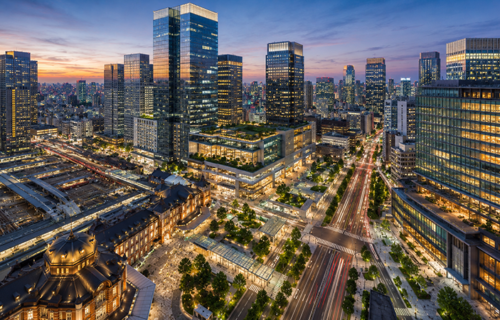
Around Tokyo Station, major redevelopment schemes are introducing new office space, residential units, retail facilities, educational institutions and public gathering areas within a single district. These developments are designed to maximise land efficiency while creating vibrant neighbourhoods that remain active throughout the day and evening.
A similar approach is evident in Toranomon, where multiple interconnected towers have transformed the area into a major business and lifestyle destination. The district now combines corporate headquarters, hospitality facilities, cultural attractions, residential accommodation and public spaces within a unified urban framework.
Shibuya is also continuing its transformation from a retail and entertainment centre into a multifunctional business district. Several major projects currently under construction will add substantial office, residential and commercial capacity over the remainder of the decade, reinforcing the area’s role as one of Tokyo’s most dynamic urban centres.
Meanwhile, Shinagawa is emerging as another strategic growth corridor. Large redevelopment sites are attracting major corporate occupiers alongside hotels, retail facilities and new public infrastructure, supporting the area’s evolution into a key gateway district for both domestic and international business activity.
Transport Connectivity at the Core
One of the most important aspects of Tokyo’s redevelopment model is the close integration between real estate projects and transportation infrastructure.
Rather than treating stations as separate transport facilities, developers are increasingly designing entire districts around rail hubs, pedestrian networks and public transit connections. This approach improves accessibility, reduces reliance on private vehicles and supports sustainable urban growth.
Shibuya Station provides one of the clearest examples of this strategy. Serving millions of passengers every day, the station area has undergone a long-term transformation aimed at improving passenger circulation, accessibility and connectivity between different transport modes. The redevelopment extends beyond the station itself, creating new public spaces, commercial facilities and pedestrian routes throughout the surrounding district.
Around Tokyo Station, redevelopment projects are similarly enhancing connections between rail services, metro networks and surrounding commercial districts. New underground walkways and public spaces are helping to improve pedestrian movement while linking previously disconnected parts of the city centre.
Expanding Public Realm and Green Space
While Tokyo remains one of the world’s most densely populated metropolitan areas, recent redevelopment projects place increasing emphasis on public space, landscaping and environmental quality.
Developers are incorporating plazas, parks, rooftop gardens and pedestrian-friendly environments into projects that would once have been dominated solely by commercial uses. These spaces are intended to improve the urban experience for residents, workers and visitors while contributing to broader sustainability objectives.
The integration of green infrastructure has become particularly important as Tokyo seeks to enhance resilience, reduce urban heat effects and create more attractive environments for global businesses and talent.
Supporting Future Growth
Urban renewal is also being supported by continued investment in transportation infrastructure beyond central Tokyo. Proposals for new rail connections and transit improvements aim to strengthen links between the city centre, waterfront districts and major international gateways, including Haneda Airport.
Improved connectivity is expected to support future commercial development while enhancing Tokyo’s position as a leading international business destination.
Outlook
Tokyo’s latest redevelopment cycle represents more than a construction boom. It reflects a broader shift toward integrated urban planning that combines real estate, mobility, public space and sustainability within a single development model.
As projects in Yaesu, Toranomon, Shibuya and Shinagawa continue to progress, they are creating a new generation of urban districts designed to meet the evolving needs of residents, businesses and international investors. Together, these developments are reinforcing Tokyo’s position as one of the world’s most innovative and resilient metropolitan centres while setting new benchmarks for large-scale mixed-use urban regeneration.
Source: © CIJ.World Japan Research & Analysis Team