Thursday, 24 September 2026
Environmental performance and earthquake resilience are increasingly shaping investment decisions across Japan’s real estate sector. What were once considered separate areas of risk management and sustainability have become closely linked, creating a new framework through which investors evaluate property assets.
As climate targets become more ambitious and concerns over natural disasters remain ever-present, developers, lenders and institutional investors are placing greater emphasis on energy performance, carbon reduction and structural resilience. This shift is influencing everything from asset valuations and financing conditions to redevelopment strategies and long-term portfolio planning.
The Growing Divide Between Old and New Buildings
One of the most important distinctions in the Japanese property market remains the seismic standard under which a building was constructed. Buildings completed before June 1981 were designed according to older earthquake regulations and are generally viewed as carrying higher structural risk than properties developed under subsequent standards.
As a result, older buildings often face additional scrutiny during acquisition and financing processes. Investors frequently commission structural assessments to determine whether seismic upgrades have been completed and whether a property can meet contemporary safety expectations. Financial institutions have also become increasingly cautious, with lending terms often reflecting the perceived resilience of an asset.
Properties built after the introduction of modern seismic regulations generally attract stronger investor interest, while more recent developments benefit from increasingly sophisticated engineering standards designed to improve performance during major earthquakes.
Retrofitting Gains Momentum
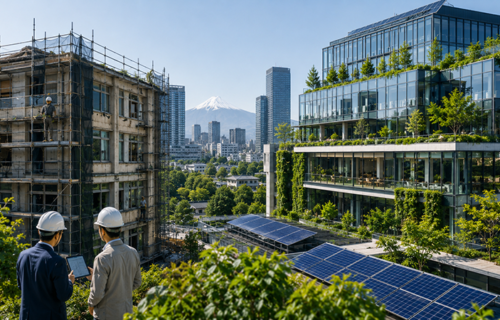
Rather than replacing ageing buildings through demolition and reconstruction, many owners are turning to renovation programmes that improve both structural safety and environmental performance.
Government policies are encouraging this transition through financial incentives aimed at reducing energy consumption and accelerating the modernisation of existing building stock. Support programmes are helping owners invest in insulation upgrades, energy-efficient equipment, renewable energy systems and building management technologies.
The approach reflects a growing recognition that upgrading existing buildings can deliver significant environmental benefits while preserving valuable urban assets. In many cases, refurbishment projects require fewer resources and generate lower carbon emissions than constructing entirely new buildings.
Several projects across Japan have demonstrated that even older office buildings can achieve high levels of energy performance after renovation. These examples are helping to strengthen investor confidence in retrofit strategies as a viable long-term investment approach.
Carbon Reduction Becomes a Business Priority
Japan has committed to substantial reductions in greenhouse gas emissions over the coming decades, placing increasing pressure on the built environment to improve its environmental performance.
The property sector plays a central role in achieving these objectives. Buildings account for a significant share of energy consumption and carbon emissions, making energy efficiency improvements essential to national decarbonisation efforts.
Investors are responding by incorporating environmental performance metrics into asset selection and portfolio management decisions. Green certifications, energy ratings and sustainability reporting have become increasingly important factors when evaluating investment opportunities.
Research across global real estate markets suggests that sustainable buildings can benefit from stronger tenant demand, lower operating costs and improved rental performance. As a result, environmental upgrades are increasingly viewed not only as a regulatory requirement but also as a means of protecting asset value and enhancing long-term returns.
Insurance and Risk Management Take Centre Stage
Natural disaster exposure remains one of the defining characteristics of Japan’s property market. Earthquakes, typhoons and flooding continue to influence investment decisions, particularly as climate-related risks become more pronounced.
Insurance providers increasingly differentiate between assets based on construction quality, resilience measures and structural performance. Buildings that demonstrate higher levels of earthquake resistance can often benefit from more favourable insurance conditions, creating additional incentives for owners to invest in upgrades.
For institutional investors, resilience has become an essential component of environmental, social and governance strategies. Assessing a building’s ability to withstand future shocks is now considered as important as evaluating its financial performance.
A New Investment Framework
Japan’s real estate market is entering a period in which sustainability and resilience are no longer viewed as optional enhancements. Instead, they are becoming fundamental criteria that influence asset pricing, financing availability and investor demand.
The combination of stricter environmental goals, ageing building stock and ongoing exposure to natural disasters is accelerating the modernisation of the country’s property sector. Investors are increasingly focusing on assets that can meet both decarbonisation objectives and seismic safety expectations, while developers are integrating these considerations into project design from the outset.
As capital continues to flow toward higher-quality, future-ready buildings, resilience and sustainability are expected to become defining characteristics of Japan’s next generation of real estate investment opportunities.
Copyright: CIJ.World Japan Research & Analysis Team