Sunday, 4 October 2026
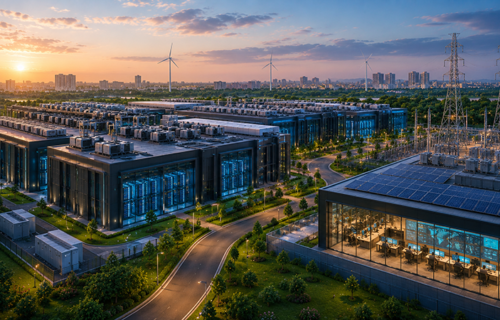
India has entered a new phase of digital infrastructure development in which data centres, cloud campuses and artificial intelligence facilities are becoming major drivers of real estate investment and land acquisition. As cloud computing, AI applications and digital services expand across the economy, demand for large-scale digital infrastructure is creating new opportunities for developers, investors and infrastructure operators.
The growth story is supported by powerful structural trends. India is one of the world’s fastest-growing digital markets, with rising internet penetration, expanding cloud adoption, rapid growth in digital payments and increasing use of artificial intelligence across industries. These developments are driving significant investment in data centres and related infrastructure, with industry forecasts suggesting that India’s operational capacity could more than double over the remainder of the decade.
This expansion is creating substantial demand for land. Hyperscale data centres require large contiguous sites with access to reliable power, high-capacity fibre networks and transportation infrastructure. As a result, locations such as Mumbai, Navi Mumbai, Chennai, Hyderabad, Bengaluru and Delhi-NCR have emerged as key digital infrastructure hubs. These cities combine strong connectivity, established technology ecosystems and proximity to major enterprise customers.
Several large-scale projects highlight the scale of investment underway. Developers, infrastructure companies and technology firms have announced multi-billion-dollar commitments to data centre campuses across the country. Mumbai remains the largest market, while Hyderabad and Chennai continue to attract significant investment. Andhra Pradesh, Gujarat and other states are also positioning themselves as future data centre destinations by offering land, infrastructure and policy support.
Artificial intelligence is emerging as the next major catalyst for growth. Traditional cloud workloads already require significant computing capacity, but AI applications place much greater demands on infrastructure. Training and deploying advanced AI models requires GPU-intensive computing environments, low-latency connectivity and sophisticated cooling systems. As Indian enterprises accelerate AI adoption, demand for specialised data centre capacity is expected to rise substantially.
This shift is influencing real estate requirements. AI-focused facilities often require greater power density and more advanced infrastructure than conventional data centres. As a result, developers are increasingly focusing on sites that can support future expansion while providing access to reliable energy and digital connectivity.
However, the long-term sustainability of this growth depends on several critical factors. The biggest challenge is not necessarily land availability but power supply. Data centres consume significant amounts of electricity, and future growth will require substantial investments in generation capacity, transmission networks and grid reliability. Without adequate energy infrastructure, the pace of expansion could slow regardless of market demand.
Environmental considerations are also becoming increasingly important. Large-scale facilities require significant cooling capacity and can place pressure on local water resources. As a result, operators are investing in more efficient cooling technologies, renewable energy procurement and sustainable design strategies to reduce environmental impacts.
The industry is also beginning to look beyond established metropolitan markets. While Mumbai, Chennai and Hyderabad remain dominant, emerging locations such as Pune, Visakhapatnam, Kochi and Ahmedabad are attracting attention due to lower land costs, improving infrastructure and growing connectivity. These secondary markets could help distribute future capacity more evenly while reducing development pressure on major urban centres.
The momentum behind India’s digital infrastructure sector remains strong. Cloud adoption, AI deployment, digital services growth and government-led digital initiatives continue to create substantial demand for new capacity. Yet the next phase of growth will depend less on technology demand alone and more on the industry’s ability to secure power, land, sustainability solutions and supporting infrastructure.
The long-term outlook remains positive, but sustainable growth will require coordinated investment across energy, telecommunications and real estate. If these challenges are addressed successfully, India could emerge as one of the world’s leading digital infrastructure markets by the end of the decade.
Source: CIJ.World India Research & Analysis Team