Saturday, 19 September 2026
State support measures introduced during financial crises have played an important role in maintaining the stability of Europe’s banking sector and preventing wider systemic failures, according to a new study involving researchers from the German Institute for Economic Research (DIW Berlin). The findings suggest that the impact of state aid on competition depends largely on how support measures are structured.
The research, conducted by an international consortium and based on a newly compiled dataset combining European Commission state aid records with bank balance sheet data from 2007 to 2021, examined the effects of different forms of government assistance on competition within the banking sector.
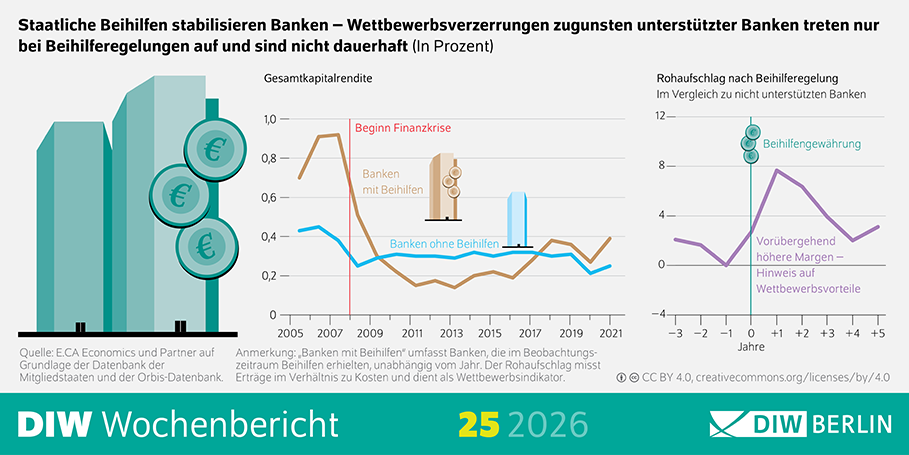
According to the study, targeted support provided to individual banks facing financial difficulties generally did not result in negative competitive effects. Such measures, including recapitalisations, were typically accompanied by strict conditions requiring restructuring efforts and the participation of shareholders and creditors in absorbing losses. Researchers found that these requirements helped limit potential distortions to competition.
The analysis identified different outcomes for broader state aid schemes designed to provide rapid liquidity support across the banking sector. Banks benefiting from these programmes experienced temporarily higher profit margins compared with similar institutions that did not receive assistance. However, the study found that these advantages were short-lived and largely disappeared within two to three years.
The findings arrive as European policymakers continue to refine the framework governing state aid. In recent years, the European Commission has activated temporary aid mechanisms in response to several economic shocks, including the COVID-19 pandemic, the energy crisis and more recent disruptions linked to geopolitical tensions and energy price volatility.
Researchers argue that the evidence supports a balanced approach combining rapid crisis intervention with carefully designed safeguards. The study concludes that swift support can help preserve financial stability during periods of stress, while targeted conditions and oversight remain essential to ensuring that competition within the banking sector is maintained over the longer term.
The authors suggest that lessons from previous crises could help inform future policy responses, particularly as governments and regulators prepare for potential economic and financial disruptions in the years ahead.