Thursday, 10 September 2026
A proposed law introduced in the Hungarian Parliament on 2 June 2026 could bring significant changes to the regulation of political and outdoor advertising across the country. The draft legislation, identified as Bill T/122, aims to restrict hate-inciting political advertisements, strengthen townscape controls over commercial advertising, and amend certain investment-related regulations. If approved, the new rules would come into force on 1 August 2026.
The proposed measures would affect a broad range of stakeholders, including outdoor advertising operators, media companies, property owners and developers, construction firms using advertising banners on building sites, retailers, political parties and local governments.
One of the most notable elements of the bill is the introduction of stricter content rules for political advertising. Political advertisements would be prohibited from containing material that violates human dignity, targets national, ethnic, racial or religious communities, assigns collective responsibility to groups, or seeks to incite hatred. The restrictions would also cover images and videos that portray individuals in a false or misleading manner for such purposes. In addition, political advertisements would not be permitted to include content considered harmful to the physical, mental, moral or emotional development of minors.
Under the proposal, Hungary’s Media Council would be required to decide within 15 days whether a disputed advertisement qualifies as prohibited political content following the submission of a complaint.
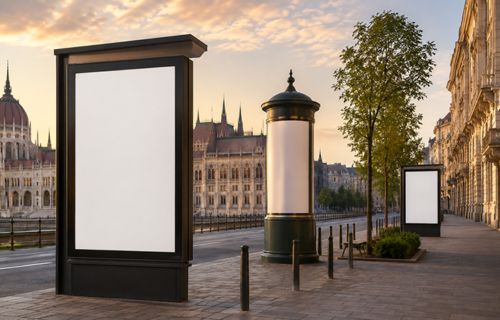
The legislation would also substantially reshape the outdoor advertising market. Advertising visible from public spaces would only be allowed on specified structures, including street furniture, advertising columns, utility poles and roof-mounted carriers. Several widely used formats, such as wall advertisements, advertising mesh banners and scaffold advertising banners, would no longer be permitted.
Advertising surfaces would be limited to a maximum size of 15 square metres. At the same time, formats smaller than the standard citylight poster size would generally be prohibited unless otherwise authorised by government decree.
Political campaign posters would face additional placement restrictions. They could no longer be displayed on lighting poles, telephone poles, traffic signs, road safety equipment or trees.
The proposal would also introduce new administrative requirements for advertising installations. Townscape permits would remain valid for five years and would need to be renewed at least 30 days before expiration. Existing advertising structures that do not comply with the new rules would have to be removed or modified by 30 September 2026.
Local governments would regain a central role in regulating advertising placements through a townscape notification procedure. This authority had previously been exercised by district offices. Municipalities would also have the power to establish additional advertising-free zones through local decrees. In Budapest, the city administration would be able to introduce advertising restrictions applicable across the capital.
Enforcement powers would also be strengthened. If non-compliant advertising installations remain in place after the September 2026 deadline, local authorities could order their removal and impose penalties on both the owners of the advertising structures and the owners of the properties on which they are located. Operators whose installations could be brought into compliance through modification would be required to initiate the relevant townscape notification procedures by the same deadline.
With parliamentary consideration now underway, businesses involved in outdoor advertising, media services, construction and political campaigning are expected to closely monitor the progress of the legislation and evaluate its potential impact on their operations and future advertising strategies.