Wednesday, 30 September 2026
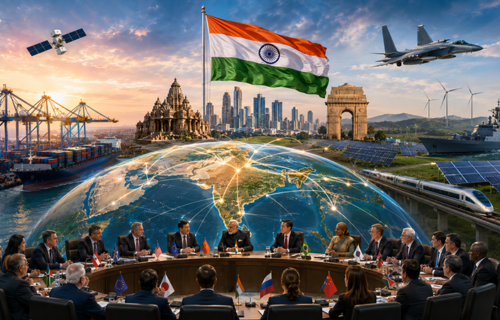
India’s geopolitical influence has grown steadily over the past two decades, reflecting its economic expansion, strategic positioning and evolving foreign policy approach. While the country historically adhered to a doctrine of non-alignment, it has increasingly adopted a more flexible and pragmatic strategy, often described as “multi-alignment,” allowing it to engage simultaneously with competing global powers.
This shift is contributing to a gradual reconfiguration of alliances, particularly as global power dynamics become more fragmented.
From Non-Alignment to Strategic Flexibility
India’s foreign policy has moved beyond its traditional Cold War-era positioning, maintaining engagement with a broad spectrum of partners. Relations with the United States have deepened across trade, technology and defence, while long-standing ties with Russia—particularly in energy and defence—remain intact.
At the same time, India continues to engage with multilateral groupings such as BRICS and regional partnerships across Asia. Negotiations with the European Union on a free trade agreement are ongoing, rather than concluded, reflecting a gradual expansion of economic diplomacy.
This approach enables India to preserve strategic autonomy while navigating increasing competition between major powers.
Positioning Within the Global South
India has also sought to strengthen its role among developing economies, positioning itself as a representative voice for the Global South. This was particularly visible during its presidency of the G20, where the African Union was admitted as a permanent member.
Through forums such as the G20 and BRICS, India has advocated for greater representation of emerging economies in global governance institutions, including reform of the United Nations system.
Engagement with resource-rich countries in Africa and Latin America has also increased, driven in part by the need to secure critical minerals for energy transition and industrial development. State-backed initiatives such as KABIL (Khanij Bidesh India Ltd.) have been established to support overseas resource partnerships, although their scale and impact are still developing.
Strategic Role in the Indo-Pacific
In the Indo-Pacific region, India has expanded its strategic footprint, particularly within the Indian Ocean. Initiatives such as SAGAR (Security and Growth for All in the Region) emphasise maritime cooperation, security and regional stability.
India has increased its participation in naval exercises, anti-piracy operations and humanitarian assistance efforts, reinforcing its role as a regional security contributor. Infrastructure projects such as the development of Iran’s Chabahar Port also reflect efforts to strengthen connectivity and trade routes.
Limits and Constraints
Despite its growing influence, India’s geopolitical role remains constrained by several factors. Regional tensions, particularly with China, continue to shape strategic priorities. At the same time, global conflicts—including the war in Ukraine—have complicated India’s balancing strategy, especially in maintaining relations with both Western economies and Russia.
India’s ability to act as a mediator in international conflicts is also limited. While it maintains dialogue with a wide range of actors, it is not yet widely seen as a central broker in major geopolitical disputes.
Institutional challenges at the global level, including gridlock within multilateral organisations, further limit the effectiveness of emerging powers in reshaping governance structures.
A Gradual Shift Toward Multipolarity
India’s rise is contributing to the emergence of a more multipolar global order, rather than a fundamental realignment of alliances in the near term. Its strategy of multi-alignment allows it to engage flexibly, but also reflects the complexity of navigating competing geopolitical interests.
While India is unlikely to replace existing major powers, its growing economic and strategic weight ensures that it will play an increasingly important role in shaping regional dynamics and global governance over the coming decades.
Source: CIJ.World India Research & Analysis Team