Wednesday, 30 September 2026
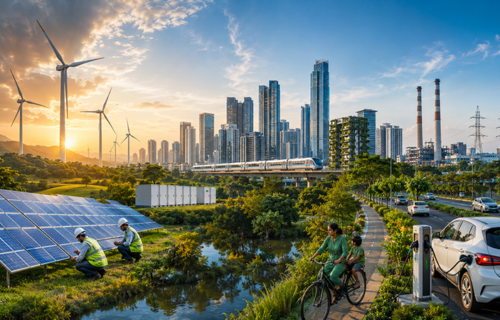
India’s economic expansion is entering a phase where growth and sustainability are becoming increasingly intertwined. As one of the fastest-growing major economies, the country is attempting to maintain momentum while responding to rising climate risks and accelerating its transition towards cleaner energy.
The balancing act is becoming more complex as climate-related disruptions intensify and energy demand continues to rise alongside industrialisation and urbanisation.
Growth Outlook Remains Resilient
India’s economy continues to demonstrate strong underlying momentum, supported by domestic consumption, infrastructure investment and a growing services sector. Estimates from the Reserve Bank of India and the International Monetary Fund generally place near-term GDP growth in the range of 6–7 percent, with India remaining one of the fastest-growing large economies globally.
While earlier projections above 7 percent have been cited, most current forecasts suggest a more moderate but still robust trajectory, reflecting global economic uncertainty and tightening financial conditions.
Foreign investment inflows and public capital expenditure continue to support growth, although external demand remains uneven.
Climate Risks Intensify
Climate-related challenges are becoming a more visible constraint on long-term growth. Rising temperatures, more frequent heatwaves and increasing instances of flooding are already affecting productivity, infrastructure and urban resilience.
Research cited by institutions such as the World Bank indicates that climate change could have a measurable impact on India’s economic output over time, particularly through reduced labour productivity and disruptions to agriculture and supply chains.
Sectors such as agriculture, coastal infrastructure and urban systems are particularly exposed, with climate risks expected to increase in both frequency and severity over the coming decades.
While specific loss estimates vary widely across studies, there is broad consensus that the economic cost of inaction could be substantial.
Energy Transition Gains Momentum
India has made measurable progress in expanding its renewable energy capacity, driven by policy support and falling technology costs. According to the International Energy Agency, the country is among the fastest-growing renewable energy markets globally.
Non-fossil fuel capacity has increased significantly in recent years, with solar energy leading new installations. Government initiatives such as rooftop solar programmes and green hydrogen development aim to accelerate the transition further.
India has committed to increasing the share of non-fossil fuel capacity to around 50 percent of total installed capacity by 2030. Current progress suggests movement in that direction, although achieving the target will require sustained investment and grid modernisation.
Structural Constraints Remain
Despite progress, India’s energy transition faces structural challenges. Coal continues to play a central role in power generation, reflecting the need to balance energy security with decarbonisation goals.
Financing requirements for the transition are substantial, particularly in areas such as grid infrastructure, storage and industrial decarbonisation. In addition, regulatory complexity and land acquisition issues continue to affect project timelines.
The pace of transition will therefore depend not only on capacity additions but also on improvements in system integration and policy execution.
A Long-Term Balancing Act
India’s development trajectory increasingly depends on its ability to align economic growth with climate resilience and energy transition goals. The direction of policy is clear, but the scale of the challenge remains significant.
While the country is making progress in expanding renewable energy and strengthening climate awareness, the transition will be gradual. Maintaining growth while reducing emissions and adapting to climate risks will require sustained investment, policy consistency and technological advancement over the coming decades.
Source: CIJ.World India Research & Analysis Team