Sunday, 18 October 2026
Poland’s commercial real estate investment market recorded approximately €1 billion in transactions in the first quarter of 2026, marking the strongest start to a year since 2022 and indicating renewed activity across the sector.
The volume was supported by a relatively high number of deals, with 26 transactions covering 54 assets, reflecting solid liquidity and continued investor engagement at the start of the year.
Logistics assets accounted for the largest share of investment activity, followed by retail, while the office sector maintained a steady level of transactions, with additional deals still progressing.
“The scale of the volume recorded in the first quarter and the structure of transactions indicate growing readiness among investors to deploy capital,” said Piotr Mirowski. “The increasing number of portfolio and long-term transactions confirms confidence in the fundamentals of the Polish commercial real estate market.”
Portfolio transactions and sale-and-leaseback deals continued to play a significant role in the market, reflecting investor preference for assets with stable income profiles.
Alongside the recovery in activity, the structure of demand is evolving. Domestic investors are becoming more visible, following strong participation in 2025, when Polish capital reached a record share of total investment volume.
“We are seeing a new wave of buyers who are focusing on stabilised, income-generating assets rather than taking on development risk,” Mirowski said. “This is pragmatic capital with a long-term perspective.”
Domestic investors are typically targeting mid-sized assets and increasingly using bank financing, which has become more widely available in recent months.
“The market is being shaped by a new group of investors,” Mirowski added. “In many cases, these are experienced entrepreneurs who have built capital outside the real estate sector and are now allocating it into commercial property.”
Macroeconomic conditions continue to support investment decisions despite external uncertainty. Poland remains one of the faster-growing economies in the European Union, supported by a strong labour market and rising real wages.
“Strong consumption and solid demand fundamentals translate into lower risk on the tenant side,” said Grzegorz Sielewicz. “This supports rental stability and more predictable occupier behaviour.”
At the same time, pricing differences compared to Western Europe continue to attract investor interest, with Polish assets offering relatively higher returns.
Looking ahead, market participants expect further activity during 2026, supported by both domestic investors and a gradual return of international capital.
“We are at the beginning of a longer-term trend,” Mirowski said. “Polish capital is still gaining momentum, and as experience and financial capacity grow, investors are likely to move towards larger transactions.”
The first quarter results point to a market that is not only recovering in terms of volume, but also undergoing structural change, with domestic capital playing an increasingly important role.
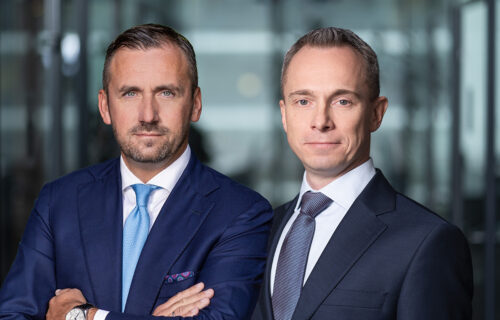
Photo: Piotr Mirowski, Head of the Investment Advisory Department at Colliers and Grzegorz Sielewicz, Chief Economist for the Central and Eastern Europe Region at Colliers.