Sunday, 4 October 2026
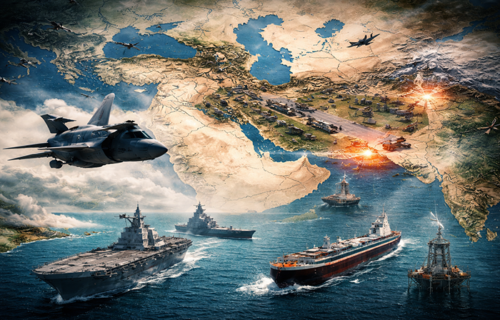
Recent military and political developments stretching from Eastern Europe to the Middle East are drawing growing attention from analysts who see the possibility that several global dynamics; security policy, energy markets and great-power competition, may be converging at the same time. While the individual events are unfolding in different regions, their timing and potential consequences suggest they could be part of a broader geopolitical shift.
Romania has recently become part of this discussion after reports that the United States has explored expanded operational use of the Mihail Kogălniceanu Air Base, a major NATO logistics hub located near the Black Sea coast. The facility has long supported allied missions in multiple theatres, but new requests reportedly under consideration could allow it to play a larger role in supporting operations connected to the escalating confrontation involving Iran. The matter has reportedly been reviewed by Romania’s Supreme Council of National Defence, highlighting the strategic sensitivity of the issue.
The possibility that infrastructure in Eastern Europe could support activities related to developments in the Middle East reflects the increasingly interconnected nature of modern military logistics. Bases far from the front lines are often used for coordination, support operations and long-range deployment, particularly in conflicts that involve air power and multinational alliances.
At the same time, tensions surrounding Iran have intensified, raising concerns about the risk of broader instability across the region. Any escalation in this area carries global implications because of the proximity of the Strait of Hormuz, a narrow maritime corridor through which a large share of internationally traded oil passes each day. Even limited disruptions in this area have historically caused rapid movements in energy prices and heightened volatility across global markets.
European military forces have also increased their presence in nearby waters. France, for example, has deployed a naval task force centred on the French aircraft carrier Charles de Gaulle, operating in the eastern Mediterranean and adjacent maritime zones. Official explanations emphasise the protection of commercial shipping and the need to safeguard European interests in one of the world’s most important energy transport routes.
Energy considerations remain a central factor in how governments interpret the current situation. Oil flows from the Middle East influence economic stability across Europe, Asia and North America. When tensions rise in the Gulf, markets often react quickly, reflecting concerns about supply disruptions or potential blockages in maritime trade routes.
In this environment, the position of major energy exporters becomes increasingly relevant. Countries with the capacity to increase production or redirect supplies could gain strategic influence if Middle Eastern shipments are interrupted. This reality inevitably brings attention to Vladimir Putin, whose country remains one of the world’s largest producers of oil and gas.
Political dynamics in the United States also play a role in shaping the wider strategic environment. The confrontational stance toward Iran associated with Donald Trump has reinforced the perception that Washington is prepared to exert stronger pressure on Tehran. Such a posture has implications not only for regional stability but also for relations with countries that maintain political or economic ties with Iran.
Taken together, the developments now unfolding across the Black Sea region, the Middle East and global energy markets illustrate how interconnected modern geopolitics has become. Military deployments, infrastructure access agreements and maritime security operations may appear as isolated decisions, yet they often form part of a larger strategic landscape shaped by energy security, alliance commitments and global power competition.
Whether the current sequence of events represents a temporary alignment of circumstances or the early stage of a broader geopolitical realignment remains uncertain. What is clear is that developments in regions separated by thousands of kilometres, from Romania’s Black Sea coast to the waters of the Persian Gulf, are increasingly influencing one another in ways that could have lasting implications for both security and global energy markets.
Editorial Note: The views expressed in this article reflect a forward-looking analysis of current geopolitical developments. They are intended for informational purposes only and should not be interpreted as financial, legal or investment advice.