Thursday, 10 September 2026
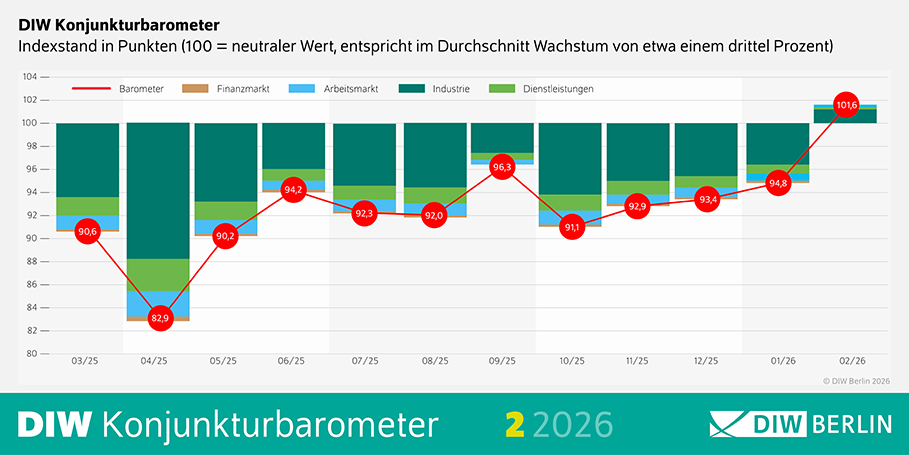
The economic barometer of the German Institute for Economic Research (DIW Berlin) increased to 101.6 points in February, marking a rise of nearly seven points compared with January. The reading moves above the neutral 100-point threshold for the first time in almost three years, signalling a return to average growth conditions in the German economy.
“The signs that Germany will find its way out of economic stagnation this year are becoming stronger,” said Geraldine Dany-Knedlik, Head of Economic Forecasting at DIW. “In particular, fiscal policy measures are increasingly having an effect and should support overall demand in the remainder of the year.”
Sentiment among businesses and households has improved in recent weeks, although uncertainty continues to weigh on the recovery outlook. DIW noted that it remains unclear how quickly allocated public funds will translate into tangible investments and added value. Potential delays in planning, approval and implementation could weaken short-term economic effects. External risks also persist, including ongoing trade policy uncertainty linked to US tariff developments, which continue to affect Germany’s export-oriented industries.
Industrial indicators show early signs of stabilisation. Order intake has increased recently, while the business climate improved in February according to ifo surveys. The Purchasing Managers’ Index (PMI) for German manufacturing rose above the 50-point expansion threshold for the first time in nearly four years. However, production growth remains subdued, reflecting weak global demand and ongoing structural adjustments in sectors such as automotive and chemicals.
“There are signs of a recovery in industry, but the development remains fragile for the time being,” said DIW economic expert Laura Pagenhardt. “While we are seeing initial signs of recovery, the ongoing uncertainty surrounding domestic and international economic conditions is likely to continue to dampen private investment in particular.”
The services sector has also shown improvement. Business expectations have strengthened, according to ifo data, and the services PMI continued to rise in February. DIW links this trend partly to a modest improvement in consumer confidence, suggesting a gradual return in household spending. A stabilising labour market is also contributing to the more positive outlook.
“The long-awaited upswing should now slowly become a reality,” said economic expert Guido Baldi. “For sustained long-term growth, it is now crucial that the German government’s substantial financial resources stimulate concrete investments and that economic policy reform efforts progress rapidly.”