Scallier Sells Commercial Property in Nowa Wieś near Pruszków

Scallier, a Poznań-based company specialising in the development and management of commercial real estate in Poland and Romania, has sold a retail property in Nowa Wieś near Pruszków, within the Warsaw metropolitan area. The transaction was carried out in partnership with PKB Inwest Budowa.

The property, acquired by Centerscape, offers approximately 2,000 sq m of space on a 0.8-hectare plot. It consists of two buildings: one anchored by a Biedronka supermarket, the other occupied by tenants including PEPCO, Maxi Zoo and Totalizator Sportowy.

The facility was completed and opened at the end of 2023. After around 18 months in operation, it was purchased by a company owned by a U.S.-based fund active in commercial real estate across Germany, the Czech Republic and Poland.

“This is another transaction completed with our partner PKB Inwest Budowa,” said Bartosz Nowak, Managing Partner at Scallier. He added that the companies are also preparing a retail park project in Pyrzyce for sale.

Retail parks and smaller convenience centres remain a key focus of new investment in Poland, supported by the continued expansion of discount and chain retailers. According to market data, such formats now represent more than a quarter of modern retail space in the country.

Scallier’s role in the Nowa Wieś project included land acquisition, leasing, investment advisory and the sale process, undertaken as part of its long-term cooperation model with PKB Inwest Budowa.

GARBE PYRAMID-MAP: European Logistics Rents Stabilise with Moderate Growth Outlook through 2030

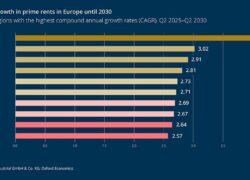
Europe’s logistics real estate market is entering a phase of consolidation, with moderate rental growth expected over the next five years, according to the latest GARBE PYRAMID-MAP mid-year update. GARBE Research projects that average prime rents will rise by €0.70 per square metre between the second quarter of 2025 and the second quarter of 2030, corresponding to a compound annual growth rate (CAGR) of 1.9 percent. This is a sharp slowdown compared to the 5.6 percent CAGR recorded from 2020 to 2025.

“The exceptional rent surge of recent years cannot be sustained indefinitely,” said Tobias Kassner, Head of Research & ESG at GARBE Industrial Real Estate. “However, prices remain stable, and top locations still hold further growth potential.”

Regional Leaders and Market Dynamics

Prime logistics hubs such as Munich, Stuttgart, Inner London, Manchester, Paris, Barcelona, and Warsaw are expected to outperform, with rents projected to grow above 2 percent annually. These markets continue to benefit from their roles as central distribution and supply chain nodes.

In the first half of 2025, average European prime rents increased by €0.06 to €7.42 per square metre per month. This represented growth of 0.8 percent—well below both previous years and the projected 2025 inflation rate of 2.06 percent (Oxford Economics). Across the 121 regions surveyed:
• 59 percent recorded unchanged rents,
• 36 percent saw modest increases averaging €0.18 per square metre,
• Only 5 percent experienced declines, down from 8 percent at year-end 2024.

This points to an emerging stabilisation of rents.

Diverging Regional Trends

The survey highlights significant differences across Europe:
• Germany: Rents rose by €0.06 on average, though without Munich the figure would have been just €0.03. Leipzig and Magdeburg saw declines, while five of the seven largest logistics hubs posted gains.
• Italy: Five of seven regions reported rent increases averaging €0.24.
• France: Four of ten regions recorded modest increases of €0.04.
• Spain: Three of four markets posted gains averaging €0.13.
• United Kingdom: Growth slowed to €0.11.
• Netherlands: Rents rose by €0.05.

Vacancies and Demand Outlook

Take-up across Europe remained broadly in line with recent levels, but vacancies edged higher. The continent’s average vacancy rate surpassed 6.6 percent in Q1 2025. The fastest increases were seen in the UK, Italy, and Slovakia, while Germany, Spain, and Poland showed early signs of recovery. Activity remained muted in Austria and the Czech Republic.

Structural Drivers and Policy Support

Despite slowing momentum, GARBE expects continued moderate rent growth, supported by structural shifts in supply chains, specialised industry demand, and the quality of logistics locations. Policy measures such as Germany’s new “Super-AfA” accelerated depreciation model could stimulate activity in the medium term, although short-term impacts remain limited.

Overall, GARBE concludes that the logistics property market remains robust, with investors likely to find opportunities in regions offering strong transport links, specialised demand, and high-quality sites.

Source: For more detailed statistics and methodological information can be found on the link below:


Denisa Gelatková Appointed Managing Director of Blue Assets CZ & SK

Blue Assets CZ & SK, the property management arm of Panattoni in the Czech and Slovak markets, has appointed Denisa Gelatková as its new Managing Director. She succeeds Robert Chmelař, who is leaving the company to pursue other opportunities.

Gelatková joined Blue Assets in 2023 as Regional Property Management Director. In her new role, she will oversee a portfolio of more than 1.5 million square metres of managed industrial and commercial properties across the Czech Republic, including over 60 assets leased to more than 170 tenants in sectors such as logistics, manufacturing, and pharmaceuticals.

She stated that her focus will be on strengthening the team, improving efficiency in daily operations, and making greater use of technology and data in decision-making. Gelatková noted that she intends to build on the work of her predecessor, who was instrumental in establishing the company’s operations.

Before joining Blue Assets, Gelatková held senior roles at Pinnacle, Lidl, and Knight Frank, and managed projects within Accolade Group’s portfolio, including Panattoni Park Cheb and several industrial parks in western Bohemia.

Blue Assets manages key logistics and industrial properties such as Panattoni Park Kojetín, Amazon’s distribution hub and one of the most modern facilities of its kind in the Czech Republic.

Logivest Brokers First Berlin Logistics Hub for Global Foods Trading

Logivest has arranged the first Berlin logistics location for Global Foods Trading GmbH, one of Europe’s leading distributors of Southeast Asian food products. The company has leased around 3,700 square metres at Wittestraße 38 in Reinickendorf. The property is owned by Prologis Germany Management GmbH.

Having previously operated from Frankfurt, Global Foods Trading is expanding its operations in Germany with the move to Berlin. The location in the north of the city offers direct access to the A111 motorway and the B96 federal highway, providing efficient transport links to wholesalers and restaurants across the capital.

The new facility was developed by Prologis with a strong focus on sustainability. It comes pre-equipped for a rooftop photovoltaic system, features an air heat pump, and provides charging stations for electric vehicles. Several ramps and a ground-level gate support smooth goods handling.

An additional requirement in the site search was alignment with feng shui principles. Global Foods Trading placed importance on goods being received from the north-east, consistent with Chinese traditions of harmony. Logivest tailored its property search accordingly.

“Berlin is a thriving logistics hotspot with very limited space available. To ensure short travel distances, we focused on identifying a central and well-connected location. The Reinickendorf property meets these needs and supports Global Foods Trading’s expansion strategy,” said Lucas Rauhut, Consultant Industrial and Logistics Letting at Logivest.

“The new space in Berlin is an important step for us in driving our growth forward and ensuring more efficient supply to our customers in the region,” added Manav Bhandari, Managing Director of Global Foods Trading GmbH.

The property has already been occupied.

UK Government Sets Out New Policy on Data Centres, Sustainability and Resilience

The UK Government has published a new policy paper, Data Centres: Planning Policy, Sustainability and Resilience, outlining the future direction for the development of the sector. The paper follows the 2024 decision to designate data centres as part of the UK’s Critical National Infrastructure (CNI), a move with significant regulatory and planning implications.

The government notes that data centres are central to the digital economy, supporting online services, cloud computing, financial markets, and emerging technologies such as artificial intelligence. The UK had about 450 data centres in 2024, with a combined capacity of 1.6 GW. Capacity is forecast to rise to between 3.3 GW and 6.3 GW by 2030. While most are concentrated in Greater London, new hubs are developing in Manchester and South Wales.

According to the report, data centres contributed £4.7 billion annually in gross value added to the UK economy and supported around 43,500 full-time jobs, mainly in operations, construction, and supply chains. The sector is also identified as a key part of the government’s AI Growth Zones programme, designed to foster clusters of research and innovation.

Planning Policy and Infrastructure

Recent updates to the National Planning Policy Framework (NPPF) require local planning authorities to consider the specific needs of data centres when preparing local plans and deciding applications. AI Growth Zones will benefit from streamlined approvals and infrastructure support. Data centres will also be able to opt into the Nationally Significant Infrastructure Projects (NSIP) regime, with applications decided directly by the Secretary of State.

Sustainability Challenges

The paper highlights concerns over energy use. Data centres currently consume about 2.5% of UK electricity, a figure expected to quadruple by 2030. To address this, the government has reformed the grid connection process to prioritise clean energy projects and is encouraging operators to use renewable sources through power purchase agreements. The newly formed AI Energy Council will help align AI and energy sector needs.

Water use is also identified as a challenge. The government is working with industry and the Environment Agency to improve transparency on water consumption, promote efficiency, and ensure sufficient supply for new facilities. Applications for AI Growth Zones will need confirmation from local water suppliers that demand can be met.

Resilience and Security

As part of the CNI designation, data centres will have enhanced access to government support in the event of threats or emergencies, including coordination with the National Cyber Security Centre. The forthcoming Cyber Resilience Bill will extend statutory cybersecurity duties to the sector. Operators are also encouraged to adopt standards such as EN 50600, ISO 27001, and BREEAM resilience criteria.

Balancing Growth and Risk

The government acknowledges the importance of data centres for economic growth and digital innovation, but also emphasises the need to balance expansion with environmental and security considerations. The policy aims to ensure that as the sector grows, it remains sustainable, resilient, and aligned with national priorities for clean energy and net-zero emissions.

Source: CMS

Office House in Warsaw Introduces Waste Heat Reuse Technology

Office House, the first completed building within the Towarowa22 development in Warsaw, has become the first office project in Poland to implement a system for reusing waste heat. The technology, introduced in cooperation with Veolia Energia Warszawa, is designed to recover heat generated by the building’s air conditioning system and feed it back into the city’s district heating network, which is the largest in the European Union. According to the developers, the recovered energy could supply enough heat for approximately 800 flats annually.

The building received a BREEAM Outstanding certification with a record score of 97.9%, the highest achieved in Warsaw to date. Developers AFI, Echo Investment, and Archicom attribute this to a range of sustainability measures, including the reuse of waste heat, rainwater retention, and the use of recycled construction materials.

AFI Poland stated that the building’s primary energy demand is 32% lower compared to traditional office buildings. Veolia, which operates the municipal heating network, describes the “Hybrid Node – Heat Prosumer” system as a method that integrates municipal heat with local renewable sources, reducing environmental impact and reliance on conventional energy.

Office House provides 32,000 square metres of office space, accommodating around 3,000 employees. Tenants include professional services firms and logistics companies, with restaurants and services planned on the ground floor. The building also incorporates features such as photovoltaic panels, a three-layer façade to improve insulation, and green spaces including conservatories and planted balconies designed by JEMS Architekci.

The Polish Green Building Council has recognised Office House as the “most sustainable project” of the year. The broader Towarowa22 area is expected to be complemented by new public spaces, including a park scheduled for completion by the end of 2026.

AFI Becomes Sole Owner of Warsaw’s Office House After €160.5M Buyout

AFI has acquired Echo Investment’s remaining 30% stake in Office House, marking full ownership of the landmark office building in Warsaw’s Towarowa22 district. The transaction valued the building at EUR 160.5 million, consistent with both parties’ valuation of the property.

Office House, located at 10 Wronia Street in the city center, was completed in May 2025 and stands out for its sustainability credentials. The building earned a BREEAM Outstanding certificate with a record-breaking score of 97.9%, the highest achieved in Warsaw and among the best worldwide.  Designed with energy efficiency in mind, it is powered by green energy and features a triple-layer façade, advanced heat recovery systems, and intelligent building management technologies. Additional certifications such as WELL Health & Safety, WiredScore, and SmartCore are currently being pursued.

The building offers approximately 32,000 m² of high-quality office space, capable of accommodating around 3,000 employees. Its tenant roster includes notable names such as Crowe, emagine, and a leading logistics company, with a multimedia firm also preparing to move in. The ground floor will soon feature a diverse culinary hub—including eateries like Splendido, Ato Ramen, The Brunchery, Pearl Seafood Restaurant, and Babajaga—as well as a premium fitness facility, Change Studio.

Sebastian Kieć, CEO of AFI in Poland, described the transaction as a planned strategic move aligned with AFI’s goal of increasing its involvement in major, multifaceted developments. He emphasized AFI’s multifaceted role—developer, investor, and property manager—and confirmed their ongoing commitment to the next phases of Towarowa22.

Echo Investment’s COO, Rafał Mazurczak, stated that he was proud of the building’s high-spec design and successful commercial performance. The sale of the remaining share brings the first stage of Towarowa22 to a close, with proceeds earmarked to fuel further office development in Warsaw.

Towarowa22 continues to evolve as a “superblock” project in Warsaw’s Wola district—a development conceived as eight integrated city blocks blending mixed-use buildings with public space and a pedestrian-focused street grid. AFI now holds 100% control, having increased from its previous 70% stake, while Echo Investment has exited completely.

Alongside this, work is underway on the Apartamenty M7 residential project, and Echo is preparing to launch Apartamenty Gutenberga under the Archicom Collection. Green spaces are being developed around Office House and the historic Dom Słowa Polskiego. Future plans include a 120-meter residential tower and a 150-meter office tower near Rondo Daszyńskiego.

OECD Report: Tax Burden on Wages Edges Up in 2024, Families with Children Benefit from Reliefs

Workers across the OECD saw modest increases in the tax burden on their wages in 2024, though households with children benefited from targeted tax reliefs, according to the OECD’s latest Taxing Wages 2025 report.

The study shows that the average tax wedge – the share of labour costs taken by income tax and social security contributions, minus benefits – for a single worker earning the average wage rose slightly to 34.9% in 2024. The tax wedge represents the gap between an employer’s total labour cost and the employee’s net take-home pay, illustrating how much of the cost of employment is absorbed by taxes and contributions rather than wages. This marks the third consecutive annual increase, following declines during the COVID-19 pandemic.

Tax wedges climbed in 20 of the 38 OECD member countries, declined in 15, and remained unchanged in three. Belgium retained the highest tax wedge at 52.6%, followed by Germany (47.9%), France (47.2%), Italy (47.1%), and Austria (47.0%). At the other end, Colombia recorded no tax wedge, while Chile (7.2%) and New Zealand (20.8%) had the lowest levels among OECD members.

Households with children fared better. The average tax wedge for a single parent earning 67% of the average wage fell to 15.8%, declining in 24 countries, with particularly sharp drops in Poland (down 7.2 percentage points) and Portugal (down 4.1 points). Similarly, one-earner and two-earner couples with children saw the burden ease in most countries.

By contrast, one-earner couples with two children at average wages recorded a slight average increase to 25.8%, though declines were registered in 20 member states. The difference in tax treatment between single workers and families narrowed modestly, reducing the fiscal advantage of households with children.

The OECD highlighted that post-tax incomes improved in real terms in 28 member countries in 2024, a turnaround from the widespread declines of 2022 and 2023 when inflation eroded wages.

A special feature of the report examines the role of tax credits and allowances in shaping personal income tax burdens. The analysis found that credits and allowances significantly boost household net incomes and increase the progressivity of personal income tax systems. On average, tax credits reduced liabilities by 1.9% for single workers, 4.7% for one-earner couples with children, and 7.3% for single parents. Allowances were even more significant, amounting to 15.9% of taxable income for single workers and nearly 28% for single parents.

The OECD concludes that while effective tax rates on labour remain high in many member countries, well-targeted tax reliefs and benefits continue to cushion households, particularly those with children, against fiscal pressures.

Full OECD report “Taxing Wages 2025” can be found on the link below:

Slovakia’s Housing Market 2025: Strong Demand, Tougher Affordability

Slovakia’s residential apartment market is experiencing one of its strongest phases in years, with prices reaching record highs, sales rebounding sharply, and new developments reshaping the housing landscape. At the same time, affordability pressures are mounting, especially in major urban centers such as Bratislava and Košice, raising concerns about accessibility for households despite overall market stability.

According to the National Bank of Slovakia (NBS), average residential property prices climbed to €2,777 per square meter in the second quarter of 2025, marking a 12.8% year-on-year increase and a 2.9% rise compared to the first quarter. This sets a new historical record for the country’s housing market. Bratislava continues to lead the trend, with average asking prices rising by nearly 3% quarter-on-quarter, reaching their highest ever.

After a slower start to the year, partly influenced by a VAT hike that temporarily dampened activity, Bratislava’s market recovered strongly in spring. A total of 797 residential units were sold in the capital during the second quarter, representing a 60% increase from Q1 and the second strongest quarter in the last four years. Analysts point to this rebound as evidence of strong underlying demand despite rising costs.

Eurostat data confirm the broader trend, with Slovakia’s house price index up 12.2% year-on-year in March 2025. The Slovakia Housing Index also hit a record 194.6 points in early 2025, up from 190.58 at the end of 2024, underscoring sustained growth momentum.

However, regional affordability is becoming increasingly uneven. While overall housing affordability across Slovakia remained stable in the first quarter of 2025, NBS data indicate worsening conditions in Bratislava and Košice, where housing costs are rising faster than incomes. By contrast, regions such as Žilina and Banská Bystrica saw slight improvements due to stronger wage growth relative to housing costs. In Košice, apartment prices are close to all-time highs, with rental growth outpacing sales price increases.

Despite these tensions, experts stress that Slovakia’s housing sector is not approaching a systemic crisis. Macroprudential policies enforced by the NBS—including strict loan-to-value, debt-to-income, and debt-service-to-income limits—are helping to prevent overheating and safeguard financial stability. Analysts describe the environment as one of “heightened tension” but with the prospect of a soft landing rather than a sharp correction.

The supply side of the market continues to evolve, with large-scale projects reshaping Bratislava’s skyline. Eurovea Tower, completed in 2023, is now Slovakia’s tallest residential skyscraper at 168 meters with nearly 400 apartments. Klingerka Tower, finished in 2022, adds another 380 units, while the ongoing Sky Park project, scheduled for completion in 2027, will bring over 1,400 new apartments to the capital.

Overall, Slovakia’s apartment market in 2025 reflects both the strength and resilience of buyer demand and developer confidence. Prices are at historic highs, sales volumes are climbing, and significant urban development is underway. While affordability challenges in Bratislava and Košice highlight growing inequalities, the market remains supported by disciplined lending practices and cautious financial oversight, suggesting a balanced trajectory for the remainder of the year.

85% of EU City Residents Have Basic Data Literacy Skills

More than four out of five city residents in the European Union have at least basic information and data literacy skills, according to Eurostat data released to mark International Literacy Day.

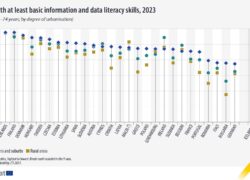
In 2023, 85.4% of people aged 16–74 living in EU cities were able to perform basic digital tasks such as finding, evaluating, and managing online information. The share was slightly lower among residents of towns and suburbs (80.4%) and rural areas (77.6%).

Across most of the EU, urban populations reported the strongest levels of data literacy. In 22 member states, cities recorded the highest shares of digitally literate residents. However, four countries showed a different trend: Denmark (95.9%), Ireland (94.4%), Cyprus (90.4%) and Belgium (89.4%) reported the highest levels in towns and suburbs, while in Malta rural areas led (91.6%), although data reliability was low.

The Netherlands recorded the highest literacy levels overall, with more than 97% of residents in cities, towns, and rural areas reaching at least basic data literacy. Finland (97.7%) and Denmark (95.8%) also ranked among the top performers in cities. By contrast, Germany (77.5%), Bulgaria (78.0%) and Italy (78.2%) reported the lowest shares in urban areas.

Disparities were more pronounced outside cities. In rural areas, the lowest levels were observed in Bulgaria (57.7%), Romania (64.9%) and Germany (71.2%), while Finland (95.2%) and Denmark (94.2%) joined the Netherlands in leading the rankings.

The findings highlight persistent digital divides across regions and countries, even as overall literacy levels remain high.

International Literacy Day, established by UNESCO in 1967, is observed annually on September 8 as a reminder that literacy, both traditional and digital, is a fundamental human right and a foundation for dignity.

LATEST NEWS