Monday, 21 September 2026
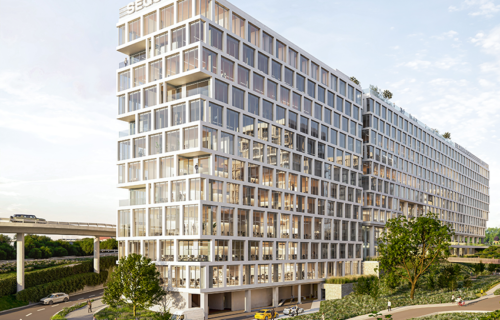
The Sequoia office building, being developed as part of the Nové Roztyly mixed-use project in Prague 11, has reached a key construction milestone with the completion of its foundation slab.
The project, developed by Passerinvest Group and being built by the GEMO Group, is scheduled for completion in the first half of 2028. The completion of the foundation slab follows earlier works on the excavation pit and allows construction of the underground and above-ground floors to proceed.
According to the developer, the project is being built on a sloping site with an elevation difference of up to 13 metres and below the groundwater level, presenting additional engineering challenges.
Sequoia forms part of the broader transformation of the Nové Roztyly district, where Passerinvest Group is developing a mixed-use urban area that will include office space, public areas, services, green spaces and future residential projects. The development follows the completion of the nearby office scheme, Roztyly Plaza, and is located close to the Roztyly metro station and the Krč Forest.
Upon completion, Sequoia will provide more than 33,000 sqm of office space and 375 sqm of retail space across 11 floors. The building will also include a canteen and café, shared meeting facilities with capacity for up to 200 people, rooftop terraces, private loggias and cyclist amenities.
The development will offer 488 parking spaces in underground garages, with selected spaces equipped with electric vehicle charging infrastructure.
The project is targeting BREEAM Outstanding certification and will incorporate technologies including heat pumps, photovoltaic panels and energy-efficient heating and cooling systems. Sustainability measures will also focus on indoor environmental quality, water management, biodiversity and blue-green infrastructure solutions.
Construction of the excavation pit took place between September 2025 and April 2026, during which more than 66,000 cubic metres of soil were removed. The foundation slab covers almost 5,800 sqm, has a thickness of 750 mm and required approximately 4,500 cubic metres of concrete and 720 tonnes of steel reinforcement.
The building is supported by 219 foundation piles ranging from 900 mm to 1,500 mm in diameter, with a combined length of nearly 1.6 kilometres. The underground structure has been designed to withstand groundwater conditions through the use of waterproof concrete construction and specialised sealing systems.