Saturday, 24 October 2026
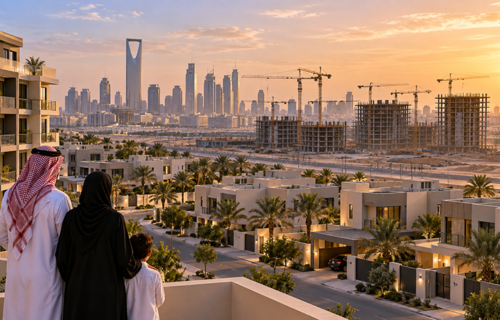
Saudi Arabia continues to expand its housing supply at extraordinary speed, but the residential market is beginning to expose a challenge that construction alone cannot resolve. The country needs additional homes as its cities grow and its economy attracts more activity, yet weaker sales during the second quarter of 2026 suggest that the ability of households to purchase those homes is becoming increasingly important. Residential transactions slowed markedly during the quarter. The total value of housing deals was approximately 26.9% lower than a year earlier, while the number of transactions declined by around 14.2%. At the same time, residential land values increased by approximately 6.3%. Apartment prices remained comparatively resilient, while villa prices recorded a much larger decline.
The combination creates an unusual development equation. The underlying land required to produce housing is becoming more expensive while buyers appear more cautious about committing to finished homes. If this pattern continues, developers will increasingly have to reconcile the price they pay for development sites with the amount households can borrow and comfortably repay. This is particularly significant because Saudi Arabia’s housing requirement remains substantial. Population growth, household formation, economic diversification and continued urban expansion all support the need for additional residential supply. The slowdown in transactions therefore does not necessarily indicate that people no longer want homes. It raises a different question: whether enough of the homes available are being offered at prices that match household purchasing capacity.
The contrasting performance of villas and apartments provides an indication of how that pressure could reshape the market. Villas have traditionally occupied an important position in Saudi housing, but their larger floor areas and greater land requirements generally produce higher total purchase prices. Apartments can accommodate more households on the same site and provide a lower entry price by reducing the amount of space each buyer purchases. The second-quarter figures do not prove that Saudi households are abandoning villas in favour of apartments. Differences in location, age, specification and the properties actually transacted can all influence market averages. Nevertheless, the substantial decline in villa pricing compared with the relative resilience of apartments suggests that the total amount buyers are being asked to spend deserves closer attention.
For developers, the issue begins with land. When site prices rise, there are only a limited number of ways to maintain acceptable development returns. Selling prices can increase, construction costs can fall, margins can narrow or more saleable space can be created from the same site. When buyers resist higher prices, increasing density becomes one of the most practical responses. That could gradually alter Saudi residential design. Instead of simply increasing the size and specification of homes, developers may need to pay greater attention to the final purchase price. Smaller apartments, more efficient layouts, compact family homes and villas on reduced plots could allow projects to reach a wider group of purchasers without necessarily reducing construction quality.
Riyadh is likely to be central to this adjustment. The capital is expanding rapidly as employment, corporate activity, entertainment, tourism and infrastructure investment increase. These trends create additional residential requirements, but they also intensify competition for land in established and well-connected areas. Moving housing development further from expensive locations provides one solution, although cheaper land does not automatically create affordable living. A household purchasing a less expensive home on the edge of a city may face longer journeys, greater transport costs and reduced access to schools, shops, healthcare and employment.
Infrastructure therefore becomes part of the housing affordability equation. Riyadh’s expanding transport network has the potential to make a wider range of residential locations practical for commuters. If peripheral districts can be connected efficiently to employment centres, developers gain access to a larger pool of land on which housing can potentially be delivered at lower prices. The same principle applies to new master-planned communities. Their success will depend on more than the number of homes constructed. Schools, retail, recreation, healthcare, roads and transport connections determine whether households view a new district as a realistic alternative to established neighbourhoods.
Jeddah faces similar pressures, although its urban structure is different. New residential districts can expand outward from an established metropolitan economy with existing employment, airport connections, commercial activity and public services. Developers still have to balance the lower cost of emerging locations against buyers’ preference for established neighbourhoods and shorter journeys.
Financing adds another layer to the affordability challenge. Most purchasers experience the housing market through the size of the deposit and the monthly mortgage payment rather than through abstract movements in property prices. A home can therefore become harder to purchase even when its nominal value changes relatively little if financing conditions increase the monthly burden. Saudi Arabia has developed extensive mechanisms intended to broaden access to home ownership. Public housing initiatives, financing programmes and partnerships between government-related organisations and private developers have accompanied a substantial increase in home ownership. Such measures remain important because they can help eligible households bridge the gap between savings, income and property prices.
However, buyer assistance cannot indefinitely compensate for housing whose production cost moves beyond household purchasing capacity. Sustainable affordability ultimately requires supply to be created at price points that households can support without increasingly large interventions. This is where the Q2 divergence between land and completed housing becomes especially relevant. If residential sites continue appreciating while buyers become increasingly price-sensitive, the pressure will eventually move back through the development chain. Developers will have to reconsider density, location, unit mix and land acquisition strategies.
Companies that already control land could consequently have an advantage. Sites acquired before substantial increases in value provide developers with greater flexibility when setting selling prices. Partnerships involving public-sector land can potentially create similar flexibility, while higher-density planning can spread land costs across a larger number of homes. For investors, this means residential opportunity should not be measured simply by population growth or the number of homes Saudi Arabia expects to require. The composition of that demand matters. A development aimed at households capable of purchasing SAR1 million homes faces a fundamentally different market from one requiring buyers to finance properties costing several times as much.
The most successful projects may therefore be those designed around household budgets from the beginning rather than adjusted after sales slow. That means considering the likely mortgage payment, required deposit and total purchase price before deciding unit sizes, density and specifications. There is also an opportunity for residential developers to rethink what affordability means. Smaller does not necessarily have to mean basic. Efficient apartments can still provide attractive communal spaces, landscaping, recreation and access to services. Compact villas can preserve private family space while using considerably less land than conventional detached housing.
This could produce a more diverse Saudi housing market. Apartments may become increasingly important for younger households and buyers seeking lower entry prices, while smaller villas and townhouses could provide alternatives for families wanting more space without paying for large plots. None of this means Saudi Arabia is facing an absence of residential demand. The country’s demographic and economic development continues to create a considerable long-term requirement for housing. The more important distinction is between needing a home and being able to purchase the particular homes available.
That difference helps explain why declining transactions can coexist with extensive construction and rising land values. Housing demand can remain structurally significant while the pool of buyers capable of completing purchases at prevailing prices becomes more selective. Saudi Arabia’s residential expansion is therefore entering a more demanding stage. Increasing supply remains necessary, but the market will increasingly judge developers by whether their homes match household finances as closely as they match demographic projections.
The next phase of Saudi housing may consequently be defined less by the sheer number of units announced and more by decisions about size, density, location and connectivity. With land becoming more expensive and buyers showing greater sensitivity to total purchase costs, affordability is moving from a social policy issue to a central development consideration. For Saudi Arabia’s residential market, building enough homes is only half of the challenge. The other half is ensuring that the people those homes are intended for can realistically afford to buy them.
Source: CIJ.World Research & Analysis Team