Sunday, 11 October 2026
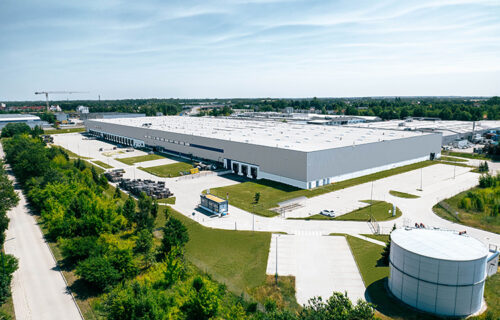
Logicor has fully leased the warehouse and production space at Logicor Łódź III following two new agreements, including approximately 5,500 sqm taken by electronics distributor Transfer Multisort Elektronik (TME). The transactions come as occupier demand strengthens across Poland while the development pipeline remains comparatively restrained.
The second agreement was signed with an unnamed manufacturer of aluminium components. Together, the two transactions bring the industrial accommodation at Logicor Łódź III to full occupancy, although approximately 1,500 sqm of office space remains available. 25-08-2026_ENG- Logicor Łódż III_press release.docx
TME is expanding its logistics capacity at the property to support the distribution of electronic components. The Łódź-based company serves customers across more than 150 countries and will use the additional space as part of its international distribution operations. 25-08-2026_ENG- Logicor Łódż III_press release.docx
The leasing activity takes place against a strengthening Polish warehouse market. AXI IMMO recorded approximately 3.51 million sqm of gross take-up nationwide during the first half of 2026, an increase of 21% year-on-year. More significantly, net take-up covering new agreements and expansions increased by 58%, with these transactions accounting for around 60% of leasing activity.
The Łódź region was already among the country’s busiest warehouse markets at the beginning of the year. Approximately 228,000 sqm was leased in Łódzkie during Q1 2026, placing it fourth nationally behind the Mazowieckie, Wielkopolskie and Dolnośląskie regions. The independently reported figure confirms the market data cited in Logicor’s announcement. 25-08-2026_ENG- Logicor Łódż III_press release.docx
The supply side is becoming equally important. Poland’s modern warehouse and industrial stock reached approximately 38.0 million sqm at the end of June, following delivery of around 1.23 million sqm during the first half. However, only approximately 1.30 million sqm was under construction, representing the lowest development pipeline for more than nine years.
Developers are also maintaining greater discipline over speculative construction. Only around 38.6% of the space being developed at the end of H1 was speculative, with much of the remaining pipeline already secured through pre-leases or being developed for identified occupiers.
This combination of stronger demand and restrained construction has begun reducing immediately available space. Poland’s national warehouse vacancy rate fell to approximately 6.3% at the end of June, compared with 7.3% at the end of the first quarter and 1.8 percentage points below the level recorded a year earlier.
The figures do not indicate a general shortage of warehouse space across Poland, but they point towards increasingly selective availability, particularly for occupiers requiring larger modern units in established logistics locations.
Łódź remains well positioned within that market because of its central location and access to Poland’s principal north-south and east-west transport corridors. Logicor Łódź III is approximately 9 km from central Łódź and 8 km from Łódź Lublinek Airport, with access to the A1 and A2 motorway network. 25-08-2026_ENG- Logicor Łódż III_press release.docx
The region’s role has expanded beyond conventional distribution as manufacturers, e-commerce companies and international logistics operators have established facilities around the metropolitan area. Its combination of motorway connectivity, central geography and established industrial workforce has helped Łódź develop into one of Poland’s principal warehouse clusters.
Logicor’s latest leasing should therefore be viewed as part of that wider market rather than evidence by itself that regional demand is accelerating. Full industrial occupancy at a single property cannot establish the condition of the Łódź market, but it comes alongside independently reported growth in Polish net take-up and declining vacancy.
The national development pipeline also suggests that competition for suitable existing space could become more significant if occupier demand remains at current levels. Developers have so far resisted returning to the substantially higher levels of speculative construction seen during earlier phases of the logistics cycle.
For existing warehouse owners, that environment could support occupancy and rental performance, particularly at properties with strong transport connections and buildings capable of accommodating both distribution and light manufacturing requirements. For occupiers, reduced speculative development may mean that searches for larger facilities need to begin earlier, particularly where location and technical requirements significantly restrict the number of alternatives.
The completion of the latest leases at Logicor Łódź III consequently illustrates a broader shift taking place in Poland’s industrial market. Demand strengthened during the first half of 2026 while new construction remained controlled and national vacancy moved lower.
Rather than a market characterised by indiscriminate expansion, Poland is increasingly entering a period in which the quality, size and location of available space matter as much as the headline vacancy rate. For established logistics hubs such as Łódź, that could strengthen the position of well-connected existing properties as occupiers compete for a more limited pipeline of immediately available modern space.