Saturday, 19 September 2026
Japan’s commercial real estate market is increasingly becoming part of the country’s energy transition. As the government works towards its goal of achieving net-zero greenhouse gas emissions by 2050, developers, investors and property owners are expanding their focus beyond traditional building performance to include clean electricity generation, energy storage and long-term energy resilience.
Rather than viewing buildings solely as places to live or work, the industry is beginning to treat them as energy-producing assets capable of lowering operating costs, improving environmental performance and generating new sources of value. This trend is becoming particularly visible across office buildings, logistics facilities, industrial parks and mixed-use developments, where large rooftops and significant electricity demand create favourable conditions for renewable energy projects.
Buildings Become Part of the Energy Network
The integration of renewable energy into commercial property is accelerating across Japan. Developers are increasingly installing rooftop solar systems while securing long-term renewable electricity through corporate power purchase agreements (PPAs). These arrangements allow property owners to source clean electricity directly from renewable energy producers, helping to reduce exposure to volatile energy prices while supporting corporate sustainability targets.
One of the country’s largest initiatives was announced in early 2026 when Nomura Real Estate partnered with Clean Energy Connect to establish a business dedicated to developing hundreds of distributed solar facilities across Japan. Electricity generated by these installations will supply properties within Nomura’s portfolio through long-term agreements, demonstrating how renewable energy can become an integral part of real estate operations rather than a separate infrastructure investment.
The approach reflects a wider shift within Japan’s property sector, where developers are seeking greater control over their energy supply while reducing dependence on conventional electricity sources.
Japanese REITs Accelerate Sustainability
Japan’s listed real estate investment trusts are also expanding renewable energy across their portfolios. Many have introduced rooftop solar installations on office buildings, logistics centres and retail properties as part of broader environmental strategies.
Alongside on-site generation, property companies are increasing their use of renewable electricity certificates and other market mechanisms to support the transition towards cleaner energy supplies across their operational portfolios.
For investors, these measures are becoming increasingly important as environmental performance plays a larger role in investment decisions, tenant expectations and access to sustainable finance.
Battery Storage Gains Strategic Importance
As renewable electricity production grows, battery energy storage is emerging as an essential component of Japan’s energy infrastructure. Solar and wind generation fluctuate depending on weather conditions, making energy storage increasingly valuable for balancing electricity supply and demand.
Battery systems allow surplus electricity generated during periods of high renewable output to be stored and released when demand increases or renewable generation falls. This improves grid stability while helping maximise the use of renewable energy.
Industry organisations have highlighted growing investment in large-scale battery projects as equipment costs continue to decline and renewable energy capacity expands throughout the country.
Real Estate and Energy Storage Are Converging
Battery storage is no longer viewed solely as part of the electricity network. Increasingly, developers are considering battery systems as complementary infrastructure within commercial property developments.
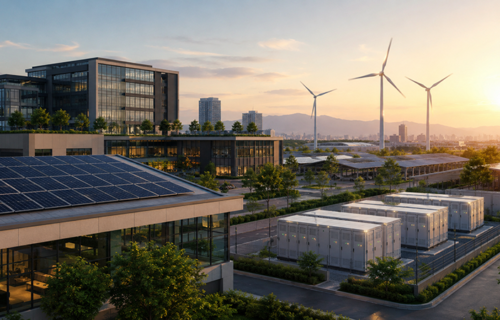
Industrial parks, logistics hubs and business campuses can combine rooftop solar generation with on-site battery storage, allowing buildings to store electricity for later use, reduce peak electricity purchases and improve resilience during supply disruptions.
This integrated approach can also create additional revenue opportunities by allowing stored electricity to participate in electricity balancing markets where regulations permit.
The combination of renewable generation and battery storage is becoming particularly attractive for large commercial assets with predictable energy demand and significant available space.
Major Projects Signal Long-Term Confidence
Japan is also witnessing growing investment in utility-scale battery storage. Companies including PowerX and Banpu Japan are developing large battery facilities in Fukushima and Miyazaki Prefectures that will strengthen regional electricity networks while supporting greater renewable energy integration.
These projects are designed to improve grid flexibility and accommodate increasing volumes of renewable generation as Japan continues to diversify its energy mix.
Although most of these developments operate independently of commercial real estate, they demonstrate the wider investment flowing into energy infrastructure that increasingly complements property development.
Challenges Continue to Shape the Market
Despite growing momentum, several obstacles remain.
Grid connection capacity remains limited in some regions, delaying both renewable generation and battery projects. Developers also continue to face evolving electricity market regulations, while forecasting future revenue from battery storage remains more complex than for traditional real estate investments.
Financing structures are also adapting as lenders and investors evaluate projects that combine property assets with electricity generation and energy infrastructure.
In addition, developers must ensure that renewable energy systems, battery installations and building operations are integrated efficiently while maintaining safety, reliability and long-term asset performance.
A New Investment Theme for Japanese Real Estate
The convergence of commercial property, renewable electricity and battery storage represents one of the most significant structural changes taking place in Japan’s real estate market.
Instead of serving only as locations for business activity, buildings are increasingly becoming active participants in the country’s energy system. Solar generation, long-term renewable electricity contracts and battery storage are creating opportunities to improve operational efficiency while strengthening energy security.
As Japan continues its transition towards a lower-carbon economy, the relationship between property and energy infrastructure is expected to deepen further. Developers who successfully combine sustainable buildings with resilient energy systems are likely to be well positioned to meet evolving tenant expectations while creating more stable long-term investment value.
Source: © CIJ.World Japan Research & Analysis Team