Tuesday, 20 October 2026
Artificial intelligence is beginning to change the economics of space, moving the industry beyond satellites that simply collect and transmit information towards increasingly software-defined infrastructure capable of analysing data, managing missions and potentially providing computing capacity in orbit. Speaking at Ai4 2026 in Las Vegas, Heather Pringle, CEO of Space Foundation and a retired U.S. Air Force major general, described AI as increasingly embedded across the space industry, from Earth observation and spacecraft design to mission management, collision avoidance and onboard processing.
The shift is happening alongside rapid expansion of the commercial space economy. Launch costs have fallen, reusable rockets have increased deployment frequency and satellite constellations have become much larger. Governments are also relying more heavily on commercial companies rather than developing every capability internally. Pringle argued that this is helping move space away from a hardware-dominated model towards one that is increasingly based on software and services, because some capabilities can continue evolving after launch rather than remaining fixed for the lifetime of a satellite.
One of the clearest examples comes from Earth observation. Satellites already collect enormous amounts of imagery covering agriculture, weather, infrastructure, environmental change and natural disasters. Historically, much of that information has been transmitted to Earth before being processed. NASA demonstrated a different model in 2026 when researchers successfully deployed the NASA-IBM Prithvi geospatial foundation model aboard two orbital platforms, allowing AI analysis to take place in orbit before all of the underlying data was sent back to terrestrial systems.
The significance goes beyond speed. Satellite communications bandwidth is limited, particularly when large quantities of high-resolution imagery are involved. If AI can identify relevant information in orbit, satellites may only need to transmit the data that matters most. A system monitoring wildfires could prioritise areas where conditions have changed, agricultural monitoring could identify unusual crop patterns and disaster-response satellites could detect flooding or fire damage before the full dataset reaches Earth.
This begins to change the relationship between satellites and terrestrial data centres. Instead of space functioning mainly as a source of raw information for computing infrastructure on Earth, part of the analysis can increasingly happen close to the sensors themselves. The concept resembles edge computing on Earth, where information is processed near the point at which it is generated rather than continually transmitted to a central cloud facility.
That becomes increasingly important as satellite constellations grow. Large networks generate huge volumes of telemetry and imagery while also requiring constant monitoring of satellite condition, orbital position and surrounding traffic. AI can help identify anomalies, predict equipment failures and support decisions about how satellites should manoeuvre. Collision avoidance is becoming particularly important because low-Earth orbit is increasingly crowded with active satellites, debris and planned future constellations.
The implications extend beyond satellite operations because commercialisation is also changing how governments procure space capabilities. Pringle said U.S. agencies increasingly seek to use commercial services where practical rather than attempting to match the speed of private-sector development internally. NASA, the U.S. Space Force and other agencies can therefore become major customers of privately developed satellite communications, imagery, launch capacity and digital services.
This represents a significant shift in the structure of the space economy. Public agencies remain major sources of research funding and mission demand, but private companies increasingly own and operate the infrastructure. That commercial model is already visible in communications and Earth observation and is beginning to extend into lunar services, private space stations, manufacturing and potentially computing.
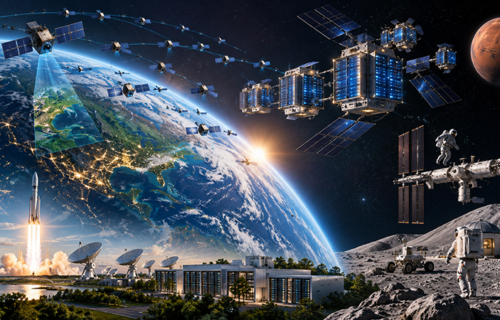
Among the most ambitious ideas discussed at Ai4 was the development of orbital data centres. The concept has moved from speculative discussion towards actual corporate proposals. SpaceX filed with U.S. regulators in early 2026 for permission to develop an orbital data-centre system involving as many as one million satellites, while other companies have proposed computing constellations involving tens of thousands of spacecraft. These numbers represent proposed systems rather than deployed infrastructure, and their economics, engineering and regulatory feasibility remain uncertain.
Nevertheless, the scale of the proposals shows how seriously some companies are beginning to examine space-based computing. The attraction is closely connected with the terrestrial AI infrastructure boom. AI requires enormous quantities of electricity and increasingly large data-centre campuses, putting pressure on electricity grids, development land, cooling systems and planning processes in major markets.
Space theoretically offers a different resource environment. Solar energy can be available for long periods in orbit, while computing infrastructure would not compete directly with terrestrial uses for development land. But those advantages are offset by major engineering difficulties, particularly cooling. Data centres on Earth remove heat using air or liquid systems. In space there is no atmosphere to support conventional cooling, meaning heat must primarily be rejected through radiation, which creates important limits on how densely computing equipment can operate.
Launch cost, reliability, maintenance and hardware replacement are additional challenges. Terrestrial data centres can replace failed servers continuously, while repairing or upgrading computing infrastructure in orbit is far more complicated. Communications represent another constraint because orbital data centres would only be useful if enormous amounts of information could move efficiently between satellites, ground infrastructure and end users.
Pringle therefore described orbital computing as a technology that still requires considerable development rather than an immediately mature alternative to data centres on Earth. She suggested that meaningful commercial progress could potentially emerge within roughly five to seven years, although this remains her own assessment rather than an established industry forecast.
What is clearer is that the economics are beginning to attract capital. The AI boom has dramatically increased the value of access to power, computing and connectivity, encouraging companies to examine infrastructure concepts that would previously have appeared economically unrealistic. Space infrastructure may therefore begin competing for investment within the wider digital-infrastructure sector.
Investors who traditionally examined fibre networks, terrestrial data centres, towers and cloud infrastructure may increasingly encounter opportunities involving satellite communications, orbital connectivity and space-based computing. The boundaries between these sectors are already becoming less clear because satellite networks ultimately depend on terrestrial fibre, cloud computing, ground stations and physical data centres.
Space infrastructure therefore does not replace terrestrial digital infrastructure. It extends it. Ground stations still require suitable locations, power and connectivity. Launch facilities require large areas of specialised industrial infrastructure. Satellite manufacturing requires advanced production facilities, while space companies also need laboratories, research centres and testing environments. As the number of commercial missions increases, this supporting property ecosystem could expand with it.
The development of private space stations could create another layer of commercial activity. Several companies are working on privately operated orbital platforms intended eventually to supplement or replace some of the functions currently provided by the International Space Station. These facilities could support scientific research, manufacturing and commercial experimentation, including specialised pharmaceutical and advanced-material processes.
AI could make such facilities more practical by reducing the number of tasks requiring continuous human control. Autonomous monitoring, robotics and intelligent mission-management systems could allow orbital platforms to operate with fewer personnel while handling more experiments. This illustrates a broader relationship between AI and the economics of space: because deploying people in orbit remains exceptionally expensive, technologies that allow machines to make more decisions independently can create proportionally greater value.
The same principle applies to exploration. The further spacecraft travel from Earth, the less practical continuous human control becomes because communications delays increase. Autonomous systems therefore become increasingly important for missions to the Moon, Mars and beyond. AI can help spacecraft interpret sensor information, identify hazards, plan movements and respond to unexpected conditions without waiting for instructions from Earth.
This does not mean humans disappear from mission control. It means decisions increasingly have to be divided between those requiring human judgement and those machines can execute safely within predetermined boundaries.
The Artemis programme illustrates the increasingly international nature of major space missions. Artemis II carried astronauts around the Moon in 2026 with significant contributions from international partners, including Europe and Canada. Future space infrastructure is therefore unlikely to be developed by individual countries operating completely independently.
International partnerships can provide both economic scale and operational resilience. That resilience is becoming increasingly important because satellite infrastructure now supports communications, navigation, financial transactions, aviation, logistics, weather forecasting and many other parts of the global economy.
Governments consequently view access to space infrastructure as a strategic issue as well as a commercial one. Satellite networks increasingly need to be designed to continue operating if individual spacecraft fail or are damaged. Large constellations provide one form of resilience because the overall network can potentially continue functioning after losing individual satellites, while multiple orbital layers and links between national and commercial systems provide further redundancy.
The growing strategic importance of orbital infrastructure also creates geopolitical complications. Major economies are investing more heavily in satellite communications, Earth observation and defence-related space capabilities, making resilience, sovereignty and allied cooperation increasingly important parts of infrastructure planning.
The AI race and the space race are therefore beginning to overlap. AI needs enormous quantities of infrastructure, while space increasingly needs AI to manage the complexity created by larger constellations, greater data volumes and more autonomous operations.
That relationship could eventually produce an entirely new category of digital infrastructure extending from terrestrial data centres through fibre networks and ground stations into orbit. Much of that vision remains early, and orbital data centres in particular still face serious technical and economic obstacles. Announcements involving enormous future constellations should not be confused with completed infrastructure.
But the direction of travel is becoming clearer. Space is no longer simply a destination for scientific missions or communications satellites. It is gradually becoming another layer of the digital economy.
For real-estate and infrastructure investors, that means the AI infrastructure story may eventually extend considerably beyond the enormous data-centre campuses currently being built on Earth. The next phase could involve the physical infrastructure connecting terrestrial computing, ground stations, satellite networks and eventually computing systems operating in orbit.
If that happens, the boundary between aerospace and digital infrastructure will become increasingly difficult to define.
Source: CIJ.World Research & Analysis Team