Sunday, 11 October 2026
Africa’s growing role in global critical-mineral supply chains is beginning to reshape property markets well beyond the mines themselves. Investment in copper, cobalt and other strategic resources is generating demand for housing, industrial space, logistics facilities and urban infrastructure, particularly across the mineral-producing regions of the Democratic Republic of Congo and Zambia and along new transport routes towards Angola.
The continent already supplies a large share of several minerals required for electrification and advanced manufacturing. Africa accounts for most global cobalt and manganese production and close to a fifth of copper output. With international demand expected to increase further, governments are also seeking to move beyond extraction by attracting processing and manufacturing investment that can retain more economic value locally.
For real estate, this creates opportunities at several stages of the mineral supply chain. New mines bring workers, contractors and service companies into areas that often have limited existing property stock. Housing demand can be followed by requirements for retail, healthcare, schools, hotels and other services, while mining suppliers create additional demand for workshops, storage facilities and industrial land.
Zambia demonstrates how quickly this process can transform a location. Copper investment around Kansanshi helped drive rapid expansion in Solwezi, creating economic growth but also placing pressure on housing and infrastructure. The experience influenced the development of Kalumbila further west, where the Sentinel copper mine was accompanied by a planned settlement including residential areas, education, healthcare and commercial facilities.
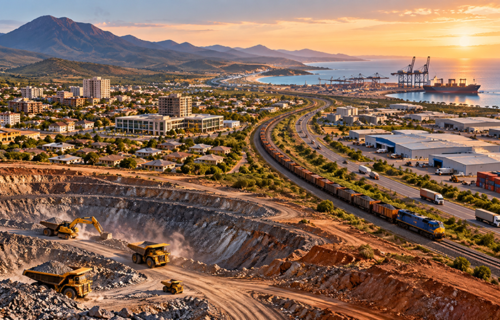
The larger property opportunity could increasingly emerge between mining areas and export markets. The Lobito Corridor is intended to improve connections between Angola’s Atlantic coast and the copper and cobalt regions of the DRC and Zambia. Investment around the route now extends beyond rail infrastructure, with governments and development institutions looking at energy, industrial development, trade and wider economic activity.
As these connections improve, transport nodes could create new locations for warehouses, processing facilities, distribution centres and industrial parks. Employment generated around those activities could subsequently support housing, retail and hospitality. The result could be a series of new economic clusters developing along routes that were previously viewed primarily as channels for exporting minerals.
The availability of electricity will be critical to whether that transformation occurs. Extracting minerals is only the first step in creating a larger industrial economy. Processing and manufacturing require dependable power, water and transport infrastructure. Areas able to combine mineral resources with reliable energy and international connectivity are therefore more likely to attract industrial investment and the property development that follows it.
The risks remain substantial. Mining-linked property demand can change with commodity prices, production decisions and government policy. Land ownership, infrastructure delays and environmental and community concerns can also affect projects. In the DRC, changes to the regulation of strategic minerals demonstrate how government intervention can quickly alter supply chains and investment assumptions.
For property investors, the opportunity is therefore not simply to follow the next mine. The more durable locations could be those where mining becomes the foundation for a broader economy involving processing, logistics, services and permanent urban development. That distinction will determine whether new settlements remain dependent on a single operation or develop into independent property markets.
Africa’s mineral boom is consequently beginning to create a new real estate geography. The most significant property opportunities may emerge not underground, but along the infrastructure connecting mines with power, processing centres, growing cities and international ports.
Source: © CIJ.World Africa Research & Analysis Team