Wednesday, 30 September 2026
Europe is approaching the 2026/27 heating season with less gas in storage than a year ago, leaving the market more sensitive to prolonged cold weather and disruption to global supplies. Germany, Europe’s largest gas consumer, entered September with storage sites approximately 53% full, compared with around 71% at the same point last year.
A particularly cold winter would not automatically result in gas shortages for households. Instead, the more immediate risk is a sharp increase in wholesale prices as European buyers compete for additional supplies. Industrial consumers would be especially exposed because energy-intensive production can become uneconomic well before physical supplies to protected residential customers are threatened.
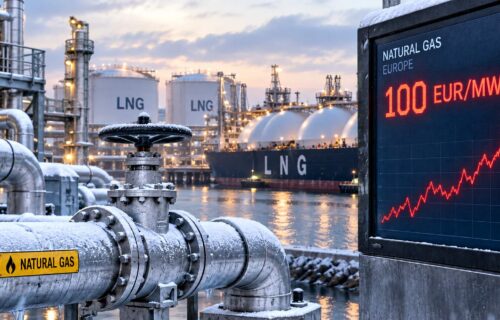
ARETE ENERGY investment director Martin Pacovský estimates that an extended period of low temperatures could push European gas prices towards €100–130/MWh. More extreme movements would be possible if strong European demand coincided with tighter LNG availability or higher consumption in Asia. Such levels should be viewed as a stress scenario rather than a price forecast, as actual market conditions will depend heavily on temperatures, storage withdrawals and international LNG flows.
Europe has considerably expanded its ability to receive liquefied natural gas since the 2022 energy crisis, providing more alternatives to Russian pipeline supplies. However, unused regasification capacity does not itself guarantee additional energy. LNG is traded internationally, meaning European buyers may need to offer higher prices to attract cargoes when demand strengthens simultaneously in other major markets.
Gas storage is another part of the equation. Capacity reserved by traders and suppliers can be substantially higher than the amount of gas physically stored, making headline capacity figures an incomplete measure of winter security. The economics of operating storage facilities have also become an issue, with the International Energy Agency warning that part of Europe’s storage capacity faces financial pressure despite its importance to energy security.
Households would generally experience a wholesale price increase later than industrial consumers because retail tariffs depend on how suppliers purchase gas and on the duration of fixed-price contracts. A cold winter can nevertheless create a double impact by increasing both the unit cost of energy and the volume required for heating.
The consequences would extend into commercial property and industry. Higher gas prices can increase operating costs for gas-heated offices, shopping centres, hotels, warehouses and residential buildings, while manufacturers with energy-intensive processes face a more direct impact on production economics. District-heating systems using gas may also eventually have to reflect higher fuel costs through regulated tariffs.
Europe therefore enters the winter with considerably stronger import infrastructure than during the initial energy crisis, but with less protection from storage than a year ago. The critical issue will be whether temperatures remain close to seasonal norms. A prolonged cold spell combined with competition for LNG could once again turn energy prices into a significant cost issue for European industry, households and real estate.