Monday, 5 October 2026
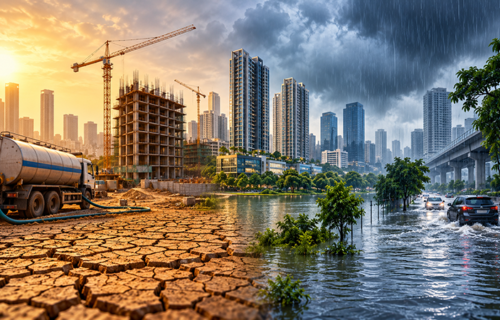
For Indian real estate, access to water is moving from an environmental concern to a development and investment consideration. Cities can experience shortages during prolonged dry periods and severe waterlogging only weeks later when intense monsoon rainfall overwhelms drainage systems. For developers and property investors, this creates two connected risks: insufficient reliable water for construction and building operations, and excessive water capable of disrupting access, damaging property and affecting long-term asset values.
The scale of the challenge extends well beyond individual cities. The World Bank estimated in 2026 that around 600 million people in India face water stress. India has approximately 18% of the world’s population but only around 4% of global water resources, while roughly 70% of annual rainfall is concentrated within three months. Rapid urbanisation and rising industrial demand are increasing pressure on the infrastructure needed to manage this uneven distribution of water.
Mumbai provided a clear demonstration of how quickly these conditions can affect property development. In June 2026, municipal authorities suspended water supplies to construction sites after reservoirs serving the city fell to just 10.35% of capacity, while commercial and industrial users also faced reductions. Projects able to obtain alternative supplies could continue, but the restrictions exposed developers to potential disruption and additional costs. Water risk also continues after completion, with residential developments, offices, hotels, shopping centres, logistics facilities and industrial properties potentially requiring storage, wastewater treatment, recycling, rainwater harvesting or alternative supplies when municipal infrastructure is insufficient.
At the opposite extreme, excessive rainfall can influence both operations and property values. Research examining Mumbai residential transactions between 2015 and 2019 found that homes in locations exposed to flood risk recorded average prices approximately 12.6% to 15% below comparable lower-risk areas within the study. This does not mean every flood-exposed Mumbai property carries the same discount today, but it provides evidence that environmental exposure can become reflected in real estate pricing. Rapid urban expansion can intensify the problem by reducing natural drainage while simultaneously increasing demand for water.
Bengaluru and Gurugram demonstrate how the two sides of the problem can emerge in rapidly expanding business and residential markets. Groundwater pressure, dependence on alternative supplies and periodic urban flooding can coexist with continued development and strong occupier demand. Institutional investors are consequently paying greater attention to water availability, consumption, recycling and flood resilience when assessing long-term property performance. For an asset expected to operate for decades, today’s municipal supply is only part of the equation; groundwater conditions, drainage capacity and future climate exposure also matter.
The issue becomes even more important as India develops increasingly infrastructure-intensive real estate. Data centres and certain industrial facilities require dependable utilities as part of site selection, while hotels, large residential communities, offices and shopping centres have substantial operational requirements. A cheaper land parcel can therefore become less attractive if a project depends heavily on groundwater, tanker deliveries or inadequate drainage. Conversely, developments designed around wastewater recycling, rainwater management and reliable infrastructure may be better positioned to withstand changing conditions.
India’s water challenge is therefore beginning to influence where property is built, how developments are designed and how long-term investments are assessed. Location, rental potential, tenant demand and connectivity will remain fundamental, but investors increasingly need to understand how an asset obtains, manages, reuses and disposes of water throughout its lifecycle. As urbanisation places greater pressure on India’s cities, water resilience is becoming another measure of whether a property can operate reliably and preserve its value over the long term.
Source: © CIJ.World India Research & Analysis Team