Sunday, 27 September 2026
The World Bank has approved a $600m programme to strengthen Serbia’s gas infrastructure over the next decade, combining investment in transmission and storage with changes to the organisation and regulation of the country’s gas sector. The programme is intended to improve supply reliability while allowing Serbia to make greater use of alternative import routes.
The first phase will receive €170m, equivalent to approximately $195.5m, according to the World Bank. Initial investment will focus on the Trupale–Pojate transmission pipeline and on building the institutional and technical capacity needed to implement the wider programme.
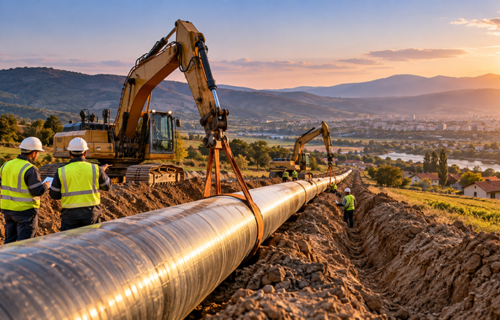
The planned high-pressure pipeline will extend for approximately 62 km between Trupale, near Niš, and Pojate. It represents the first section of a longer transmission corridor intended to connect southern and central parts of Serbia and remove restrictions within the existing network. Regional energy reporting indicates that the wider Trupale–Pojate–Veliko Orašje corridor is expected to extend for around 140 km.
The location is significant because Trupale is connected with the Serbia–Bulgaria interconnector, which has given Serbia access to additional gas supplies, including deliveries from Azerbaijan. Strengthening Serbia’s domestic transmission system should allow gas entering through alternative routes to reach industrial users, district heating networks, businesses and households further inside the country.
Later stages of the World Bank programme are expected to include additional transmission infrastructure and underground storage. Projects being considered include new storage capacity at Tilva in Vojvodina and further pipelines, although the scope, financing and construction schedules for subsequent phases have not yet been finalised. Serbia has also been expanding its existing storage capacity as it seeks to reduce the risks associated with dependence on external supplies.
The programme also forms part of a wider restructuring of Serbia’s gas market. Alongside physical investment, the World Bank financing is intended to support regulatory changes, network planning and stronger management of gas infrastructure. These measures are linked to Serbia’s efforts to bring its energy market closer to European Union requirements while increasing competition between supply routes.
Gas remains an important part of Serbia’s energy system while the country expands renewable generation and gradually reduces its dependence on coal. Earlier World Bank analysis found that additional gas capacity could support the transition away from coal in the shorter term, while stressing that achieving longer-term decarbonisation will require substantially greater renewable generation and eventual retirement of coal-fired capacity.
For Serbia’s property and industrial markets, greater transmission and storage capacity could also strengthen the infrastructure available to manufacturing facilities, logistics operations and other energy-intensive investments. Rather than representing a single construction project, the $600m World Bank commitment establishes a decade-long financing framework through which Serbia can modernise its gas network, diversify supply and potentially attract further development and private capital into its energy infrastructure.