Friday, 18 September 2026
Businesses are preparing to introduce AI agents at a scale that could significantly change how employees work, but corporate processes and workforce planning are not developing at the same pace, according to research examined by Deloitte.
The potential scale of adoption is substantial. Deloitte cites a Gartner forecast suggesting that the average Fortune 500 company could operate around 150,000 AI agents by 2028. In Deloitte research among senior managers and executives, around two-thirds said multi-agent AI could significantly change the way work is performed within the next two to three years, while only about one-quarter considered their workforce or business processes ready for such a transition.
Rather than attempting to predict a single outcome, Deloitte examined several possible ways in which humans and AI agents could eventually work together. The scenarios consider whether companies treat agents more like digital workers or as underlying technology infrastructure, as well as whether the economic benefits of the technology become widely distributed or remain concentrated among a relatively small group of businesses and workers.
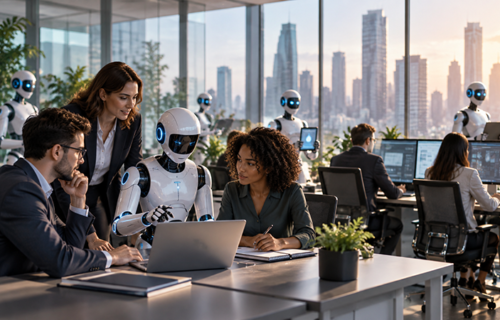
One possibility is that employees increasingly manage groups of specialised agents in much the same way they currently coordinate colleagues or teams. This could create new supervisory roles, but Deloitte warns that treating software too much like a human participant could make responsibility less clear when errors occur. Ultimately, accountability for business decisions and quality control would still need to remain with people.
Another possibility involves AI becoming a largely invisible operational layer capable of processing substantial volumes of routine work. Employees could then concentrate on judgment, customer relationships and more complex decisions. However, greater automated output could create a different problem: people may be required to review and approve far more material than before, potentially increasing cognitive pressure rather than reducing workloads.
The employment consequences could become more significant if companies use AI primarily to remove routine positions. Deloitte identifies the disappearance of junior roles as a particular risk because entry-level jobs traditionally provide employees with the experience needed to develop into senior specialists and managers. Reducing those positions without creating alternative development routes could eventually leave companies with shortages of experienced people capable of supervising automated systems and dealing with unusual situations.
The research suggests that corporate investment is currently weighted heavily towards the technology itself. Deloitte reports that 93% of organisational AI investment goes towards technology infrastructure, compared with only 7% directed towards issues involving people and the organisation of work. This imbalance could become increasingly important as companies move from isolated AI applications towards systems involving numerous autonomous agents.
Governance remains another major challenge. Nearly 70% of respondents in Deloitte research identified difficulties governing and trusting AI agents as an important obstacle to generating value from the technology. The consultancy argues that businesses will need to establish clear points at which human judgment is required and ensure that responsibility does not disappear as more stages of a process become automated.
Companies may also have to reconsider how they measure productivity. Faster processing and greater volumes of output do not necessarily translate into better results if employees become overwhelmed by reviewing machine-generated work. Deloitte cites separate research in which 53% of respondents acknowledged sending colleagues AI-generated work they considered unhelpful, low-effort or poor quality because they were already struggling with their workloads.
Human judgment could consequently become more valuable as routine activities are automated. In an informal Deloitte webinar poll involving 1,700 respondents globally, 47% identified judgment as the most important behaviour for employees in an AI-driven environment. Critical thinking and resilience were also identified by executives interviewed for the research as capabilities likely to become increasingly important.
Trust may ultimately determine how quickly employees adopt the technology. Deloitte’s research found that workers with high levels of trust in their organisations were 3.8 times more likely to use agentic technology. The findings suggest that companies will need to give employees clearly defined responsibilities, explain where human authority remains essential and provide credible channels through which problems with automated systems can be raised.
The implications extend beyond technology departments. If AI agents assume a growing share of administrative, analytical and operational work, businesses may eventually reconsider organisational hierarchies, recruitment, outsourcing and the composition of corporate teams. The precise effect on employment and workplace requirements remains uncertain, however, and Deloitte presents its alternative scenarios as planning exercises rather than predictions.
The emerging challenge for businesses is therefore not simply how many AI agents they can introduce. As deployment expands, the more important questions are likely to concern who remains accountable for their output, how employees develop the skills needed to supervise them and whether productivity gains can be achieved without weakening human expertise, trust and organisational resilience.