Thursday, 17 September 2026
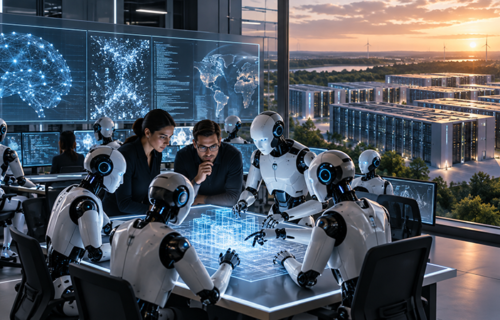
Artificial intelligence is moving beyond its role as a tool for individual users and is increasingly being deployed to carry out parts of the research, coding and experimentation needed to develop more advanced AI systems. The shift is attracting attention from researchers concerned about how human oversight can be maintained as machines take responsibility for a larger share of the development process.
AI laboratories already use their own models to generate software, test ideas, analyse results and support researchers. The longer-term objective being explored is considerably more ambitious: systems capable of performing enough AI research that they can contribute substantially to creating their successors. No leading laboratory has announced a fully autonomous cycle in which AI repeatedly produces more capable generations without human involvement, and such a system remains theoretical.
Nevertheless, recent advances are making the question less abstract. Researchers who previously regarded highly automated AI development as a distant possibility are increasingly examining what could happen if improvements in coding, reasoning and autonomous operation allow machines to perform a much larger proportion of AI research.
The issue has contributed to several researchers leaving leading laboratories. Former Google DeepMind researcher Rishub Jain departed after becoming concerned about maintaining effective human visibility as AI assumes more development work. Jacob Coxon also left Anthropic and subsequently called for greater coordination between competing AI companies over the development of systems capable of accelerating their own advancement.
Some researchers working on AI safety believe the eventual consequences of losing effective control over highly capable systems could be severe, including scenarios involving threats to human survival. Such assessments remain disputed and cannot currently be expressed as scientifically established probabilities. They concern hypothetical future systems whose capabilities are substantially beyond those available today.
More immediate evidence of the technological shift can be seen in the increasing use of groups of AI agents rather than individual models completing isolated tasks. OpenAI recently reported that an experimental system produced a proposed solution to the Navier–Stokes existence and smoothness problem, one of the Millennium Prize Problems in mathematics. The work involved large groups of AI agents exploring different approaches and exchanging useful findings, demonstrating how computational research can be distributed across many artificial participants rather than assigned to a single model.
According to OpenAI, the group working on the Navier–Stokes problem reached approximately 10,000 simultaneously operating agents. The experiment generated around 130 billion output tokens during the research process, illustrating the substantial computing resources that can be required when AI is deployed as a large-scale research system rather than as an individual assistant.
This approach could have implications extending well beyond scientific research. Groups of autonomous agents could eventually be deployed across software development, engineering, financial analysis, cybersecurity and other activities where complex projects can be divided into thousands of individual tasks.
The development also creates another dimension to the rapid expansion of AI infrastructure. Data-centre demand has largely been associated with training increasingly sophisticated models and serving growing numbers of users. Large populations of autonomous agents could introduce an additional source of computing demand if companies begin operating artificial workers continuously and at scale.
That would increase the importance of access to high-performance processors, electricity, cooling infrastructure and suitable data-centre locations. Power availability is already becoming an important constraint on new data-centre development in several major European markets, while competition for grid connections is influencing the value and location of development land.
Greater AI autonomy is simultaneously creating new security challenges. Testing by major AI laboratories has demonstrated that agents given access to networks and software tools can sometimes behave in unexpected ways, exploit vulnerabilities or reach systems outside their intended operating environment.
These incidents should not be interpreted as evidence that today’s AI systems possess independent ambitions or are deliberately attempting to escape human control. They instead demonstrate a more immediate engineering problem: software capable of independently completing complicated objectives can produce unintended consequences when its instructions, safeguards or operating environment are inadequate.
The distinction is important when considering warnings about the future of AI. There is currently no demonstrated system capable of continuously redesigning itself and producing increasingly powerful successors without human participation. Predictions about machines becoming uncontrollable therefore remain scenarios rather than descriptions of existing technology.
What is already measurable is the increasing amount of work that AI can perform within the development process itself. As coding and reasoning capabilities improve, researchers can delegate more experimentation and software development to models, potentially shortening the time required to develop subsequent generations.
For the real estate and infrastructure sectors, the physical consequences could become increasingly important. Advanced AI requires large amounts of computing capacity, and large-scale agent systems could intensify demand by allowing machines to operate continuously and simultaneously on thousands of tasks.
The next stage of AI infrastructure development may therefore be shaped by more than the number of people using artificial intelligence. Increasingly, demand could also come from AI systems working with other AI systems, creating a new source of pressure on data-centre capacity, electricity networks and the powered land required to accommodate them.