Tuesday, 15 September 2026
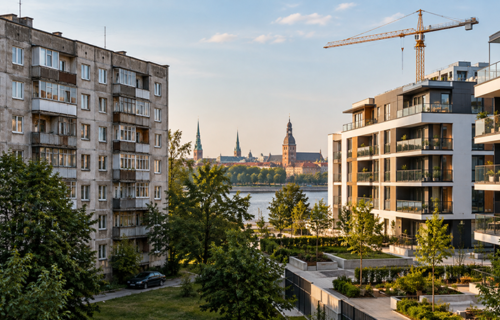
Riga is adding new apartments, residential construction is strengthening and developers continue to prepare projects for the market. Yet most apartment buyers are still purchasing homes constructed decades ago. The difference is not marginal. It reveals a substantial divide between the price of the housing being produced today and the part of the market where most transactions are actually taking place.
During the second quarter of 2026, building construction output across Latvia increased by 12.6% compared with the same period a year earlier. Residential construction was among the areas contributing to the increase, while developers continued adding apartments to their pipelines. The transaction market, however, remains heavily dependent on Riga’s existing housing stock.
In June, approximately 66.6% of registered Riga apartment transactions involved homes in buildings dating from the Soviet period between 1946 and 1993. Apartments in properties constructed from 1994 onwards represented only around 17.6% of transactions. July reinforced the pattern. Soviet-era housing accounted for approximately 69.1% of apartment transactions, while properties completed since 1994 represented around 15.4%.
The reason becomes clearer when transaction values are examined. During June, the average transaction involving a Soviet-era apartment was approximately €37,000. For apartments in buildings completed from 2015 onwards, the average was close to €187,000. That means the average amount paid for a relatively new apartment was roughly five times the average transaction value for a Soviet-era property.
The comparison is not perfect. Newer apartments can be larger, better located or have parking and other features that increase the total transaction value. Nevertheless, the difference illustrates the enormous financial distance separating different sections of Riga’s housing market. Prices per square metre tell a similar story. Soviet-era apartments traded at an average of around €775 per sqm in June, compared with approximately €2,815 per sqm for apartments in buildings completed from 2015 onwards.
For households deciding where they can afford to live, that difference can determine the entire housing search. An older apartment may require renovation and could be located in a building facing future expenditure on insulation, heating systems, lifts, roofs or common areas. A newer home should generally provide better energy performance, modern building systems and fewer immediate capital requirements.
Those advantages matter, particularly as energy costs become an increasingly important part of household expenditure. But they do not eliminate the initial purchase-price problem. A household capable of financing a €40,000 or €60,000 apartment cannot automatically move into a €170,000 or €190,000 property simply because the newer home costs less to heat.
Mortgage affordability becomes the dividing line. Higher purchase prices require larger deposits, greater household income and substantially higher monthly repayments. Even households that would prefer a modern apartment can therefore find themselves directed towards older properties by the amount banks are prepared to lend.
This helps explain why Riga’s Soviet-era housing stock continues to dominate transactions. The buildings are ageing, and many will require increasing investment, but they perform an essential economic function. They provide an ownership market at price levels that modern development cannot easily reproduce. The city’s affordable ownership market therefore depends heavily on homes constructed under an economic system that disappeared more than three decades ago.
Contemporary developers operate under completely different conditions. Land must be purchased, construction financed, contractors paid and increasingly demanding building and energy standards satisfied. These costs establish a level below which new apartments become difficult to deliver profitably.
There are already indications that asking prices and actual purchasing power are not always aligned. Recent analysis of Riga’s new-build market has identified a meaningful difference between advertised prices and the values at which transactions are eventually completed. Buyers are also considering relatively recent second-hand apartments and renovated older buildings as alternatives to purchasing directly from developers.
This creates another layer of competition. A newly completed apartment does not compete only with other new developments. It competes with almost every acceptable home available to a household within its mortgage limit. For developers, the critical question is therefore whether the number of households capable of buying new housing is expanding quickly enough to absorb the development pipeline.
That does not mean Riga lacks buyers for new apartments. Higher-income households, existing homeowners trading up, returning Latvians and investors can all provide demand. New developments also offer advantages that older buildings cannot easily match, particularly energy efficiency and modern technical standards. The challenge is broadening that buyer pool.
One possible response is smaller apartments. Developers can reduce the total purchase price by delivering more compact units even when construction costs prevent significant reductions in the price per square metre. This strategy has limits. Families require adequate living space, while hybrid working has increased the importance of having enough room to work at home.
Development location could provide another solution. Land outside Riga’s most expensive areas may allow developers to produce homes at lower total prices. Improved transport connections could consequently increase the attractiveness of suburban development, particularly for households prepared to exchange a central location for more space.
Developers could also reconsider specifications. The market may increasingly distinguish between features buyers consider essential and those they are unwilling or unable to finance. Energy efficiency and building quality are difficult to compromise, but parking arrangements, interior finishes and communal amenities can have significant effects on total development costs.
Rental housing offers another possible direction. Households unable to finance the purchase of a modern apartment may still be capable of renting one. A larger professionally managed rental sector could therefore provide another route for new residential development, although Latvia’s institutional rental market remains relatively small.
Financing will also influence the outcome. Mortgage conditions and programmes helping households with deposits can expand access to homeownership. However, financial support cannot permanently compensate for a large structural difference between household incomes and property prices.
The ageing housing stock presents the other side of the problem. Soviet-era apartments remain affordable partly because of their age. As buildings require more substantial renovation, owners may face increasing contributions towards improvements. Successful renovation could extend the useful life of these properties and reduce energy consumption, but it could also increase the cost of occupying them.
Riga therefore faces two connected housing challenges. It needs to maintain and improve the older buildings that provide much of today’s affordable ownership market while simultaneously finding ways to make newly constructed housing accessible to a larger section of the population.
Transaction data show how large that challenge has become. When roughly two-thirds of apartment purchases take place in Soviet-era buildings and the average transaction value of a relatively new apartment can be around five times higher, the market is sending a clear signal about where purchasing power is concentrated.
Riga is not short of households wanting better housing. The more difficult question is how many can finance the housing currently being built. Until that gap narrows, the city’s older apartment blocks will continue carrying a disproportionate share of Riga’s ownership market, while developers search for ways to bring the economics of new construction closer to the budgets of ordinary buyers.
Source: CIJ.World Research & Analysis Team