Sunday, 25 October 2026
Germany’s regional innovation programmes appear to generate their strongest economic impact among small and medium-sized companies, with new research showing significant increases in investment, employment spending and innovation among participating businesses.
A study involving the German Institute for Economic Research (DIW Berlin) examined Germany’s Spitzencluster programme, which supported 15 regional innovation networks with approximately €600 million of public funding. Contributions from participating organisations brought the combined project volume to around €1.2 billion.
The clusters connect businesses with universities, research organisations and other partners working in related industries. They cover areas including biotechnology, medical technology, mechanical and automotive engineering, electronics and renewable energy, creating regional ecosystems intended to accelerate research and commercial development.
Researchers compared participating companies with similar businesses that did not receive support, using corporate and patent information covering the period from 2000 to 2016. The strongest differences were identified among SMEs.
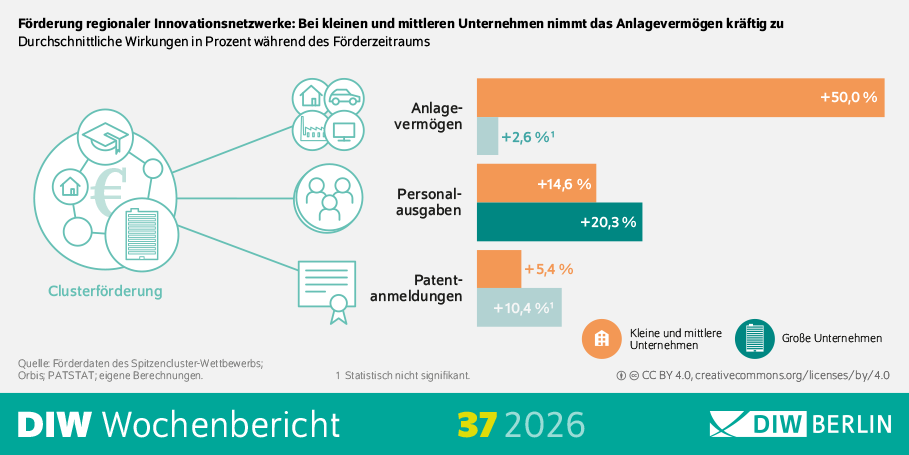
During the funding period, fixed assets among supported SMEs were approximately 50% higher on average than among comparable companies outside the programme. Spending associated with employment was almost 15% higher, while researchers also identified an increase in patent activity after taking the technological and economic significance of individual patents into account.
“Cluster funding is particularly effective for SMEs as an instrument for increasing investment, employment and innovation,” said Knarik Poghosyan from DIW Berlin’s Entrepreneurship research group. “SMEs should therefore be involved more strongly and more specifically in future cluster programmes.”
The results were less pronounced among larger corporations. While participating large companies increased expenditure on personnel, researchers did not find statistically robust evidence of comparable effects on fixed assets or patent activity.
For regional development, the findings suggest that innovation policy can have consequences beyond research expenditure alone. When smaller companies increase capital investment and employment, successful technology clusters can potentially support demand for laboratories, research facilities, advanced manufacturing premises and specialist business space. However, the DIW study itself examines company investment rather than directly measuring commercial property demand.
“The results suggest that future cluster programmes should be more closely aligned with the needs of small and medium-sized enterprises,” Poghosyan said. She noted that smaller businesses often have fewer financial and organisational resources and can therefore benefit particularly from improved access to knowledge, research partners and innovation networks.
The findings provide an important consideration for German regional economic policy. Rather than distributing innovation support uniformly across companies of different sizes, concentrating more resources on SMEs could generate stronger investment and innovation effects while reinforcing the regional business ecosystems surrounding Germany’s technology and manufacturing centres.