Wednesday, 21 October 2026
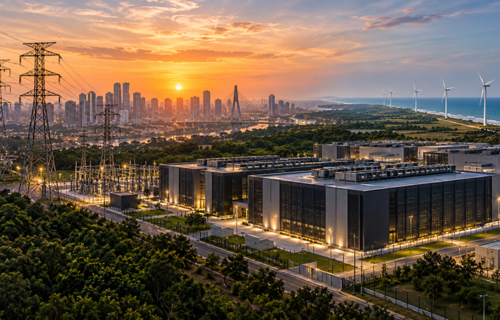
Brazil’s rapid expansion of digital infrastructure is beginning to change the way investors and developers assess land. As artificial intelligence, cloud computing and digital services require increasingly large computing facilities, the decisive factor in choosing a development site is no longer simply location or land cost. Access to sufficient electricity is moving towards the centre of the investment equation.
São Paulo remains the heart of Brazil’s data-centre industry and the largest concentration of capacity in Latin America. Its position reflects the scale of the surrounding economy, extensive telecommunications networks, proximity to corporate customers and an established cluster of operators and technology companies. New facilities continue to be developed across the metropolitan region, including projects capable of supporting the much higher computing densities associated with artificial intelligence.
The scale of the latest developments shows how quickly requirements are changing. Projects planned around Greater São Paulo are increasingly measured in hundreds of megawatts rather than the relatively modest capacities associated with earlier generations of data centres. Ascenty, Ada Infrastructure and Equinix are among the operators expanding in and around the region, while new campuses are incorporating dedicated electrical infrastructure and substantial capacity for future growth.
This expansion is creating a property challenge that conventional industrial development does not face to the same degree. A logistics warehouse can often be developed across a broad range of industrial locations provided there is suitable road access, labour availability and planning permission. A large data centre has a much narrower choice. The site must combine substantial and dependable electricity supply with telecommunications infrastructure, suitable land, security and the ability to obtain the necessary approvals.
Consequently, two parcels of industrial land located relatively close to one another can have very different potential values. A site capable of securing a major electricity connection and accessing multiple fibre routes may have strategic importance to a data-centre developer that bears little relationship to its value for conventional warehousing or manufacturing.
Brazil’s electricity authorities are already having to consider this new source of demand in longer-term network planning. Forecasts indicate that consumption from data centres could increase substantially before the end of the decade. Individual projects can require power on a scale comparable with major industrial operations, meaning that clusters of new facilities can create significant demands on regional transmission and distribution infrastructure.
This changes the development timetable as well. Acquiring land is comparatively straightforward compared with creating additional electricity capacity. New substations, transmission connections and network reinforcements can require long planning and construction periods. Developers able to secure credible access to large quantities of electricity therefore gain an advantage that competitors cannot necessarily reproduce simply by purchasing neighbouring land.
The result could be the emergence of a new hierarchy within Brazil’s industrial property market. At the bottom are sites suitable for conventional commercial development. Above them are locations offering strong telecommunications connections and proximity to established digital clusters. The most strategically valuable sites may increasingly be those where large quantities of electricity can actually be delivered within a commercially viable timeframe.
Brazil has another important advantage in this competition: its electricity system contains a high proportion of renewable generation. For global technology companies seeking to expand computing capacity while managing the environmental impact of their operations, access to renewable electricity can strengthen the country’s appeal compared with markets where additional computing demand remains heavily dependent on fossil-fuel generation.
That advantage does not mean every major project will remain concentrated around São Paulo. In fact, the search for electricity could gradually broaden Brazil’s data-centre geography. Ceará demonstrates what that alternative model could look like. Large digital infrastructure projects around Pecém can combine renewable generation with international telecommunications connectivity and available development land. Fortaleza and Ceará already occupy an important position in international fibre networks because of the subsea cables connecting Brazil with North America, Europe and other markets.
This creates the possibility of two complementary development models. São Paulo can continue serving as Brazil’s principal corporate and cloud-computing centre, supported by its enormous customer base and mature digital ecosystem. Other regions could attract very large computing campuses where access to energy, land and international connectivity outweighs the benefits of being close to the country’s largest commercial centre.
For property investors, this raises a more interesting question than how many data centres Brazil will build. It is whether control over electricity infrastructure will fundamentally change what constitutes valuable development land. Land traditionally derives much of its commercial value from location, permitted use, transport connections and surrounding demand. For digital infrastructure, an additional variable is becoming critical: how many megawatts can realistically be brought to the site, how quickly they can be delivered and how dependable that supply will be.
That could create opportunities well beyond the companies operating the facilities themselves. Landowners, infrastructure investors, developers and energy companies may increasingly compete to identify sites where electricity, fibre and property can be assembled before hyperscale customers enter the development process.
There are also risks. Announced electricity demand does not automatically translate into completed projects, while speculative acquisition of land based on assumed future grid connections could leave investors holding sites that cannot support the anticipated capacity. Water availability, environmental licensing, construction costs and local infrastructure can also affect development feasibility. The growing electricity requirements of data centres may additionally intensify debate about how new generation and network capacity should be allocated between digital infrastructure, industry and other consumers.
For this reason, it would be premature to describe electricity-ready land as a fully established property sector in Brazil. There is not yet enough transparent transactional evidence to demonstrate a consistent national valuation premium for such sites. The direction of the market, however, is becoming clearer. As AI increases the amount of electricity required by computing infrastructure, securing power is moving further towards the beginning of the development process.
Brazil’s next generation of data centres may therefore reshape more than the country’s technology industry. They could change how investors value industrial land itself. In a market where electricity connections can take longer to secure than property, the most important development opportunity may no longer be the largest or best-located parcel of land. It may simply be the site where the power can actually be delivered.
Source: CIJ.World Research & Analysis Team