Saturday, 19 September 2026
Japan’s exposure to natural disasters has influenced the design of its cities for generations, but climate change is adding another dimension to the way property risk is assessed. More intense rainfall, river flooding, surface-water inundation and coastal hazards are increasingly relevant to decisions about where buildings are developed, how they are protected and what owners must invest to keep them operational during extreme events. For commercial real estate, the issue is gradually moving beyond disaster preparedness. Flood exposure is becoming part of property due diligence, insurance assessment, development planning and long-term asset management. The important distinction for investors is increasingly not simply whether a building is located in an exposed area, but how effectively the property and the surrounding district can continue functioning when an event occurs.
Japan’s changing rainfall patterns strengthen the case for greater attention to physical climate risk. Extreme downpours have become more frequent over recent decades, increasing pressure on rivers, drainage networks and urban infrastructure. At the same time, future warming is expected to increase the intensity of heavy rainfall further. For dense metropolitan areas, the consequences can extend well beyond direct damage to buildings. Flooded roads, railway disruption, power failures and overloaded drainage infrastructure can interrupt access to commercial districts even where individual properties remain relatively well protected. This makes resilience a wider urban issue rather than something that can be addressed entirely within the boundary of a single development.
Japan has already taken an important step by integrating flood information into the property transaction process. Buyers and tenants are provided with information showing where a property sits in relation to official flood-risk maps as part of the disclosure process for relevant real-estate transactions. The system covers several forms of water-related exposure and gives prospective occupiers and purchasers an opportunity to understand potential risks before entering into a contract. For the property market, this is significant. Flood exposure is no longer information that only engineers, planners or insurers are expected to consider. It has become information presented directly to participants in real-estate transactions.
The country’s hazard mapping has also become increasingly detailed. Authorities have expanded the number of rivers and urban areas covered by inundation modelling, providing a more comprehensive picture of locations that could be affected during extreme rainfall. For developers, this information can influence decisions before construction begins. Selecting a site remains one of the most effective ways of managing physical risk, but avoiding every potentially exposed location is neither practical nor economically realistic in Japan’s largest cities. Some of the country’s most valuable commercial districts are located close to rivers, Tokyo Bay or other areas where water-related hazards have to be considered.
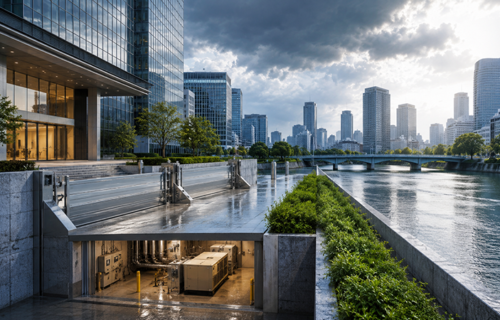
The alternative is to design buildings capable of functioning within that environment. Japan’s major developers already incorporate extensive resilience measures into selected commercial properties. Flood barriers can protect entrances, while watertight doors can isolate underground areas. Critical electrical and mechanical equipment can be positioned above the most vulnerable levels, reducing the risk that inundation disables an entire building. Emergency electricity is another important component. Some major Japanese office properties are designed to maintain essential functions for several days following a major disruption. Backup generators, stored fuel and independent energy systems can keep critical equipment operating even when external infrastructure is unavailable.
Water supply, ventilation, communications and emergency accommodation can also form part of the resilience strategy. These systems have particular relevance in Tokyo, where a major disaster could leave large numbers of employees unable to return home. Commercial buildings may need to function temporarily as safe locations for tenants and other people stranded in the district. This changes the role of resilience in premium office development. Emergency systems were once viewed largely as technical requirements. Increasingly, they can form part of the quality proposition of a building, particularly for corporate occupiers concerned about business continuity.
A multinational company leasing substantial office space may place value not only on location, sustainability and amenities, but also on whether employees can remain safe and whether essential operations can continue during an emergency. Mitsubishi Estate, Mitsui Fudosan and Mori Building are among the major developers that have incorporated extensive business-continuity infrastructure into large Tokyo properties. These measures include combinations of flood protection, backup electricity, independent energy supply, emergency water and crisis-management systems. In some developments, mechanical equipment has deliberately been placed away from the most flood-sensitive areas.
The approach demonstrates an important difference between hazard and actual asset vulnerability. Two office buildings located within the same potential inundation zone may have very different risk profiles. One could contain critical electrical equipment in an exposed basement and have limited emergency power. Another could have protected entrances, watertight mechanical areas, elevated equipment and sufficient backup generation to maintain important functions. For investors, understanding that difference is becoming increasingly important.
Japan has begun developing systems that attempt to evaluate resilience at the building level rather than judging property risk solely from its geographical location. Assessments can consider both exposure and the measures incorporated into the property to reduce potential damage and maintain operations. This could eventually become useful in investment analysis because hazard maps alone cannot explain how a particular asset will perform during a disaster.
Insurance is moving in a similar direction. Japan has introduced greater geographical differentiation into residential flood-insurance pricing, with locations separated into different categories according to their underlying exposure. Higher-risk locations can face higher reference premiums for flood coverage. The system does not translate directly into commercial-property insurance, where underwriting is more complex and individual building characteristics matter considerably. Nevertheless, it demonstrates a wider shift toward more detailed pricing of physical risk.
That direction is likely to become increasingly relevant to institutional property. Insurers need to understand both the probability of a damaging event and the likely financial consequences when it occurs. A building with stronger physical protection and business-continuity systems may therefore present a different risk from a poorly protected property in the same neighbourhood. The same principle could eventually influence lenders. Banks financing commercial property already examine the physical condition, location, income and marketability of collateral. As climate-risk information becomes more detailed, exposure to flooding and other hazards can become another component of long-term risk analysis.
The difficulty is converting that information into financial values. There is not yet sufficient evidence to conclude that Japanese commercial properties located within flood-risk areas universally trade at a fixed discount or command lower rents. Tokyo itself demonstrates why such a simple relationship would be misleading. Some highly valuable districts face forms of water-related exposure while simultaneously benefiting from exceptional transport infrastructure, employment concentration and occupier demand. Those advantages can outweigh perceived physical risks, particularly when modern buildings incorporate substantial protection.
Climate risk is therefore more likely to influence individual investment decisions through a combination of factors rather than through a single market-wide discount. An investor may consider the expected cost of flood protection, insurance, future capital expenditure and potential business interruption alongside conventional assumptions about rents, vacancy and exit value. Liquidity could ultimately become one of the more important consequences. Properties that can demonstrate effective resilience may remain easier to finance, insure and sell as investor scrutiny increases. Assets with poorly understood exposure or expensive adaptation requirements could encounter a smaller pool of potential buyers.
This creates another potential form of obsolescence within Japan’s commercial property market. A building does not need to be physically damaged by flooding to become less competitive. If future owners expect substantial expenditure to protect critical equipment, improve drainage or provide adequate emergency systems, those costs can affect investment decisions before any disaster takes place. Existing buildings are particularly relevant. New developments can incorporate flood protection, elevated mechanical systems and emergency infrastructure from the design stage. Retrofitting an older building can be considerably more difficult.
Basement electrical systems cannot always be relocated easily. Installing barriers may require changes to entrances and underground connections, while increasing backup power capacity can involve significant structural and mechanical work. Owners therefore need to determine whether the cost of adaptation is justified by the expected remaining life and income potential of the property. This links climate resilience with the wider challenge of modernising Japan’s ageing commercial building stock.
Properties already requiring investment in energy efficiency, mechanical systems and interiors may increasingly need resilience expenditure at the same time. For some assets, combining these upgrades could extend their commercial life. For others, the accumulated capital requirement may strengthen the argument for redevelopment. Japan’s approach to flood management is also expanding beyond individual properties. Government policy increasingly considers entire river basins and urban catchments when addressing water risk. Storage areas, drainage systems, river improvements, development controls and land-use planning can all contribute to reducing the consequences of extreme rainfall.
This matters enormously for real estate because the performance of a commercial building depends on the infrastructure surrounding it. A resilient office tower has limited value if employees cannot reach it, electricity distribution fails across the district or surrounding streets remain flooded for an extended period. The most effective property resilience strategies therefore depend partly on cooperation between government, infrastructure operators and private owners.
For institutional investors, this makes climate due diligence more complicated but also more meaningful. Assessing an asset increasingly requires understanding the building itself, the land beneath it and the resilience of the surrounding district. Investors may need to consider expected flood depth, drainage capacity, emergency access, power redundancy and the location of critical building systems alongside conventional property fundamentals. Climate adaptation is therefore becoming less of an environmental concept and more of an asset-management discipline.
Japan is unlikely to see a simple division between safe and unsafe real estate. Its largest cities are too complex, and some of their most valuable districts occupy locations where natural hazards cannot be eliminated entirely. Instead, a more important divide may emerge between properties that understand and manage those risks and properties that do not. Buildings capable of maintaining essential operations, protecting critical systems and recovering quickly from disruption may increasingly demonstrate an advantage over less prepared competitors.
The financial value of that advantage is still developing. Japan does not yet provide enough evidence to establish a universal resilience premium or flood-risk discount across commercial real estate. But the mechanisms through which such differences could eventually emerge are becoming clearer. Hazard information is already part of property disclosure. Insurance is becoming more sensitive to location. Climate exposure is entering corporate risk assessment. Major landlords are investing in sophisticated protection and emergency systems, while investors increasingly have access to detailed information about physical hazards.
The next stage will be determining how consistently those factors influence financing, insurance costs, transaction liquidity and ultimately property valuations. For Japan’s commercial real-estate market, climate resilience is consequently becoming more than protection against the next flood. It is increasingly about ensuring that an asset can remain operational, financeable and competitive throughout a period in which physical climate risks are becoming harder for investors to ignore.
Source: © CIJ.World Japan Research & Analysis Team