Thursday, 27 August 2026
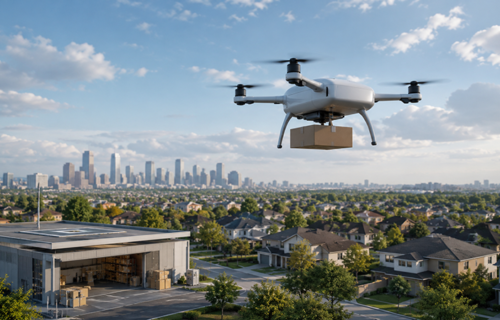
Amazon is preparing to expand autonomous drone deliveries across nearly 500 U.S. cities and towns by the end of 2026, potentially moving aerial delivery beyond its experimental phase and into the infrastructure supporting mainstream e-commerce. The expansion also raises a longer-term question for the property industry: whether large-scale drone operations could influence where last-mile facilities are located and how they are designed.
Prime Air currently operates from 11 locations across seven states, giving Amazon a relatively small base from which to attempt a sixfold expansion in geographical coverage. Tens of millions of customers could eventually fall within the service area if the programme develops according to plan.
The attraction for consumers is speed. Small products can arrive within around an hour of ordering and, in some cases, within 30 minutes. Packages are generally limited to five pounds, or approximately 2.27 kg, and must fit within the aircraft’s cargo capacity. Amazon estimates that despite this restriction, more than 60% of its most frequently purchased products are potentially suitable for drone delivery.
This means the technology is unlikely to replace conventional parcel distribution. Furniture, larger electronics, bulk groceries and most substantial household purchases will continue to require road transport. The opportunity instead lies in lightweight products where customers place a premium on receiving an order quickly.
Amazon’s ability to expand the network depends heavily on autonomy. Its aircraft use onboard cameras, sensors and obstacle-detection technology to navigate and respond to their surroundings without requiring an individual pilot to continuously control each flight. This allows a comparatively small operational team to support a much larger fleet than would be possible if every aircraft required direct human control.
Prime Air operates under Federal Aviation Administration Part 135 certification, providing the regulatory basis for commercial operations. Expansion into additional markets can nevertheless involve further regulatory and local requirements. Planning, safety, airspace and community acceptance therefore remain important factors in determining how quickly the proposed network can grow.
Amazon says the latest aircraft are designed to operate in a wider range of everyday weather conditions, including light rain and varying temperatures. The company also says cameras are used for navigation rather than monitoring people and that employees do not routinely watch live video feeds from the aircraft. Noise could prove more contentious as the number of flights increases. Amazon maintains that its latest drones are quieter than an idling delivery vehicle during the short period when they approach a property and become considerably less noticeable at normal flying altitude. These remain company claims, however, and their practical significance will become clearer as operations expand into hundreds of communities.
The transition to greater scale is significant because autonomous delivery has already encountered questions surrounding noise, privacy, safety and operational reliability. Expanding rapidly will require Amazon to demonstrate that technology developed for relatively controlled deployment can perform consistently when thousands of flights interact with different neighbourhoods, weather conditions and physical environments.
For commercial real estate, the more interesting development may be what happens on the ground. Conventional e-commerce distribution relies on large fulfilment centres feeding regional facilities and delivery stations, from which vans carry multiple parcels to consumers. Drone delivery operates differently. An aircraft carries a very small load, completes an individual journey and must return to collect another order. Distance between inventory and customer consequently becomes particularly important.
Amazon says an existing Prime Air location can serve an area of around 175 square miles. If drone delivery eventually handles meaningful order volumes, this relatively local operating model could increase the strategic importance of distribution facilities positioned close to large suburban populations. Rather than eliminating large fulfilment centres, drones could therefore encourage another layer of logistics property beneath them. Large facilities would continue holding extensive inventories and replenishing the network, while smaller locations closer to consumers could store products particularly suited to rapid delivery.
That would reinforce a trend already visible across e-commerce logistics: the closer retailers move towards immediate delivery, the more valuable proximity to consumers becomes. Property specifications could change as well. A logistics building designed to support significant drone activity may require dedicated launch and recovery areas, automated parcel handling, charging infrastructure and suitable electricity capacity. Developers could also need to consider surrounding buildings, vegetation, power lines and other physical obstacles in ways that have little relevance to conventional warehouse development.
Airspace could effectively become another location criterion. A warehouse with excellent motorway access may not necessarily be equally suitable for intensive drone operations if its surroundings restrict safe flight paths. Conversely, properties with suitable infrastructure and large residential populations within flying range could gain an additional strategic advantage.
There is also a potential planning issue. Distribution centres have traditionally generated concerns around truck movements, employee traffic and operating hours. Drone hubs could introduce another consideration as local authorities and communities assess the implications of repeated aircraft movements above residential areas.
Amazon’s pricing suggests that the company wants to make the service sufficiently inexpensive for routine purchases rather than positioning it solely as a premium delivery option. Prime customers placing orders worth at least $50 can use drone delivery without an additional charge, while smaller Prime orders carry a $2.99 fee and non-members pay $4.99.
Whether those economics remain attractive as the network expands will be critical. A delivery van can leave a depot carrying dozens or hundreds of parcels, whereas each drone carries a very limited payload. Autonomous operation reduces labour requirements, but aircraft acquisition, maintenance, charging, infrastructure and regulatory compliance create costs of their own.
Amazon is also not developing the market alone. Other major technology and retail groups are expanding autonomous delivery programmes, increasing the possibility that drone infrastructure eventually becomes a competitive consideration for retailers rather than a specialist service associated with one company.
The most likely outcome is therefore not the replacement of road-based delivery but the emergence of a mixed distribution network. Large trucks would continue supplying fulfilment centres, vans would handle conventional parcel routes and larger products, while autonomous aircraft could take a growing share of urgent lightweight orders within relatively short distances.
Reaching almost 500 U.S. communities would represent an important test of whether that model works beyond limited deployments. The significance lies not simply in the number of drones Amazon can put into the air, but in whether autonomous delivery can be integrated economically into one of the world’s largest logistics networks.
For real estate investors and developers, the consequences will take longer to emerge. But if drone delivery becomes a meaningful component of e-commerce, the definition of a well-located last-mile facility could begin to change. Road access, population density and labour will remain important, while electricity, automated infrastructure, suitable airspace and the number of consumers within flying range could become additional considerations.
The wider property implication is that the final mile may gradually become less dependent on roads without becoming any less dependent on real estate. In fact, faster aerial delivery could make the location of physical inventory even more important, increasing the value of facilities capable of placing goods within minutes rather than hours of the customer.