Sunday, 11 October 2026
A consortium formed by Unibep and Track Tec Construction has formally signed a PLN 874.1 million net contract with PKP Polskie Linie Kolejowe for the reconstruction of railway infrastructure between Gdańsk Osowa and Gdynia Główna.
The agreement was concluded on 24 August 2026, marking an important step for a project that had previously experienced uncertainty during the tender process. An earlier contractor selection was cancelled in May before the Unibep and Track Tec Construction consortium was subsequently chosen again.
The two companies each hold a 50% interest in the consortium, giving Unibep a share of approximately PLN 437.1 million net in the contract. The construction programme is scheduled to be completed within 69 months.
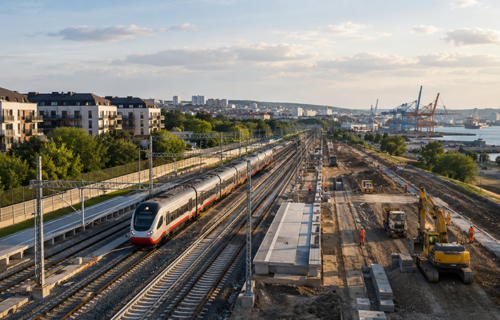
Works will cover around 13.5 km of railway line No. 201 and 4.6 km of line No. 202. The programme includes track infrastructure, bridges and engineering structures, signalling, power and traction systems, roads, platforms and sanitary installations.
An additional third track will form an important part of the investment, while electrification and other infrastructure improvements are intended to increase the number of trains that can operate through the corridor.
Passenger infrastructure will also be expanded. Two new stops are planned alongside improvements to existing facilities, increasing the role of the route within the Tri-City metropolitan transport network.
The investment has wider significance for northern Poland because the corridor serves both passenger and freight traffic. Increasing railway capacity between Gdańsk and Gdynia should improve metropolitan connections while strengthening rail access associated with the Baltic ports.
The ports of Gdańsk and Gdynia have become increasingly important generators of logistics and industrial activity, creating demand for transport infrastructure capable of handling growing freight volumes. Improving rail connections can increase the proportion of cargo transported inland by train and reduce pressure on road infrastructure.
This gives the project a direct connection with the commercial property market. The Tri-City region has developed into one of Poland’s important logistics locations, supported by its ports, motorway and expressway connections and expanding warehouse and industrial base. Additional rail capacity can improve the attractiveness of sites serving port-related distribution and manufacturing operations.
The Gdańsk Osowa–Gdynia Główna section forms part of the wider modernisation of railway line 201. Improvements to the route are intended to provide greater capacity for freight services connecting the ports with Poland’s national rail network while accommodating growing metropolitan passenger demand.
The scale of the contract reflects the complexity of the programme. Rather than being limited to track replacement, the works involve extensive reconstruction and expansion of the corridor’s supporting infrastructure, including electrification, signalling and engineering structures.
The formal signing also removes an important element of procurement uncertainty surrounding this section of the investment. Following the cancellation of the earlier selection and the consortium’s subsequent reselection, the project can now progress towards implementation under the PLN 874.1 million agreement.
For the Tri-City region, the longer-term impact will depend on how the upgraded corridor integrates with the wider rail network and port infrastructure. Greater passenger capacity could improve access between residential and employment locations, while additional freight capacity could support further logistics and industrial investment around Gdańsk and Gdynia.
With the contract now concluded, the project moves from the procurement stage into a multi-year construction programme that will significantly expand railway capacity on one of the key transport corridors serving Poland’s northern metropolitan and port economy.